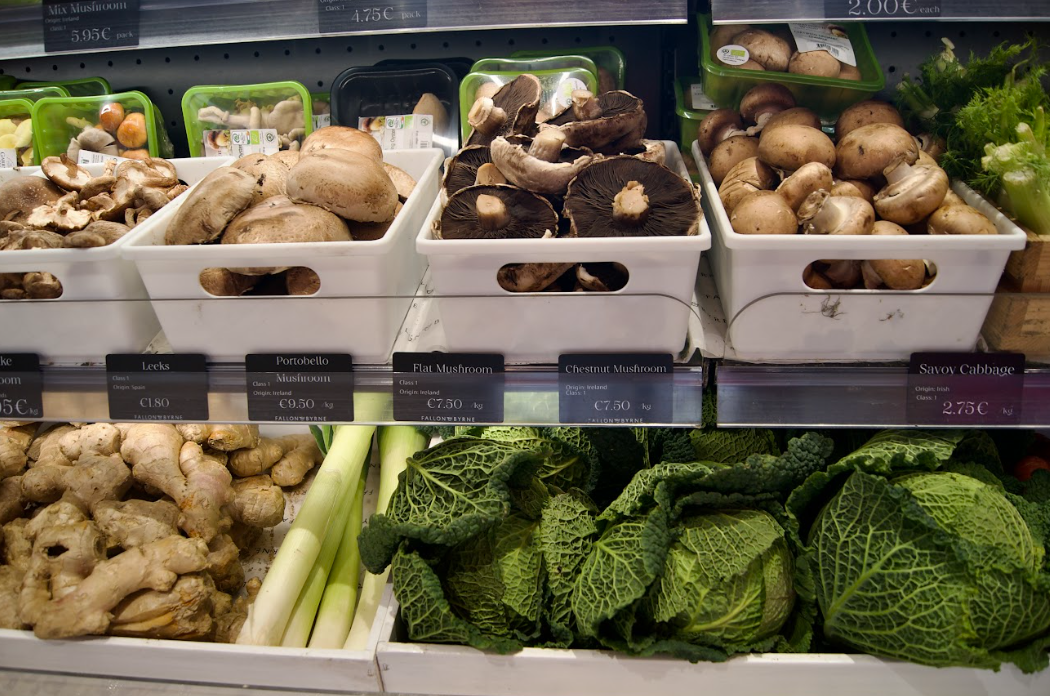
Walking into any supermarket in Dublin, whether it be Supervalu, Aldi, Lidl or Tesco, you will be met with an array of products. Looking around the shelves, you will notice patterns in regard to how food is packaged. Green labels, Celtic inspired fonts, phrases such as “traditional” and “family farmed”, and images of rolling hills and green fields. If you look closely, you will see the ever-famous green G – the guaranteed Irish symbol.
The average weekly shopper may not overtly pay attention to this; however, the imagery is powerful. In modern food culture, the entire concept of Irishness is crucial in marketing campaigns, curated perfectly to create a pristine image of Irish food culture, both to sell domestically and internationally. Irishness in food has become a powerful aesthetic, it is supposed to invoke feelings of security in consuming good quality food and invite a connection to it at its most primary level: the farmers, fishermen and artisans who produced it. Be that as it may, we must question whether this is an accurate reflection of Irish life and food production, or if it is all smoke and mirrors to prop up Ireland’s lucrative and global food image.
The feelings and images of heritage and rustic aesthetics that you associate with Irish food are not entirely organic. They are the result of Ireland’s food marketing powerhouse, Bord Bia, the semi-state-owned agency which is responsible for promoting Irish food and drink both at home and abroad. They receive massive amounts of government funding to brand and adapt the Irish food industry. Bord Bia intentionally crafted Ireland’s international image by carefully promoting Ireland as a land of green pastures, small farms and sustainable production. By invoking an image of tradition and purity, Bord Bia can sell something that many other countries struggle to: Ireland as the home of good quality sustainable food. They stamp food with the Bord Bia quality mark or the Origin Green scheme which is used to market sustainability.

However, it is not just Bord Bia that engages in tactical marketing. Kerrygold butter has used the quality and assurance of Ireland’s grass-fed dairy as a multimillion-dollar marketing ploy in the United States. This has led to the idea of Irish butter as better quality, almost a status symbol of butter. With Ireland being a net exporter of food products, specifically beef and dairy, the marketing of Irish food as the pinnacle of quality is massively beneficial to the Irish economy. Being an important marketable asset, Ireland’s nationwide government approved food marketing is crucial to selling products abroad.
Furthermore, since foreign importers may not be familiar with Ireland, Bord Bia’s branding tends to lean on stereotypical images of food production. They focus on family farming, inherited traditions, locality and heritage. Images of fishermen in small boats and farmers herding sheep in a picturesque field come to mind when we think of this. There is an ever present romanticisation of rural Ireland as a selling point of our food.
However, food products are Ireland’s third largest export industry. Whilst these ideas of home-grown rustic life are meant to sell, this industry functions in the way any other multi-billion-dollar industry does, with extreme precision and calculation. As someone who is from rural Ireland and has grown up on a farm, the reality I see personally is quite different to what is being pushed by Bord Bia. Irish farming is deeply embedded in global supply chains, increasingly mechanised and under mounting environmental scrutiny, particularly regarding emissions and land use. Whilst small family farms do exist, the reality of Irish farming is that large farms with higher emissions are necessary to supply Ireland’s worldwide supply chain. The power of the rural image lies in its emotional resonance, but its simplicity can obscure the industrial and environmental pressures that shape contemporary food production.
As previously stated, I come from a farming background, specifically in dairy. I am from County Meath, which has some of the most fertile land in Ireland. There is a large presence of tillage, dairy and beef farming here. My own father has been a dairy farmer for over three decades, supplying milk for Tirlan which is used to produce Bailey’s cream liqueur and milk powder.
When asked about what the expectation of Irish farming is for foreign customers, my father said, “People want the image of the small little farm with the cows in the pasture and the chickens running wild in the yard. That is not the reality for most farms now”.
The small family farms that are so highly valued by marketing teams cannot sustain the future of Ireland’s food export industry. Most of those farms are run by older farmers, and their practices will continue to shrink when they die. My father, James, highlighted how the farms that contribute highly to Ireland’s food industry are all run like big businesses. In the dairy industry, this means having 400-500 cows and lots of staff needed to smoothly run everything.
I inquired about how technology has transformed modern farming as someone who has been in the game since the 80s. James said consumers “should not underestimate the amount of computing in farming”. There have been massive advancements in the last decade, from detection collars which can track pregnancy and detect sickness, to feed to production ratio, to robotic milking parlours, contributing to making the industry completely tech driven. Our own calf-rearing machine, which feeds calves the exact amount of milk they need and weans them, saves labour and detects if a calf is not eating properly, which can catch illnesses quicker. James said this mostly leads to healthier stronger calves, which is more efficient and profitable. This modern tech-driven farming is a far call from traditional rural marketing.
Ireland has the worldwide reputation it needs to uphold to market high quality food, which relies on both on how it is produced and how it is presented. Despite the rustic imagery, Irish agriculture becomes increasingly modernised, technological and export-driven, however this imagery is left behind by Bord Bia for its continued marketing value. In selling Irish food abroad, it seems we are not simply exporting produce, but a carefully curated vision of Irish identity itself.