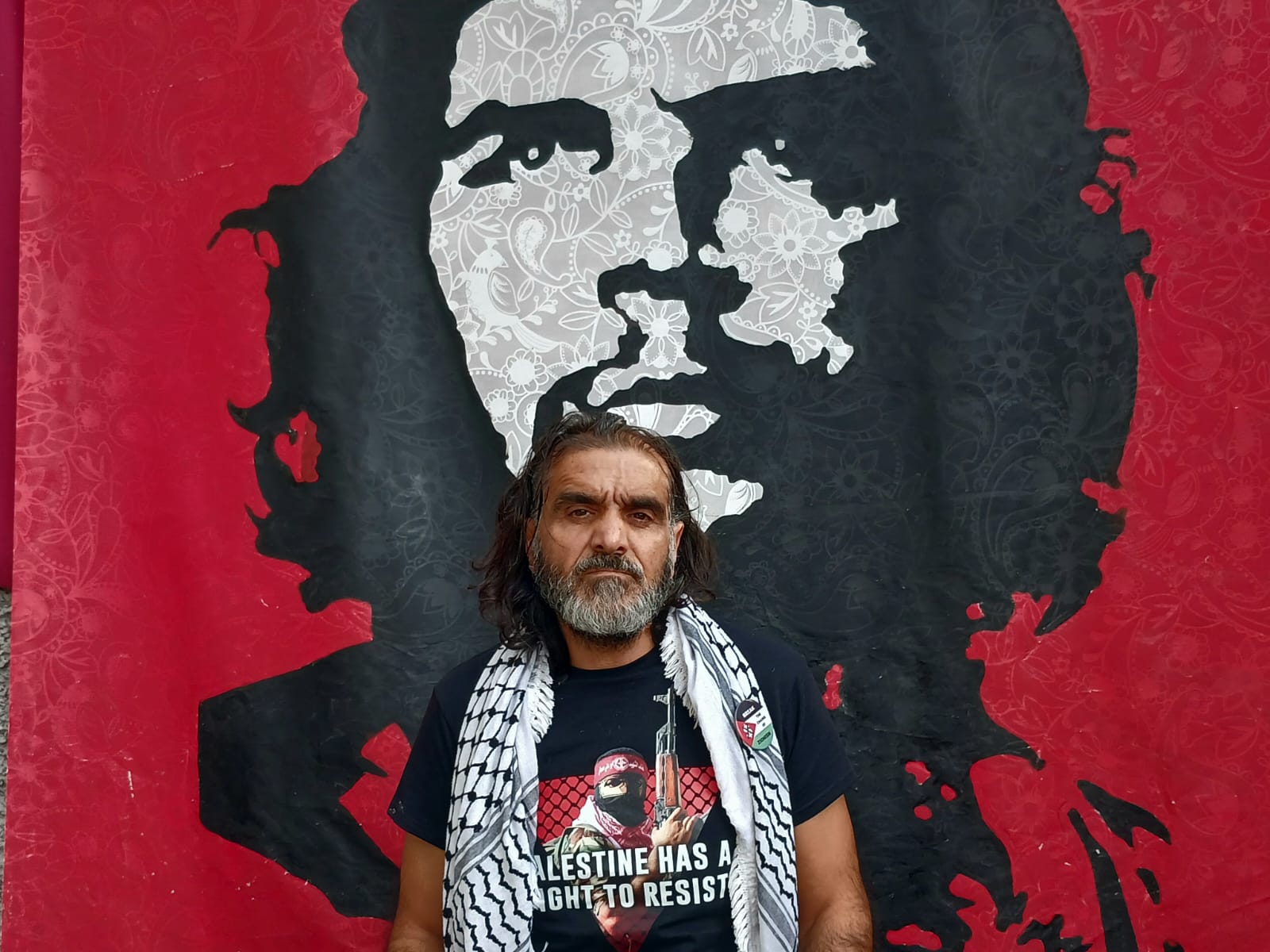

Dublin activist Sami Kupiszewski has received a deportation order that requires him to leave Ireland by August 31st, 2026. If he does not leave, he is subject to arrest and detention without a warrant by An Garda Síochána.
Kupiszewski is a 53-year-old Turkish national living in Dublin and is a visible figure in activist groups, notably having participated in protests against the International Protection Office on Mount Street in 2024. Kupiszewski applied for asylum in February 2022 but was refused on all grounds. Kupiszewski says return to Türkiye means imprisonment and persecution because of his politics. A petition has now been created to halt the deportation proceedings, which, at the time of writing, has received over 700 verified signatures in the last two days.
The order was made under section 51, International Protection Act 2015 and signed on July 15th 2026 by David Gilbride on behalf of Minister for Justice, Home Affairs and Migration Jim O’Callaghan. Notification letters are dated July 31st, sent by registered post, and were received on August 4th. The order requires Kupiszewski to reside at his current address pending removal. If he does not follow the order, he may be arrested and detained by gardaí or an immigration officer under section 5(1), Immigration Act 1999. Obstructing his removal is also a criminal offence under the same Act, and separate notice under section 14(1), Immigration Act 2004 requires Kupiszewski to surrender his passport and any other travel documents. Kupiszewski must also present at Booth 20, Burgh Quay at 11:40am on September 16th. Kupiszewski has the opportunity to apply to the Minister to revoke the order if his circumstances change under section 3(11).

The petition is a direct letter to O’Callaghan, which demands an end to the deportation proceedings because “His return would expose him to persecution for his anti-imperialist activism in a state with a documented record of torture and systematic suppression of political dissent”. The letter goes on to detail Türkiye’s “Record on Torture and Political Repression”, which includes findings from the UN Committee Against Torture that show frequent instances of torture, particularly against LGBTQ+ people within the Turkish justice system. It also argues that counter-terrorism laws have been “systematically weaponised to silence political dissent” and adds the European Commission’s 2025 Report that found that “the overall human rights situation in Türkiye has deteriorated” alongside Türkiye’s low ranking on the World Press Freedom Index.
Specifically, the letter demands the immediate halting of the deportation of Kupiszewski and an end to the deportation of political activists to Türkiye. It also asks for an end to the “weaponisation of asylum policy” alongside a call to open an independent inquiry into all dual citizens of Israel who have served in the Israeli Defence Forces.
Kupiszewski’s substantive section 35 interview for asylum was not held until April 14, 2025, which is three years and two months after his initial application. Following that, Section 39 found he did not need international protection, and he was refused refugee status, subsidiary protection and permission to remain, which he was notified of on November 19th, 2025. Kupiszewski made appeals in January 2024 and December 2025, and 12 sets of representations from him and his legal team have occurred between April 2022 and May 2026.
Section 50 prohibits return where life or freedom may be threatened on convention grounds or if there’s a serious risk of the death penalty, torture, or inhuman or degrading treatment. Niall Coen, a caseworker with the International Protection Office, recorded his claim of persecution by agents of the Turkish state as a politically active member of a minority community on July 15th 2026. Kupiszewski also submitted a Turkish passport, a Polish national ID, and a Polish driving license. Coen concluded in the report that his return does not breach section 50, citing the US State Department, Country Reports on Human Rights Practices for 2024 – Türkiye published on August 12th, 2025.
Coen’s report states that Türkiye is a designated safe country of origin under section 72 of the International Protection Act 2015 and the International Protection Act 2015 (Safe Countries of Origin) Order 2018 (S.I. 121/2018). However, the Department’s published list of the 15 designated countries does not include Türkiye.
When asked about this, Department spokesperson, Ciarán Casey, said they could not comment on individual cases, and that Türkiye is a designated safe country of origin at the EU level under Regulation (EU) 2026/464, which amends the Asylum Procedures Regulation to designate EU candidate states as safe countries of origin (barring certain exceptions). Casey also said the new EU common list (which includes Türkiye) operates for the purposes of the Asylum Procedures Regulation and the International Protection Act 2026. However, Casey clarified that the EU-wide list “does not apply to applications made under the International Protection Act 2015, which applies to applications made prior to 12th June 2026.” Casey also said that the EU-wide list does not impact the Minister’s ability to designate safe countries of origin at the national level under either act.
The University Times has since asked the Department whether Türkiye is currently designated at the national level under section 72, and by which statutory instrument. The Department has not responded at the time of writing.
In a statement issued via press release, Kupiszewski said, “Turkey is definitely not safe for me. It is evidently not safe for me. I’ve been in Turkey. I was subjected to torture, degrading treatment and imprisonment. In Ireland, I faced 5 years of extensive bureaucratic war, they just focused on deportation and attempted to push me back. They deny giving work permits, they deny everything, making it unlivable for me in Ireland. But despite the policy of isolation, I had friends and they always supported me, and I have a good relationship with the community.”
In reaction to deportation news, Kupiszewski said, “[T]hey want to deport me to Turkey. But these people, I think, do not see me as a human. If they accept I am human, they should know my background. They know already, and they are denying my circumstances. And very clear, evidently clear I will not be safe in Turkey”.
The campaign against his deportation also claimed that Kupiszewski fled to Europe and sought asylum in 2003, but faced Interpol extradition and was held in Sweden, Poland and Denmark, where courts refused surrender on human rights grounds.
The campaign also states that Kupiszewski believes his criticism of US-Israeli policy shaped the outcome of the deportation decision.
This article was updated on August 18th, 2026, to include a response from the Department of Justice received after publication.