
There’s a good chance you’ve clocked the headlines that “Ireland is running the EU” and moved on – it doesn’t exactly sound like something that directly affects you. Except one major topic being discussed over the next few months is working out how much money is left for your Erasmus semester, your PhD funding, or the research grant your department is banking on.
Ireland has held the Presidency of the Council of the European Union since July 1st, and will continue to do so until December 31st 2026. Coverage so far has largely focused on the mechanics of the role, what the Council is, who chairs it, what its motto means. Less reported is what the Presidency actually means for students, and how Trinity fits into the programme built around it.
What even is the Council of the EU?
The Council of the European Union, distinct from the European Council, is one of the EU’s main decision-making bodies. Made up of ministers from all 27 member states, it adopts and negotiates legislation on everything from AI regulation to agricultural subsidies.
The Presidency rotates between member states every six months, handing whichever government holds it the job of chairing meetings, setting the legislative agenda, and negotiating with the European Parliament and Commission. With 27 member states, each one holds the Presidency roughly once every 13.5 years. This is Ireland’s eighth time holding the Presidency since joining the EU in 1973. It is important to note that the presidency comes with no real power to dictate outcomes, but with genuine influence over what gets prioritised. Ireland doesn’t get to override anyone or push its own agenda through by force.
Ireland is running its term as part of a trio with Lithuania (from January 2027) and Greece (from July 2027), a structure meant to give continuity across the three consecutive presidencies.
Built around the motto “Strength with Unity,” Ireland’s programme centres on three priorities: competitiveness, values, and security. Over six months, Ireland is chairing 22 informal ministerial meetings, two summits, including the ninth summit of the European Political Community and an informal meeting of EU heads of state or government, both held in Dublin on 12 and 13 November respectively, and more than 250 further meetings and events.
Youth engagement
The Presidency programme includes a stated commitment to youth engagement: youth assemblies, school and university visits, and structured dialogue meant to inform students how EU decisions affect them. Delegates from Seanad na nÓg, representing Comhairle na nÓg and youth organisations nationally, have already developed recommendations feeding into the Presidency’s priorities, and youth-oriented versions of the programme are being distributed to schools.
The budget fight that will shape the next seven years
Separately from its own programming, Ireland’s term coincides with negotiations over the EU’s Multiannual Financial Framework (MFF) for 2028–2034: the EU’s roughly €2 trillion seven-year budget, covering programmes including Erasmus+ and Horizon Europe. At June’s European Council summit, before Ireland’s term began, EU leaders failed to agree the MFF and formally handed the file to Ireland, which now has to produce an updated proposal ahead of an October summit, with a full deal targeted by year’s end.
Erasmus+: what’s actually being proposed
Within that budget, the Commission has proposed raising Erasmus+ funding for 2028–2034 to €40.8 billion, up from €26.2 billion in the current 2021–2027 period. The proposal also restructures Erasmus+ around two pillars, replacing the current three Key Actions:
- Learning Opportunities for All: individual and group mobility and exchanges (the current KA1), across education, training, youth, and sport.
- Support for Capacity Building: cooperation projects, networks, alliances, and policy work (the current KA2/KA3), also across all sectors.
One of the most significant changes is folding the European Solidarity Corps, the EU’s dedicated volunteering programme for young people, into Erasmus+. It will likely sit within the learning-mobility pillar, but there’s a real risk that volunteering loses the autonomy and visibility it currently has, ending up competing for funding and attention with study and training mobility instead of having resources of its own.
Inclusion and simplification are being pitched as cornerstones of the new programme, with measures aimed at young people with fewer opportunities, financial support, affordable housing, and national inclusion plans.
So although this figure states a headline increase of 56%, it is actually more modest than it looks because once inflation and the folding-in of a separate programme are accounted for, the real increase is closer to 15%.
Not everyone thinks it goes far enough
Despite the increase, the proposal has drawn criticism as underambitious. In his September 2024 report on European competitiveness, Mario Draghi argued the EU should implement a five-fold increase in Erasmus+ funding to meet emerging challenges and build youth skills. The European Parliament had already called in several resolutions for a much larger budget increase to match rising demand for mobility and training, and some parliamentary committees have called the current proposal inadequate given the EU’s strategic challenges.
Parliament has since adopted its own negotiating position on the MFF, but the European Youth Forum says even that doesn’t go far enough on Erasmus+. Separately, the Council has agreed a partial negotiating position on Horizon Europe, the EU’s main research funding programme. EU officials have warned that if the overall MFF isn’t agreed in 2026, related regulations can’t be legally finalised in 2027, which would delay when funding is confirmed to start from January 2028.
Trinity’s role in the Presidency programme
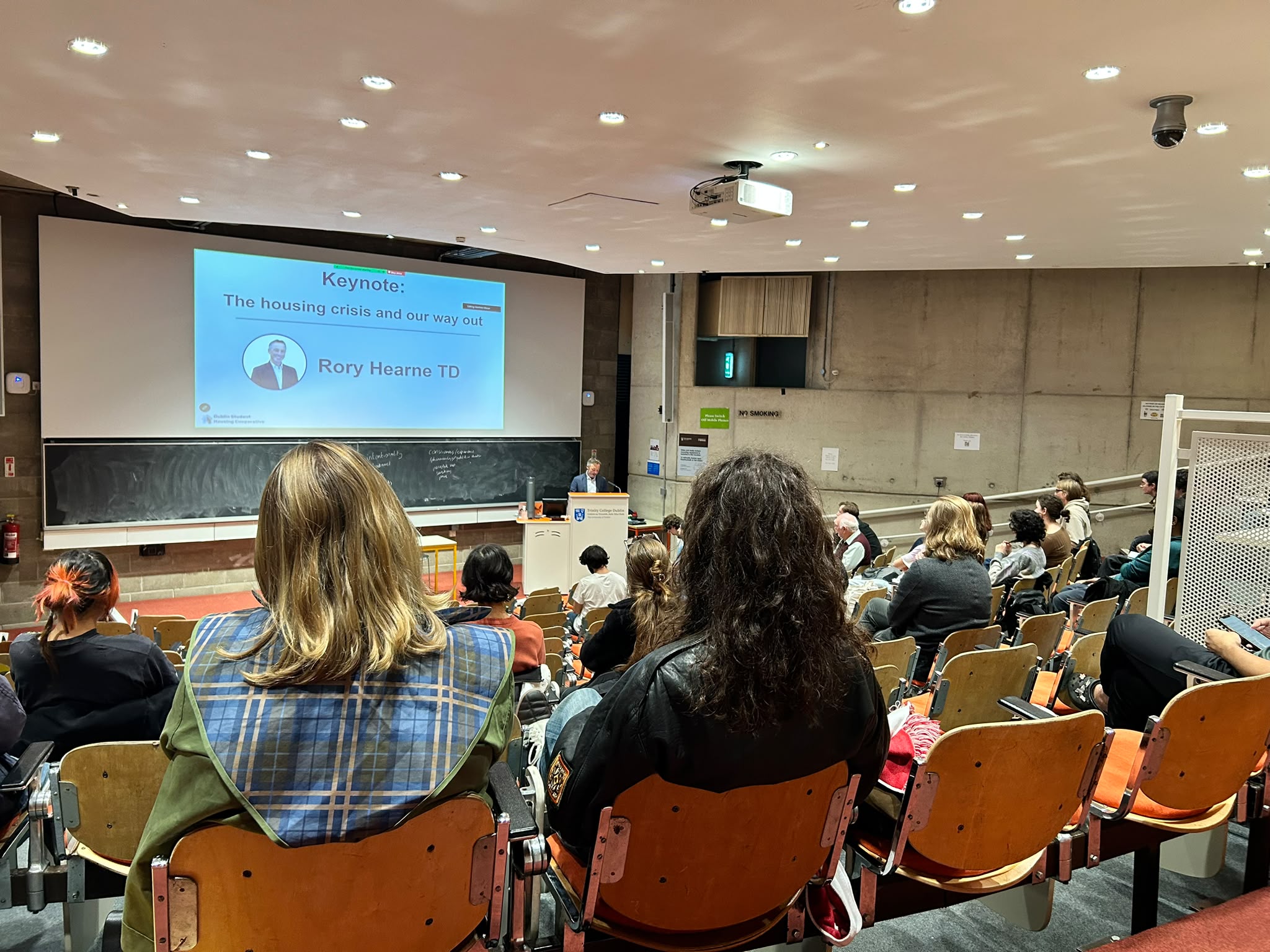
Trinity is hosting several events connected to the Presidency. In July, the college hosted the EU’s Research and Innovation Ministers for a two-day meeting in the Old Library, where ministers discussed proposals for a single, borderless EU market for researchers and researcher mobility.
Separately, the Trinity Long Room Hub is running its own public programme tied to the Presidency, encouraging public engagement with Europe. As part of this, the Hub has presented a series of Trinity European Laureate Awards to figures including former Taoiseach Enda Kenny, European Research Council President Professor Maria Leptin, former MEP Frances Fitzgerald, and, most recently, EU Commissioner Michael McGrath, who received the award from Provost Linda Doyle in Brussels. The Hub is also hosting EU Digital Talent Days on 15–16 October as part of Digital Week, bringing EU policymakers and industry figures to campus to discuss digital skills and workforce strategy.
Ireland’s Presidency runs until 31 December, when the chair passes to Lithuania. Whether the MFF, and the Erasmus+ funding within it, is agreed, with the consent of the European Parliament, by that date will determine whether the associated programme regulations can proceed on schedule into 2027, with direct implications for funding due to begin in January 2028.
So the next time someone mentions “Ireland is running the EU,” you’ll know what’s actually on the table: not abstract bureaucracy, but the decision on how many of us get funded to study abroad, how affordable that year is, and whether volunteering in Europe stays a real option or gets squeezed out of the budget entirely.