
It’s not a stretch to say that the housing crisis across Ireland has reached a state of abject emergency. This October, the Department of Housing recorded nearly 18,000 people in emergency accommodation, emphasising a trend of homelessness in Ireland that is repeatedly reaching and surpassing new highs. But for all the dialogue and discourse across the political spectrum, a genuine solution seems ever out of reach.
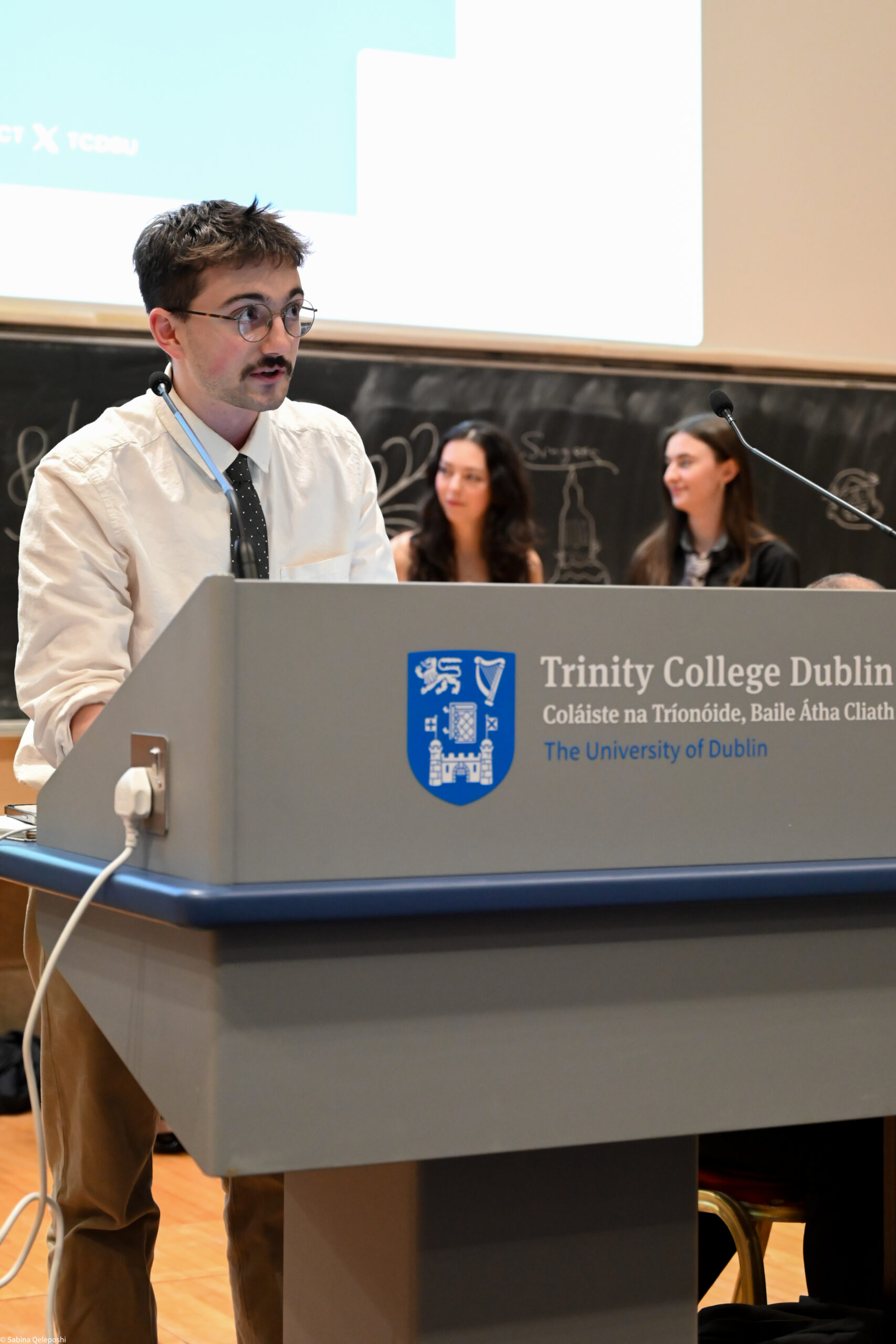
These reasons signal the need for an alternative approach, says Matthew Mosse, Chair of the Dublin Housing Cooperative. A two-year-long project in the making, the Housing Co-op aims to deliver, for the first time, cooperative student housing in Ireland. On the steps of the Graduates Memorial Building, Mosse, a third-year Trinity Physics PhD student, tells the University Times about the objectives, current phase, and origins of the project.
Mosse cites a lack of problem-solving by both the government and private sector as a catalyst for the project’s inception: “It’s gotten to such a crisis point […] that I think people are realising that we have to do it ourselves.”

Cooperative student housing offers an alternative to the private rental market, with collective ownership and operation run entirely by its student members. Mosse describes what he calls the “three Cs” of cooperative housing: cheaper, community, and control.
Cooperative housing is cheaper, he says, because it is removed from the speculative market. The only costs associated (after initial property purchase) include maintenance and mortgage payments. Mosse further notes that mortgage payments are on average cheaper than the private rental market in Dublin.
It cultivates community because “it’s a Democratic organisation”, he says. “There’s sort of a shared project”, in which students gain a sense of “community ownership”.
The democratic shape and community ownership of the cooperative model also contribute to control, with each student having a vote regarding its operations.
In March of this year, the Dublin Student Housing Co-op was awarded €1500 at the STAND Ideas Collective Incubator Showcase, which celebrated students and graduates “developing innovative responses to pressing social and environmental challenges”.
Cooperative student housing has seen success across the United States, United Kingdom and parts of Western Europe and Scandinavia for decades, but has yet to take hold in Ireland.
Mosse cites the Edinburgh Student Housing Co-op (which has operated for over a decade and currently houses 106 students) and the Heidelberg Collegium Academicum, based in Germany (housing 176 students since 2013), as successful European models. Older examples include the Berkeley Student Cooperative in the United States, which saw the movement take hold during the Great Depression. Today, more than 1,000 residents live across 20 houses and apartments operated by the Berkeley Co-op.
Asked by the University Times why he believes successful student housing co-ops have yet to materialise in Ireland, Mosse cites “very bad legislation for community ownership of property” and a general lack of “cooperative law”. Further, there is a lack of financing for community groups like the Dublin Housing Co-op, exacerbated by barriers such as taking out loans. Awareness, he says, is also lacking.
“People genuinely don’t know that it’s an option, and I think if more people knew that it was an option, there’d be more of an appetite.”
One method the group is exploring is collaborating with university student unions and Dublin City Council to renovate vacant and derelict properties. Mosse says the Co-op has been in contact with TCDSU/AMLCT’s Welfare Officer Lorenzo Cheasty, Trinity’s COO, as well as Dublin City Council, who have been “fairly responsive”. Furthermore, they are working with Cooperative Housing Ireland, an approved housing body, to assist and advise on legal and financial aspects.
“I think, again, there’s this recognition that we need to try new things”, Mosse says. “Maybe a few years ago, they might have been sort of less responsive to us, but I think there is this sort of recognition that we need to try out new solutions to see whether they work.”
Next steps for the Co-op include lobbying for the use of city council and university property
and engaging students to become project participants.
“We want to be [the] first […] to show that [Cooperative housing is] a model that can be replicated and can […] provide affordable housing for students.”
Significantly, local politicians have signalled an interest in the project, including the Greens and People Before Profit, Mosse says. Furthermore, according to Mosse, Labour Senator Laura Harmon has been working with various Irish student housing co-ops, including Dublin, on an Oireachtas briefing.
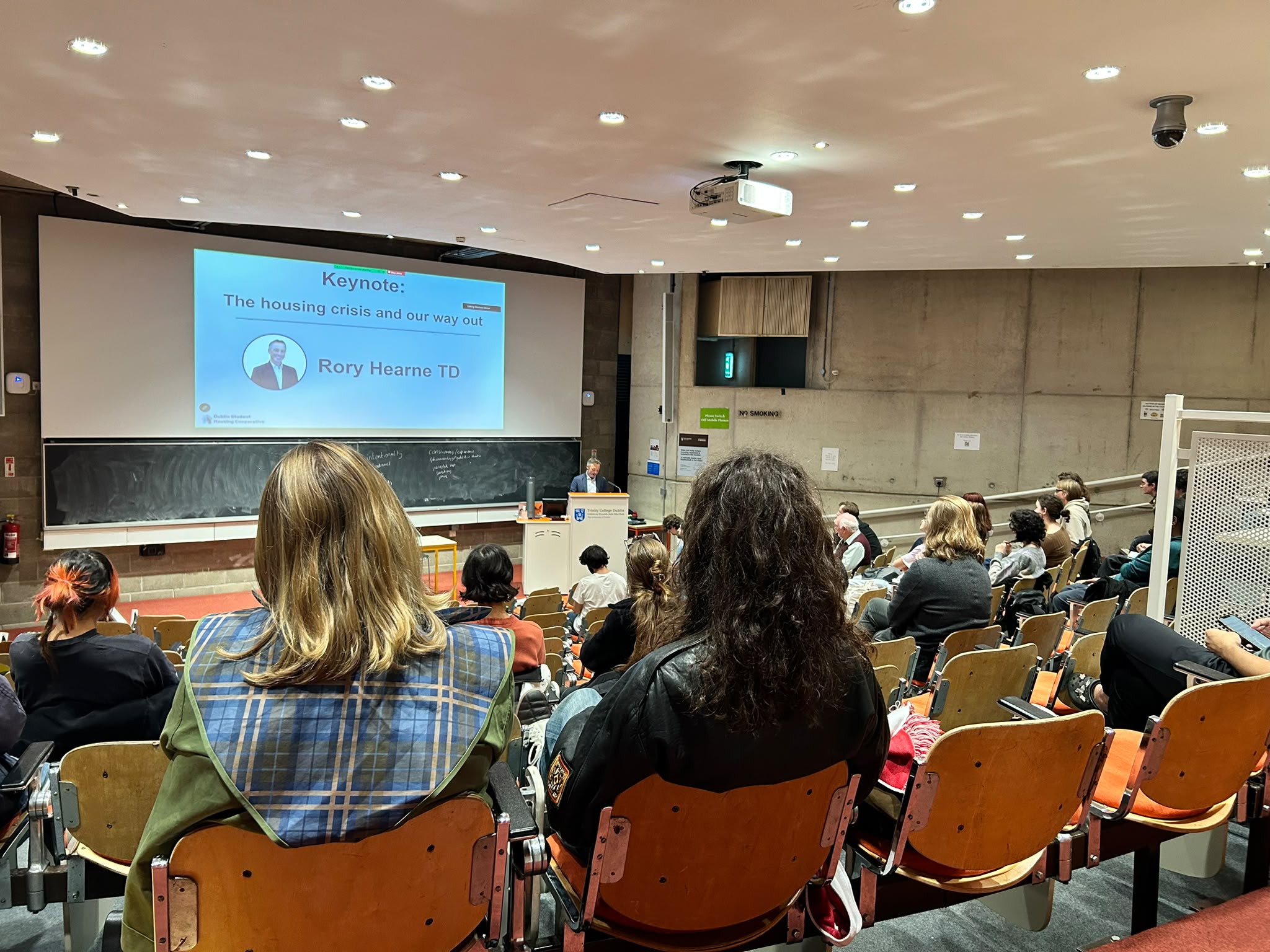
Social Democrats TD Rory Hearne has also expressed support for the project, speaking at the Dublin Housing Co-op’s 2026 Conference on the eighth of October. Roughly 70 people gathered in Trinity’s Robert Emmett Theatre at 6pm for the conference.
“I think it’s a fantastic initiative”, began Hearne. “With so much despair around, it’s just incredible to see something that offers so much hope and potential”.
Hearne described how his time as both a university student and eventual lecturer opened his eyes to the impact of the housing crisis on students and their college experience. As president of the Trinity College Dublin Students’ Union (TCDSU/AMLCT) nearly 30 years ago, Hearne spoke of protesting an already evident accommodation crisis. Citing neoliberal policies over the last 40 years as the chief reason for the “housing catastrophe that we are in today”, he criticised the notion of housing as a “commodity” and “financial asset”.
Hearne emphasised Ireland’s “huge history of cooperatives”, with “significant” cooperative housing movements in the 1970s and 80s. In those eras, he noted, land and financing were state-provided. Now, decades later — and with groups still fighting vigorously for change — Hearne questioned why this model has yet to be revisited.
“I think cooperatives offer us a future where we can come together…and we can build a different type of society that ensures people’s needs are met.”
In his concluding remarks at the conference, Heane stated: “I wish you the best of luck, and I will work in the Dáil, and in the housing committee, to push this idea […] and work with you and all the groups who want to do it. I do believe it’s possible; it’s necessary, so thank you again, and let’s do it.”
In an email statement to the University Times, Ferdia Quinn, Secretary of the Dublin Student Housing Cooperative, reflected on the conference.
“We are incredibly grateful to all our speakers, and I think the event demonstrated that the current system is not working and people recognise other solutions are necessary”, Quinn wrote.
On the various other speakers — including AMLÉ President Daniel Walsh, representatives from various Irish student housing co-ops, the Bohemian Cooperatives, and Cooperative Housing Ireland — Quinn wrote: “everyone had a very unique and interesting perspective to share, which was indeed the goal of this conference, as well as to promote further cooperation between groups”.
“Overall it was a great success and we are very grateful to all those who got involved”, said Quinn, but noted, in agreement with AMLÉ President Walsh, “no one is coming to save us”, and encouraged students who “want to see an alternative” to get involved.
“[W]e’re all just volunteers figuring it out and no one is going to do the work for us.”
While a staunch advocate for cooperative housing, Mosse says it’s unlikely to solve the housing crisis in one fell swoop. Rather, it can work alongside universal public and social housing to help make housing prices something “people feel they have some agency in”. Further, Mosse hopes it can aid the “fatalistic” notions many have regarding the housing crisis by offering a “sense of hope”.
While at the project’s inception it may have felt like a faraway aspiration, Mosse has seen it transform into something increasingly tangible.
“I am only ever feeling that it’s more feasible”, he affirms.