
For our first broadsheet of term, myself and my fellow sports editors elected to do a fun little challenge where we would attempt to predict the final Premier League table for the end of the 2026/27 season. It’s one that sports sections across various publications take on come the beginning of another year of football, and while it speaks to the thrilling unpredictability of the top flight of English football, it also confirms the inherent quality of spectacle that permeates the sport in its modern form. This is not the spectacle of events on the pitch themselves: rather, it is the spectacle that acknowledges the presence of the spectator themselves. A common criticism of the Sky Sports packaging in which modern football is delivered to its audience is that is overly sanitised, spruced up for the sake of mass consumability, lacking in the grittiness of the age in which many of its pundits would have plied their trade (albeit it is the state of the sport that provides their salaries, so never any comment upon that).
Nonetheless, it’s hard to blame investors for sensing opportunity in positioning football as a form of mass entertainment. Drama, as an art, relies inherently on conflict, and within sport, there is latent conflict in two opposing teams vying for victory. When games end with the score skewed overly towards one team, freak victories by five, six, seven goals, pundits retroactively bemoan the lack of competition across the 90 minutes. While the analogy of sport as a kind of modern gladiatorial theatre is an overused one, it is prevalent for good reason. We come to sports in part to be entertained, to watch men and women who are very good at what they do compete for glory. I believe that fans understand this — after all, how else do clubs situated in various regions of England draw spectators from all over the world? Local pride is thrown around as a kind of buzzword in football, normally reserved for academy players who break into their respective first 11s, yet it is one absent when surveying the global audience many clubs draw in.

As a part of this phenomenon, the bigger clubs obviously do better. Branding is one aspect of the commercialisation of football, and some brands simply travel better than others. Manchester United is probably more recognisable in various corners of the world than Barnsley. While this is something of a competition to see who has the best marketing team, another important swing factor is success on the pitch. If one has no direct affiliation with a single team, and is looking to choose a side to support, better off going with one that might win something. Personally, I shot myself in the foot by becoming a Man Utd fan in 2014, a ship in the night with the 20 years of dominance that my father, my link to the team, had enjoyed. The last 12, on the other hand, not nearly as fruitful. Yet even that is part of the theatre of it all. The highs (couples trophies, various thrilling comebacks, Marcus Rashford for like three months) level out with the lows (Antony), but that’s all part of the ride. We understand that what we’re seeing as viewers is somewhat engineered to provide entertainment, the plasticity par for the course of the entire endeavour.
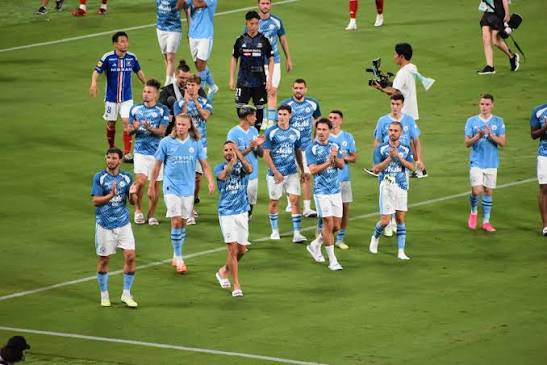
Which brings me to the 115 elephants in the room. With this past weekend being the first round of Premier League fixtures since Man City’s conviction on their various charges of misconduct, with it came a wave of overblown commentary from those sympathetic to the multi-billion pound institution and those aghast at their actions. Micah Richards spent much of the build up to his childhood club’s game with Liverpool on Sunday, expressing how “heartbroken” he was to see his side’s fall from grace (as much as the happiest man in punditry can) while Roy Keane and Jamie Carragher seemed to be quite enjoying the whole circus. There’s been a similar dichotomy within the dialect that has permeated social media over the past two weeks; on one side, some mourn the sporting achievements that have been sullied by the tribunal’s findings, while others seem positively exuberant given City’s dominance of the Premier League over the past 10 years.
Yet one has to ask; not a bit late to the party? City’s recent success has been the result of billions in investment from the Abu Dhabi United Group, i.e, since 2008, they have had the financial heft of one of the richest countries in the world behind them. In this period, they have gone from a club that went nearly 50 years without winning the top flight of English football to one that has eight titles, along with a Champions League crown in 2023, all while being coached by arguably the greatest manager of all time. They have broken their own transfer record 10 times in this period, most recently spending £125 million on Enzo Fernandez from Chelsea (an entirely different issue in itself). Fernandez is one of many key players they have snatched from their league rivals, among the likes of Raheem Sterling from Liverpool, Kyle Walker from Spurs, and Jack Grealish from Aston Villa. To say nothing of the fact that, when top talents from other European leagues have become available, they have promptly swooped in, including but not limited to Kevin De Bruyne, Eerling Haaland, and Gianluigi Donnaruma. I would challenge the average football fan to name an XI of City players from the advent of the Premier League to City’s ownership change; it certainly doesn’t include the kind of star power that fans are accustomed to nowadays.
None of this is happening without the money. While, certainly, the club should be punished for their misdemeanours, one must point out that there was little protest to City’s dominance up until this point. I mean, at what point was any of this fair? There’s is not the first case of financial and footballing transformation within the league, with Chelsea’s takeover by Roman Abramovich propelling them to similar heights during the mid 2000’s and beyond (Todd Boehly’s, on the other hand, did not, so fair play to the board at City for at least knowing what to do with their extravagant riches). It can be seen at a glance throughout European football at the highest level; Paris Saint-Germain (PSG), widely regarded as the best team in the world, have won two successive Champions League titles in no small part due to the influx of money from Qatar that has allowed them the likes of Ousmane Dembele, Joao Neves and Vitinha in their starting XI. Spotify currently owns a chunk of Barcelona. Yet, there is one constant throughout each of these examples: the football is very good. Rank commercialism funds excellent teams, even in the case of legacy clubs such as Real Madrid and Bayern Munich, who regularly spend exorbitant sums on the world’s best players, even if this money has been accumulated over time rather than the (at least recent) arrival of wealthy owners.
This leaves us with a question to ask of ourselves as fans: where do we draw the line? I feel we have little right to act incredulously towards City when the imbalance of the situation was visible from the start. Either we acknowledge the spectacle is manufactured and undeniably corrupt, or we direct our attention towards sport that better satisfies our moral compass. Specifically for Irish fans, we have at our disposal a domestic league wherein the clubs are largely fan-owned, where tickets prices are not keeping fans from stadiums, and where players are not paid the GDP of a small country in annual salary. Unfortunately, the League of Ireland just isn’t as good as its English counterpart when it comes to football. Yet, if we are to participate in the capitalist machine that is modern sport, better to do so willingly and without the pearl clutching that comes when holes are poked. At the end of the day, Richards still has his medals (for now), Keane and Carragher are still getting paid, and City, as seen on Sunday, will continue on winning thanks to their expensive squad. Either get off the train, or hop on and bear it with a smile.