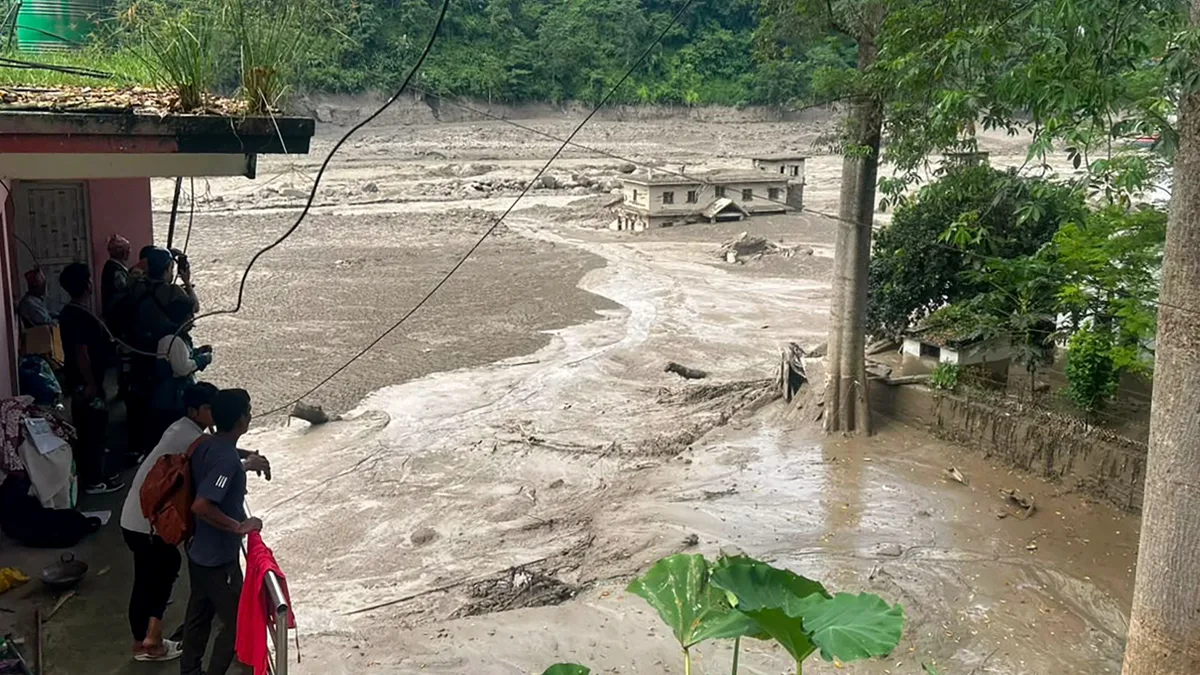

More than 350 have been killed and over 1400 are missing after a flash flood of debris cascaded down the Nepal-Tibet border on August 26ᵗʰ at 8:37am. The landslide occurred 64km north of Kathmandu — Nepal’s capital — devastating regions such as Nuwakot, Dhading, Chitwan and Rasuwa. These towns are tourist hotspots – popular for hiking and pilgrimages. As such, as of now, 800 of the missing are tourists. Two Irish nationals are amongst the unaccounted for.
Extreme flooding has been concentrated along the Bhote Koshi, Trishuli, and Narayani rivers. 40km of road and 80 bridges have been washed away. However, the worst may not be over. Currently, there are concerns of a second flooding event in the upcoming days. A lake that formed at the flood site is rising and is at risk of bursting due to the volume of debris washed into the rivers.
After the initial devastation and destruction of the landslides and floods, comes secondary consequences such as disease, malnutrition, and displacement. According to Unicef, over 17,000 children have been affected.

Nepal and China are coordinating their efforts for search and rescue, as well as promising stronger monitoring and warning systems to prevent such disasters in the future. Several countries have promised aid to the regions affected. The UK is to donate £5m, and the US $500,000. The UN is mobilising aid and rescue teams to be sent immediately. In a statement Indian Prime Minister Modi promises to provide Nepal “with all possible types of humanitarian assistance”.
Initial reports claimed that an earthquake tremor was what had caused the landslides and floods. However, new evidence leads to scientists and the US Geological Survey suggesting that a collapsed glacier is the cause of the natural disaster. This all points to the rapid melting of the Himalayan glaciers, and in turn global warming.
The collapse of a huge portion of a glacier near the Langtang Lirung peak registered an earthquake of 5.2 on the seismic scale. The collapse was 15km west of the disaster site. The massive volume of ice hitting the valley floor sent colossal volumes of debris cascading down a tributary of the Bhote Koshi river. Scientists believe the landslide dammed the river first before the water built up and burst in one go. The sudden surge in the river was measured by the International Centre for Integrated Mountain Development. Within 30 minutes, the river rose by 7-9m, carrying walls of boulders, ice, water and mud. It is not yet clear how much of the glacier collapses but estimates range from half a million cubic meters to tens of million cubic meters.
With tectonics pushing the Himalayas skyward, it is inevitable that as valleys get narrower, small chunks of glacial ice are bound to dislodge. However, Mike Searle, professor of earth sciences at Oxford University says that this event was “very unusual” as the glacier collapsed “in one go”.
Searle highlights climate change as a primary cause of the event. Rapidly increasing temperatures are, after all, deeply linked with glacial melting and in turn such catastrophic flooding. Similar disasters have been occurring in India, Switzerland and Italy during the last few years.
Dr. Cook – glacier expert at the University of Dundee – says that “you are going to get more landslides, debris flows, glacial meltwater, lake outbursts, glacier collapses, because climate warming ultimately destabilises these high mountain environments”.