
The National, according to music critic Neil McCormick, are the world’s most influential band. They are the secret weapon behind Taylor Swift’s record-breaking era, the soundtrack to Barack Obama’s 2008 campaign – and a group whose trajectory was shaped by a November night on Wexford Street two decades ago.
Though the band had finished their setlist, the Whelan’s crowd spent the next half hour singing their songs back to them. Guitarist Aaron Dessner later told the Irish Independent that he had “never seen anything like that.” Considered one of the band’s seminal shows, it convinced them that they could make a living from music.
“It was an epic show,” recalls drummer Bryan Devendorf warmly, speaking from his Cincinnati home. “There was so much interest and support. The people are just uniquely great. Singing along, friendly, exuberant – all the positive stereotypes you can think of. I love going to Dublin. One time we were in Howth – we had some awesome times there. The bread, the butter, the people – I love going there.”

25 years ago, The National released their self-titled debut album. On the cover, the laidback drummer lounged in a suburban swimming pool. Now, that motif resurfaces in an unexpected form. The Grammy-winning musician – famed for his unconventional, polyrhythmic style – has joined forces with Cincinnati songwriter and producer Kevin Carlisle to release the duo’s debut album, Pool Season. Devendorf reflects on whether the return to the pool was intentional.
“Yes and no. It wasn’t consciously thought of at the time. But looking back, that yearning for this unattainable peace pervades it all – just trying to get back to where I was. When I was a kid, we grew up with a pool in the backyard. I have all these deep, abiding memories attached to that with my parents and brother. It captures my essence, in a way.”
This shimmering, instrumental synth-pop record might seem like a departure, especially for a member of The National. Yet, Devendorf has never been content to stagnate. His band pivoted deftly from the subtle menace of Cherry Tree to the urban dissatisfaction of Boxer; from suburban overwhelm on High Violet to Sleep Well Beast’s dark political edge. Shaped by Carlisle’s production, Pool Season is a natural progression rather than an aberration.
“It’s in our blood,” Devendorf explains. “In the 80s, growing up, this is what music sounded like to us. I’ve always been listening for sweet synth-based melodies, be it New Order, Depeche Mode, or Bronski Beat, to connect with that inner young person.”
Both musicians hail from the Queen City. “Cincinnati is known for having two sides: an east and west,” says Devendorf. “I’m an Eastsider, Kevin’s a Westsider. It’s one of those cities where never the twain shall meet. We didn’t meet until we were adults, probably ten or eleven years ago. I think it was those pub quiz nights.”
“We would talk about music at the pub nights, and say that we should get together and do something sometime,” recalls Carlisle. “We ran into each other at a Kraftwerk show, and that was like, alright, let’s do something like this.”
Their hometown’s musical heritage helped shape both of their paths. “There was a band here called the Afghan Whigs,” says Devendorf. “They were the big band when I was a kid, and their drummer, Steve Earle, was my drum teacher.
“Cincinnati is a very insular town. So, it was more about making it here when I was a kid, playing in the Battle of the Bands. And then I met the [Dessner] twins when I was 14, and we started playing together around that time. There’s actually a lot of music education here. There’s a great conservatory in the University of Cincinnati. It punches above its weight culturally.”
Carlisle studied audio engineering at the same conservatory. “You were exposed to a lot of music, from jazz to classical. There were bands at that time like Over the Rhine that had broken through nationally.”
A strong sense of place anchors The National’s work – from mundane Midwestern dread to febrile Brooklyn nights, and upstate New York solitude. Song titles like Ghosts of the Ohio Derby and Warsaw Still Life give Pool Season a similarly evocative quality.
“When I was doing beats before the music existed, I was trying to capture a night feeling,” says Devendorf. “I worked obsessively, wearing headphones, layering beats. And then Kevin comes in, and he’s able to parse through all of my layers and arrange things into this whole that works.”
“Bryan had sent me Dropbox folders full of beats,” says Carlisle. “Oftentimes, I was more drawn to the titles he gave the beats than the beats themselves. And they gave me a sense of place. It was a late-night, headphones-on experience.”
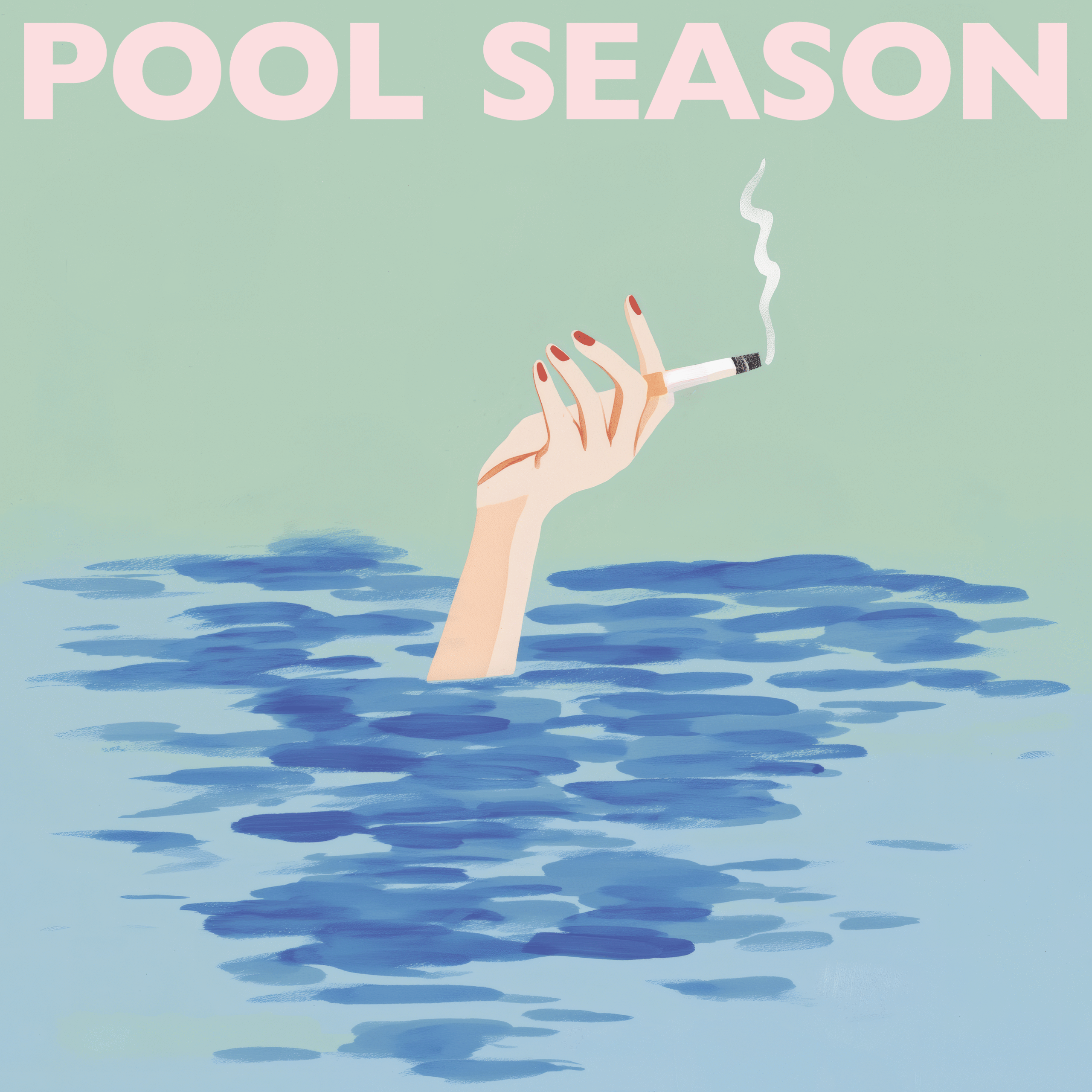
Designed by Sage Vasquez with graphic direction from Scott Devendorf – Bryan’s brother and The National’s bassist – the cover is among the new album’s most compelling features. Though suffused with pastel greens, blues, and pinks, and adorned with a summery title, a pervasive unease lingers.
A nonchalant, isolated hand rises from the water, holding a lit cigarette between its scarlet fingernails. We don’t know what lies beneath. The combination of a 1980s Florida aesthetic and classic, glamorous femme fatale imagery is intoxicating – a surreal, sunny subversion of sinister noir. Where The National infuses their Midwestern rock roots with a sheen of New York cool, this project instead channels Palm Springs.
“When we were bouncing around ideas and had decided on Pool Season as a name, the artist David Hockney had just passed away,” recalls Carlisle. “I saw some of his work in a news story, and I was drawn to that 80s essence, and pastel California or Miami colours.”
“I think it’s open-ended, ambiguous,” muses Devendorf. “Is somebody relaxing? Is somebody on a bender?”
“Definitely playful,” adds Carlisle. “But there’s a dark edge to it, too.”
Some things never change.
Pool Season is available across all major streaming platforms now, with a cassette release to follow.