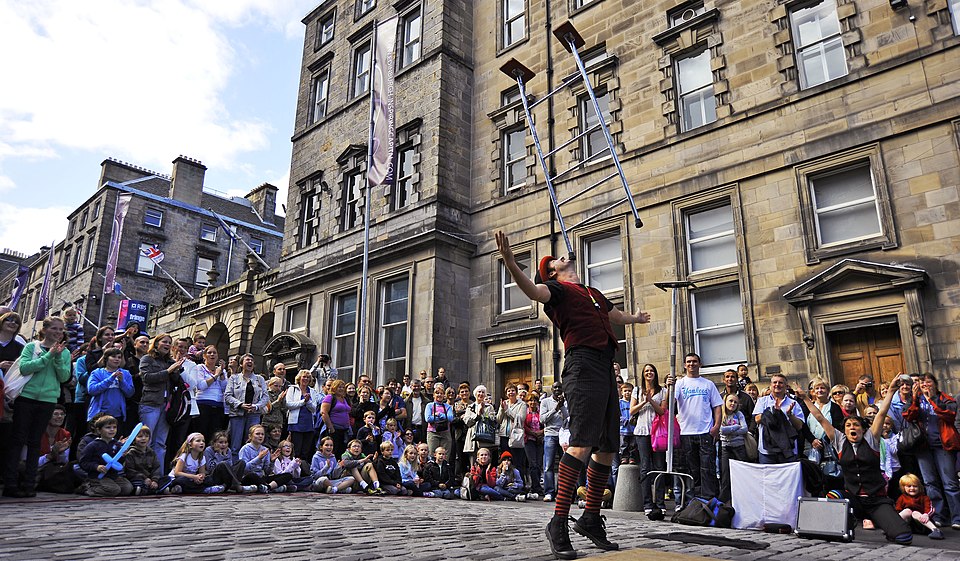

There’s no place in the world quite like the Edinburgh Fringe for a comedian. Amidst swarms of leafleters and thousands of performers, four members of Trinity’s “Improv She Wrote” brought their show on the road, and dared to enter “The Brozone Layer.” Not quite an alternative reality, but an improv show put together by last year’s co-captain Daniel Gorman, incoming co-captain Tim O’Leary, Jerome Gagnon, and newcomer George Donnery, it continued an almost decade-long tradition of seeing Trinity’s improv talent at the Fringe.
Speaking to O’Leary, Gorman and Donnery, one thing the three of them shared was their initial hesitancy to sign up to “Improv She Wrote” in the first place. Watching his first show at college back in first year, O’Leary remembers thinking “God, I could never do that.” The others felt the same, yet, different backgrounds in youth theatre and an interest in comedy, as well as an impulse to make the most of the opportunities college has to offer, gave them the drive they needed to try it out.

This impulse for exploration encapsulates what improv is all about. An oft repeated mantra during their long summer of rehearsals, or ‘training’, came from Gagnon, who maintains that “improv is an opportunity to discover.” Donnery continued, saying that any improv show is “a real tightrope act. It’s a lot about trust and putting trust in the people on stage. It’s terrifying but when you pull it off it feels […] very high risk, high reward.”
Noting that improv, while it lags behind the popularity of stand-up comedy, is uniquely well suited to audience engagement through constant participation. “A lot of people who go to standup shows now expect crowdwork, I think they should go to improv shows, it’s much more suited, [and], I’m surprised improv is not as popular,” said Donnery.
The mild, or intense, terror of taking their show beyond campus weighed on their minds, but despite the fear, it was freeing too, with O’Leary noting, “it’s like the safety net is completely gone. We were resting on our ability as improv comedians alone, and not what school we come from or what references we can come up with.”
Forced to embrace the unknown of an uncertain crowd, who were never guaranteed to show up each night, made the stakes even higher and for Gorman, although he loves performing for a home crowd, at the Fringe, with a crowd that doesn’t “owe you a laugh” means that the moment of connection between the audience and the performers is “amazing”.
Echoing this sentiment, Donnery shared that being up on the stage and winning a hard earned laugh from the crowd is “the best feeling in the world”, and makes him wonder “how does everyone not want to do this?” Threatening to trade 10 of his friends “to make one stranger laugh”, it is clear that the “high risk, high reward” feeling is an intoxicating one.
A blessing for the group came in the form of the silver wig of Fringe veteran Sir Dickie Benson, who offered them a last minute spot in his Midnight Cabaret following an act dropping out, a chance encounter which Donnery maintains “was a huge kickstart for us”. With thousands of acts vying for attention, he stressed the importance of word of mouth at the Fringe, noting that even with hours of flyering on the street, it “wouldn’t be worth as much as putting on a good show,” and having people spread the word. Building on their success with a larger audience, they performed to an almost full house for the next few nights, proving that ultimately, nothing can beat putting on a good night’s entertainment.
Despite the thrill of being there, the boys are “realists” when it comes to the disparity which has dominated much of the conversation surrounding the Fringe in recent years. It cannot be denied that the financial positions of some performers, as well as their industry connections, detrimentally widens the gap between who can even afford to perform, regardless of talent. That’s why charities such as PBH’s Free Fringe are so important to create more accessibility and opportunities for performers and artists who would otherwise be excluded from the space.
Gorman, noting that while the Fringe is a fundamentally “unfair place” that is “pay to win”, due to the unlikelyhood of anyone turning a profit, there is still a community of “amazing people” to uplift those who deserve the same chance to be seen. Praising PBH’s programme, O’Leary said that it was a “game changer”, and although it doesn’t “fully cure” the issue of disparity, their mission to help smaller shows perform at the Fringe is essential in the current climate, and helps to somewhat maintain a diversity of experience and performance.
Renowned for the weird, wonderful, and absolutely mad, Gorman remembered the words of one comedian who urged his audience to enjoy their Fringe experience and “go see something weird…take a chance on something.” For them, that was the most rewarding part, enriching their own performance and expanding their creative vision of what was possible.
O’Leary explained, “even if it’s nothing to do with improv, seeing someone do their own thing with such pride and confidence and belief in what they do, well, you leave that and think there’s no reason why I can’t apply that to what I do.” Taking inspiration from the passion of other performers is when they “did some of [their] best work.”
Their passion for what they do is undeniable, as well as their enjoyment in making their audiences and each other laugh. “Improv She Wrote” continues this year, as determined as ever to help students discover a love of improv, and is open to anyone willing to give it a go. Auditions are scheduled to be held during and just after Freshers’, with an improv workshop held on Tuesday 15th of September.