
Following their demonstration today, the PWO (Postgraduate Workers Organisation) met with the Irish Federation of University Teachers (IFUT) as well as a number of other union representatives and TDs. On the agenda was launching a plan for higher education funding, which will include funding for PhDs and early career researchers.
The meeting at the Dáil, hosted by Labour Senator, Laura Harmon, was organised to launch the 2026 edition of The Case for Publicly Funded Higher Education in Leinster House. This document sets out the evidence for sustained State investment in the sector and a funded, multi-annual plan to deliver it. Speaking at the launch were representatives of Fórsa, CONNECT, Teachers’ Union of Ireland (TUI), Services, Industrial, Professional and Technical Union (SIPTU), and Frank Jones on behalf of IFUT. A number of parties’ higher education spokespeople were in attendance, as well as Trinity alumni and leader of the labour party Ivana Bacik.
The document, which was launched at this meeting contains policy recommendations that claims to “build on the commitments already given and respond directly to the structural challenges identified throughout [the report].” Some of these reforms include, increasing public expenditure for the education sector from 2.8 per cent of GDP to 5.7 per cent (in line with the Organisation for Economic Co-operation and Development (OECD) average), to deliver an additional 6,500 jobs in the sector through a 10-year staffing plan, and to reduce student costs and student rents.

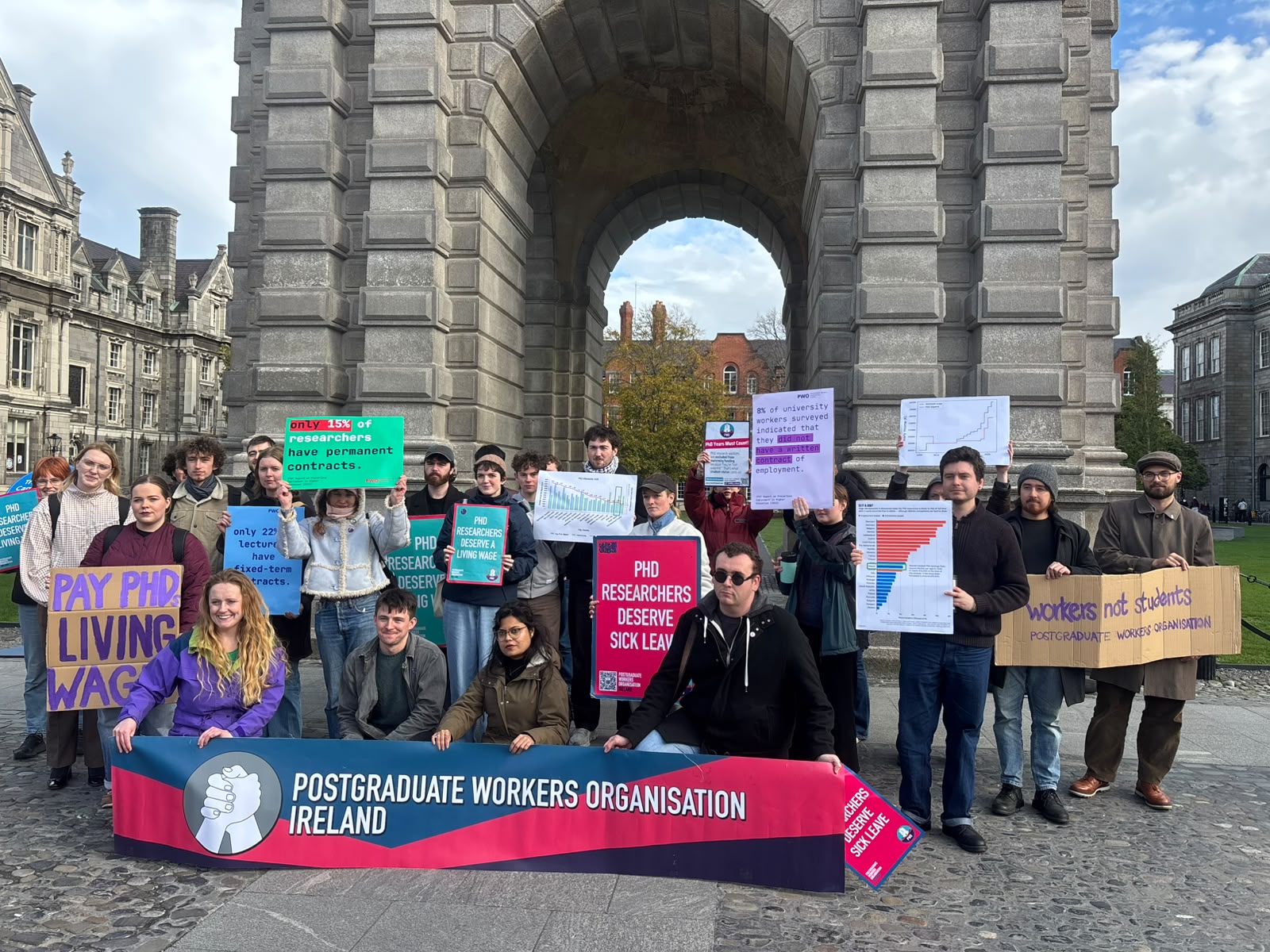
Before their meeting, the PWO demonstrated again today, although to a lesser extent than last week. Whilst classes took place today at Trinity, at 2pm around 40 protesters marched from Front Square to the Dáil, demanding fair pay and better working conditions for postgraduate workers.
Yesterday the PWO posted on their instagram that UCD postgraduate workers would go on strike on Wednesday from 8am to 5pm, and urged PhD workers around the country to follow suit and not “cross the picket line.” Despite this, classes went ahead at UCD and in universities around the country. Instead, as well as the march from Trinity, they invited prospective PhD students to get involved with them at “the HUB” in UCD.
The demonstration began with Trinity PhD researcher and officer with the PWO, Daniel Ó Laocha, citing facts and figures on the current working conditions of postgraduate workers. “Postgraduate researchers work in universities researching teaching and marking exams, keeping the universities working,” he said. “Yet, they are not recognised as workers, get paid far below minimum wage and don’t get the same security as the exact same workers.” The crowd then chanted “Shame!”. He went on, saying “We have the highest student to staff ratio in the OECD, with enrolment climbing to 57.1 per cent since 2007/2008.” “Only 15 per cent of researchers have permanent contracts, and 85 per cent of academic staff are reliant on fixed term grants.”
Trinity College Dublin Students’ Union (TCDSU/AMLCT) president Amy Kennedy spoke next, saying that “postgraduate workers are being denied their fundamental rights as workers, in this institution and those around the country.” She went on to claim that this is due to the fact that Irish universities operate under a “gig economy”.
Harry Johnston, student workers officer for the TCDSU/AMLCT went on to say: “Labs in Trinity don’t function, exams in Trinity don’t function, tutorials in Trinity don’t function without the unpaid labour of postgraduate researchers.”
Connor Reddy, introduced as a former member, but still heavily involved with the PWO reminisced on the striking he did in the past. He said “I can’t believe we are back here now, in a worse position than when we started in 2023. He then went on to claim that the Minister of Higher Education is trying to turn universities into institutions that serve corporations and tech companies, not society as a whole.
He ended his speech saying that there is power in speaking to public representatives, and campaigning, but “the real power is in withdrawing labour.” “Hopefully this is something that can come soon.”