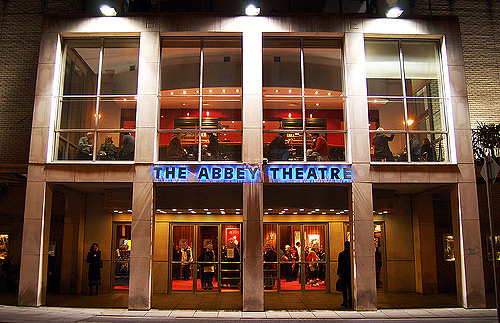

As Ireland’s national theatre, the Abbey Theatre has had an illustrious 122 year history. Founded against the backdrop of the Irish Literary Revival, and located on Abbey Street Lower, the theatre has played host to thousands of productions and performers across the years. From its humble beginnings as the former site of the Dublin Morgue, to its now international reputation of excellence, the Abbey is undoubtedly one of the most fascinating and important Irish establishments.
Founded on December 27th, 1904 by WB Yeats and Lady Gregory, among others, the Abbey operated under the patronage of Annie Horniman. Horniman, a middle-class English woman connected to Yeats, had previously aided in the production of plays in London, and as such, her financial aid was paramount in the early years of the theatre’s operation. Designed by Joseph Holloway, an architect (and later theatre critic and diarist), the theatre was small by international standards, but punched well above its weight. As one of the first theatres in Ireland to promote and stage productions by Irish playwrights and creatives, there was a definite effort made to build upon the efforts made by the Irish Literary Theatre, and the National Dramatic Company in years previous.
The establishment of the Abbey Theatre School of Acting in 1912 was perhaps one of the most significant and far-reaching achievements of the founders’ early years. Although its doors have now shut, a wide array of Irish actors passed through its hallowed halls, including Colm Meaney, Stephen Rea, and Lennox Robinson. Perhaps one of the first such “drama schools” in Ireland, actors were given an insight into the professional world, receiving training and preparation for future careers on stage. A large cohort of these actors later joined the Abbey Theatre Company upon graduation. The Peacock stage opened in 1927, housing the school, and offering opportunities to more experimental and amateur works.

That is not to say that all of the theatre’s work was well received. In 1907, the infamous “Playboy Riots” (relating to the first production of “The Playboy of the Western World”), caused a stir, as the audience turned on JM Synge and the theatre for showcasing the story of young man taken in with sympathy by a small Irish village, after confessing murder. Held to be a disgrace, and widely condemned by newspapers and politicians alike, the production later was staged in America, by the travelling Abbey Theatre Company. Here, it received much the same response, with rotten fruits thrown from the audience, and a cast arrest in Philadelphia (with charges later dropped). A later production of “The Plough and the Stars” (1926) caused similar discontent and riotous responses.
In 1909, the Abbey lost the funding of Horniman, after they refused to close the theatre following the death of King Edward VII. Seen as a mark of disrespect by Horniman, and an expression of freedom by the Abbey’s board, the end of the professional relationship with one of their initial funders was a blow to the finances of the theatre. In 1925, the theatre’s financial relationship with the government of the Irish Free State began, with funds of £850 granted to the theatre on an annual basis, by then Minister for Finance, Ernest Blythe. This funding continues to this day, as in 2025, the Abbey received €9.5 million in funding from the Arts Council.
Other aspects of the Abbey’s history include the many connections to the events of the 1916 Easter Rising. Eamon de Valera appeared in a 1905 production of “A Christmas Hamper”, whilst Countess Markievicz played a small role in Seymour’s Redemption in 1909. Participating in the rising were actors Sean Connolly (the first rebel to be killed) and Arthur Shiels, both of whom were starring in an Abbey production at the time. Máire Nic Shiubhlaigh, another Abbey actor, also took part, stationed at Jacob’s biscuit factory in the South Inner City. Charting the involvement of various people involved in the Rising allows the impact of those behind the Abbey to be seen in a more vivid light, highlighting their involvement in more than just theatre.
From a historical perspective, the work undertaken by the University of Galway’s archivising of the Abbey’s minute books, offers an intriguing insight into the day-to-day workings of the theatre in the early years of its foundation. From letters written by Gregory and Yeats, accounts of director meetings and insights into planned productions and castings, there is a wealth of information still to be discovered about the National Theatre. The fire that engulfed the theatre in 1951 sounded the death knell for the original building, with productions moving to the Queen’s Theatre on Pearse Street for the next fifteen years. Following the rebuild and design of a new, more “modern” theatre, the Abbey moved to its current premises in 1966, where they have continued from strength to strength, championing homegrown talent and producing a wide variety of shows and productions.
Today, both the Abbey and Peacock stages are known internationally, playing host to revivals, events including the Dublin Theatre Festival, as well as international and traveling productions. Their link to the All-Ireland Drama Festival involves allowing one of the nominated amateur drama companies to stage their production on the Peacock stage for a week-long run. Given the resurgence in theatre attendance across the board, the Abbey’s total Box Office revenue for 2025 was over €2.4 million. Having survived for over a century, and remaining an Irish cultural icon, the history of the Abbey proves the importance of Irish theatrical spaces, whilst keeping a link to the past.