It’s official. Sally Rooney’s books will be out of print in the UK. The Trinity graduate and literary voice of her generation has announced that because of her support for the proscribed organisation Palestine Action, she is unable to receive funds from her publisher Faber under current British legislation. In agreement, Faber and Rooney have pulled her books from sale, and as their supply dwindles in bookstores across the UK, baffled outrage steadily grows.
On October 21st, the New Statesman joined this outcry in an open letter to the British government. Signed by an array of notable figures, from the likes of “Normal People” stars Paul Mescal and Daisy Edgar Jones to recent Nobel laureate Anne Carson, the letter affirmed that “Sally Rooney is a writer, not a terrorist”, and that “her books must be available to the public. Their withdrawal from sale, on the basis of ill-conceived and draconian anti-terror legislation, is an affront to basic principles of free speech and expression so long taken for granted in this country. We categorically reject censorship — whether direct or indirect — and urge the government to change course, amending the legislation which has led us to this point of repressive absurdity”.
This open letter was attached to an op-ed written by cultural editor Tanjil Rashid. He opened the piece by comparing Rooney to her shelfmate Salman Rushdie, the writer who arguably personifies the dangerous excesses of literary censorship in public imagination. Rashid’s argument is that while Rooney and Rushdie’s books were not removed from stores by the British government, a similar “climate of fear” required their voluntary removal. In Rushdie’s case, this fear was stoked by terrorists, and in Rooney’s case, by legislation. But while a convincing case for Rooney’s literary martyrdom, the comparison is a melodrama. The “climate of fear” that forced Rushdie into a decade of hiding is not equivalent to the anxious conscience of Rooney’s publisher. No fatwa has been raised against the author for her millennial malaise, and she’s certainly in no danger of losing an eye. But ill-fitted comparisons aside, the New Statesman, along with the literary community as a whole, has made their stance on the matter clear. Rooney was forced to self-censor because British anti-terrorist laws encroached on her freedom of dissent. But this isn’t exactly the case.

Sensationalism aside, the boring matter-of-facts in this case are simple: Rooney pledged that she would direct her royalties towards Palestine Action, a terrorist group under British law. In order to not violate section 15 of the Terrorism Act, Faber could not provide Rooney money if they had “reasonable cause to suspect that it will or may be used for the purposes of terrorism.” The publisher could have even kept her books in stock if they withheld funding, but they found that idea objectionable, and rightfully so. Rooney’s removal from stores was thus strictly financial and mostly self-inflicted.
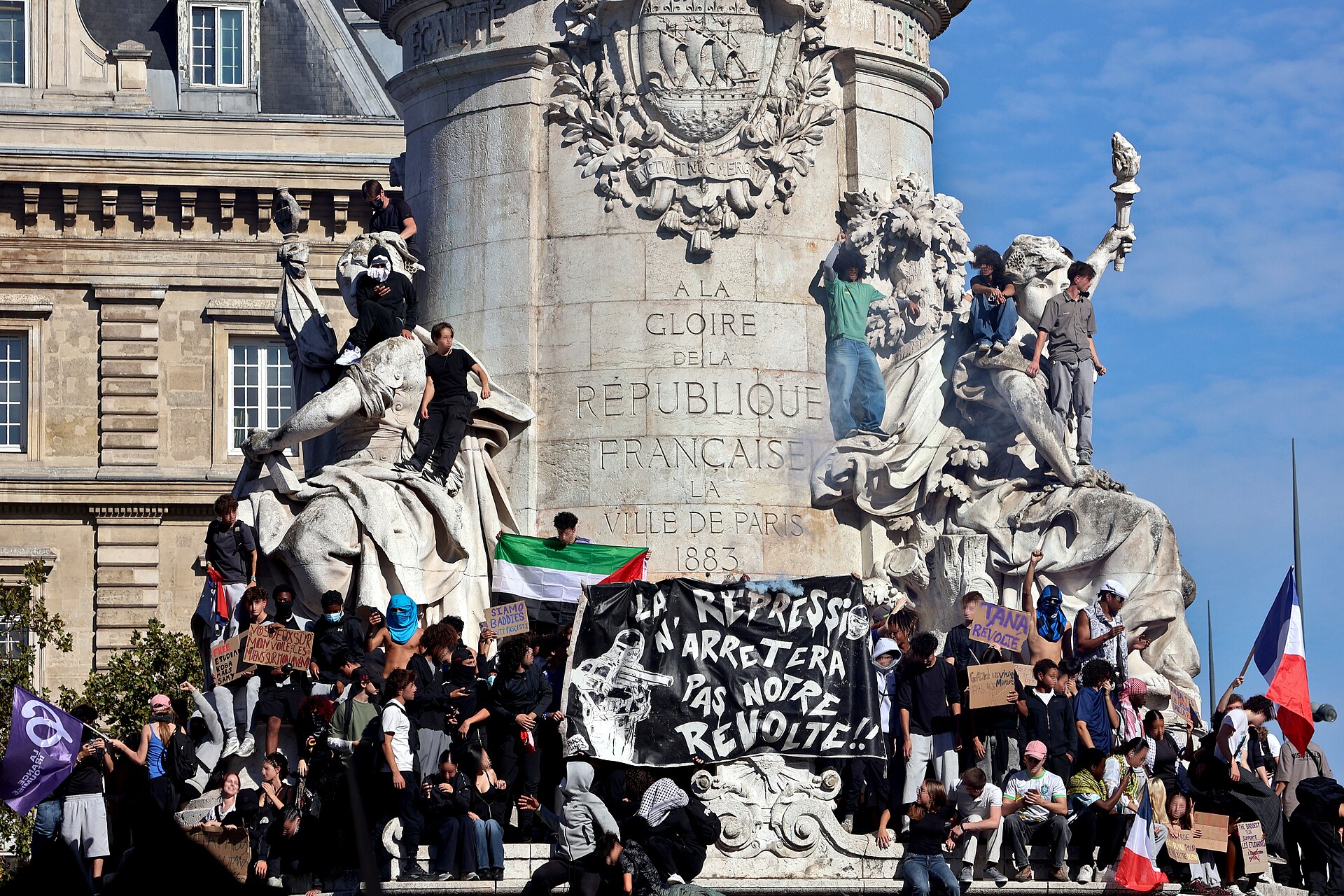
But framing Rooney as an unjustly censored artist doesn’t have to be genuine to be salient. There is a valuable political motivation for this sensational framing, and it has the power to emphasise the real danger of British anti-terrorist laws to the broader public. In July 2025, the UK proscribed Palestine Action as a terrorist organisation on the basis of property damage rather than violent intent, which is a wildly unusual justification in British law. And since it can be a criminal offence to express support for proscribed organisations in the UK, this dubious proscription has led to a critical suppression of protest and speech. Over 3,700 people have been arrested in the UK for their alleged support of Palestine Action, most of whom were simply holding a sign stating, “I oppose genocide, I support Palestine Action”. Arresting people for merely verbally affirming a group whose worst offences range from vandalism to property damage should raise the eyebrows of anyone interested in preserving free speech.
Co-founder of Palestine Action Huda Ammori would naturally agree. In fact, she brought a legal challenge against this proscription to court, noting its dangerous incursions on freedom of expression. In the high court last November, Rooney bolstered Ammori’s claim, warning that her books could be withdrawn from UK stores due to the legislation. Now that the books are disappearing from shelves, Rooney’s forewarning has transformed into useful evidence. According to Ammori, this removal marks a clear escalation of injustice: “No author should have to choose between their principles and their freedom to publish”. The less glamorous, financial realities make this argument vaguely disingenuous, but it is undeniably attractive. In reality, Rooney’s voluntary self-censorship was not born from a climate of legislative fear but rather from a clever political strategy: that is, making herself a “banned” author.
Words shape consciousness. Internally, they’re our primary tool in understanding and parsing through our experiences. On an interpersonal level, they shape narratives. To silence them is the worst offence, and so we’re rightfully vigilant in their protection. Free expression is invaluable, so much so that any attack against it becomes an outrageous, seductive scandal. In the case of the writer, this impulse is personified. A writer’s body of work is their voice, and to ban it silences the writer’s words and precludes the reader’s engagement. When we think of censorship, a book in flames is the immediate symbol in our imaginations, and a banned book is the practical progression of that image. Literary censorship is a romantic injustice.
Declaring Rooney a banned author in the UK evokes this exact imagery and impassioned sentiment. Not being able to purchase her books at Waterstones feels like a bigger injustice to the public than it being actually illegal for Rooney to publish an op-ed supporting Palestine Action in The Times. The New Statesman has readily accepted the banned author narrative, and any person with common sense reading the headlines won’t be far behind. The idea that the British government’s legislation would prevent books like “Intermezzo” or “Normal People” from remaining on shelves is completely preposterous. Following that logic, the public, rather reasonably, could determine that British anti-terrorist laws have overindulged and unfairly restricted speech. It’s a strategy relying on the sensational quality of literary censorship, but its provocation is undeniably effective.
As Rushdie himself pointed out at Yale over a decade ago, banning something gives power to the forbidden, and Rooney’s voice of opposition has certainly never been stronger. With the supreme court hearing a challenge to Palestine Action’s proscription next month, it is essential to emphasise the oppressive nature of these anti-terrorist laws, especially when they stand on such shaky legislative ground. In the case of Rooney’s recent literary martyrdom, the mundane facts are subordinate to the spectacle, and since she’s been readily chosen as the poster-woman for censorship, so be it. The public has already ruled in her favour.