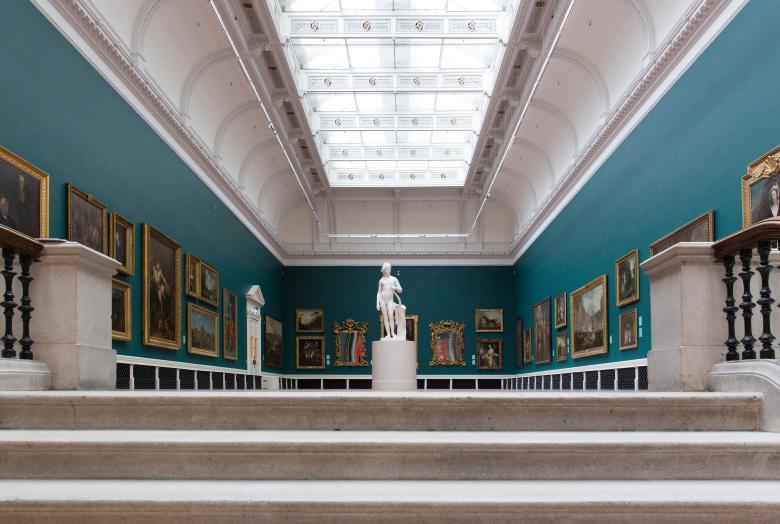

The time has come. Rainy afternoon, freezing wind outside, and a sudden desire to absorb some art. You take the first bus to the closest gallery. You are a step away from entering the building, but something suddenly stops you. You start imagining yourself walking through the silent rooms, seeing all of these people inspecting every detail of the painting as if they were analysing every brushstroke, reading labels and taking notes. You see yourself watching other people and imitating their behaviour, wondering whether you are standing at the right distance or looking for long enough. Before you know it, you are reading something that is absolutely uninteresting to you, wasting your time on a tedious, long-winded text.
Suddenly, the visit to the gallery turns into a performance rather than a genuine experience of absorbing art. You are no longer there simply to see something you might enjoy; you are trying to prove, even if only to yourself, that you know how to be in a gallery. This vision terrifies you, so you take a step back and tell yourself: “Next time, I will overcome this anxiety.” But it never happens. However, help arrives! After spending many hours “admiring” religious art in galleries without having any interest in it, I have learned that perhaps there is much less to gallery-going than you might think.
First and foremost, you need to realise that you are allowed to go to an art gallery on your own. No one checks for your art partner at the entrance, and tickets are not sold in pairs either. Besides, there are many advantages to going alone. You can focus entirely on the art itself — speaking frankly, lose yourself in it. Let your thoughts wander without distractions from the outside world. With so many people represented in paintings, you are never truly alone. You are surrounded by hundreds of individual stories, which you can get to know through your open-mindedness and unrestricted perception. Allow yourself to realise that, for a moment, you are actually sitting at a great feast with all of these individuals from the past, listening to their stories, seeing their worlds, and perhaps finding something of yourself among them.

What’s more, it is physically impossible to see every single piece of art in a gallery. It would take half your life to walk through one, leaving you exhausted and discouraged. Instead, you can pay attention to the pieces that truly catch your eye, giving yourself more time to admire them and discover what exactly drew you to them. Stand in front of them and let your thoughts wander freely. You may recall the craziest party of your life while looking at Leonardo da Vinci’s The Last Supper, and that is absolutely amazing. Art is meant to evoke feelings, memories and associations, and if a painting makes you feel something, it means that the artist has succeeded.
Stay for as long as you wish. Even if you were to spend your entire visit in the gallery with one particular painting, there is nothing wrong with that. If it has caught your attention to such an extent, it deserves your time. There is no rule saying that you have to move on after a certain number of minutes. However, you are probably asking yourself: but what about my back pain? Yes, I get you. Walking slowly for a long time or standing in one position may evoke something more than feelings in a visitor. Do not feel ashamed of taking a break. Most art galleries have seats where you can rest while still admiring the art. If they do not, simply ask a member of the gallery staff. They are not there to judge you, but to help — not only to protect the fragile pieces themselves, but also to make your visit more comfortable. After all, there is no point in trying to behave like the perfect gallery visitor if your back is screaming for a chair.
Last but not least, you can hate some artworks! Actually, you can even hate the whole gallery. Disagree, be outraged, be indignant, be disgusted! These emotions are not only allowed but absolutely valid when experiencing art. You can’t necessarily scream in a gallery, but you can always carry a little notebook with you to write down everything you hate about the work that made you sick. Failing to understand or appreciate everything on display does not make you a worse visitor. On the contrary, it gives you a perfect opportunity to practise your critical thinking. You do not have to admire something simply because everyone around you does. Sometimes, questioning why you dislike something can be far more valuable than forcing yourself to understand why everyone else loves it.
So, the next time you go to a gallery, take a proud step inside and confidently trot through its halls, absorbing all the treasures you can find there. Love, hate, be surprised, be disgusted, ask questions, wonder, and reconnect with all the people standing behind these works, invisible to us in the present. There is no specific code for visiting a gallery. Be a perfectly imperfect visitor and lose yourself in art!