Fergal Mullins
The importance of the forthcoming General Election cannot be understated. It is universally regarded as a watershed moment, the significance of which is unparalleled since the founding of the Free State. Unlike previous elections of 2002 and 2007, this election has captured the imagination of previously politically indifferent students.
The reasons for this are obvious. With the IMF now in town, the backdrop to this campaign is in marked contrast to its predecessors. The country is no longer blowing its nose with hard cash and this has made students more politically engaged.
The extent of the country’s empty coffers has been made all too clear to students; increased student fees, mass unemployment and the looming threat of emigration hanging over their shoulders. Not even the abundance of €4 naggins can paper over this reality.
This has caused the student population to stand up and take notice. Aside from the mechanics of party politics, students have made their voices heard. This was epitomized by the student march against fees and the recent march by over 3,000 student nurses against the Government’s plan to ultimately cut-off payments for their mandatory 36-week placement in hospitals. Students now want to know now more than ever what they are getting for their vote.
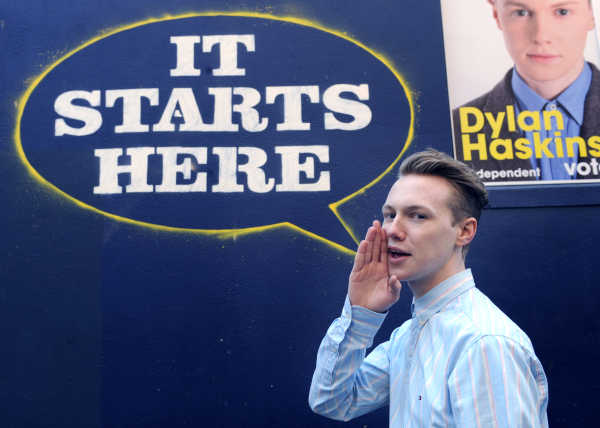
Our beloved Dylan Haskins
This upsurge in political interest among students has also filtered through to the various political party movements in Trinity itself. These parties have managed to overcome the stigma attached to politics and counteract the apathy among students. Membership has risen across the board and committee meetings are enjoying a renewed vigour from new members, especially the new freshers. Despite being on the breach of an electoral hiding, Ógra Fianna Fáil has seen fewer empty seats at its committee meetings. Labour Youth has built on its solid base with over one hundred new freshers signing up into the ranks. Young Greens, far from being punished for its role in government with Fianna Fail, has seen its popularity go from strength to strength and remarkably enjoyed more new recruits than its senior coalition partner. Young Fine Gael, spurred on by its uprising national popularity, recorded more than double the amount of new recruits than any other party and have even noted the need to form a second committee in order to contain the level of fresh faces. It would also appear than the socialist movement is alive and well in Trinity with eighty new budding left-wingers pledging their support.
This, coupled with Trinity student, Dylan Haskins, putting forward his candidature as an independent voice, shows politics to be enjoying a rude bill of health among Trinity students.
Whatever the outcome of Friday’s election, the student body will play a significant role with more than 2,500 new voters signing up during the recent voter registration drive in Trinity. The question of disengagement of young people and politics is less apparent. Students, regardless of their political allegiance are making a conscious effort to be more informed.
While politics still has a long way to go to endear itself to students, it is certainly going in the right direction.Even though a whopping 70% of TD’s in the Dail are aged over 50, irish politics isn’t exclusively an old-man’s game.