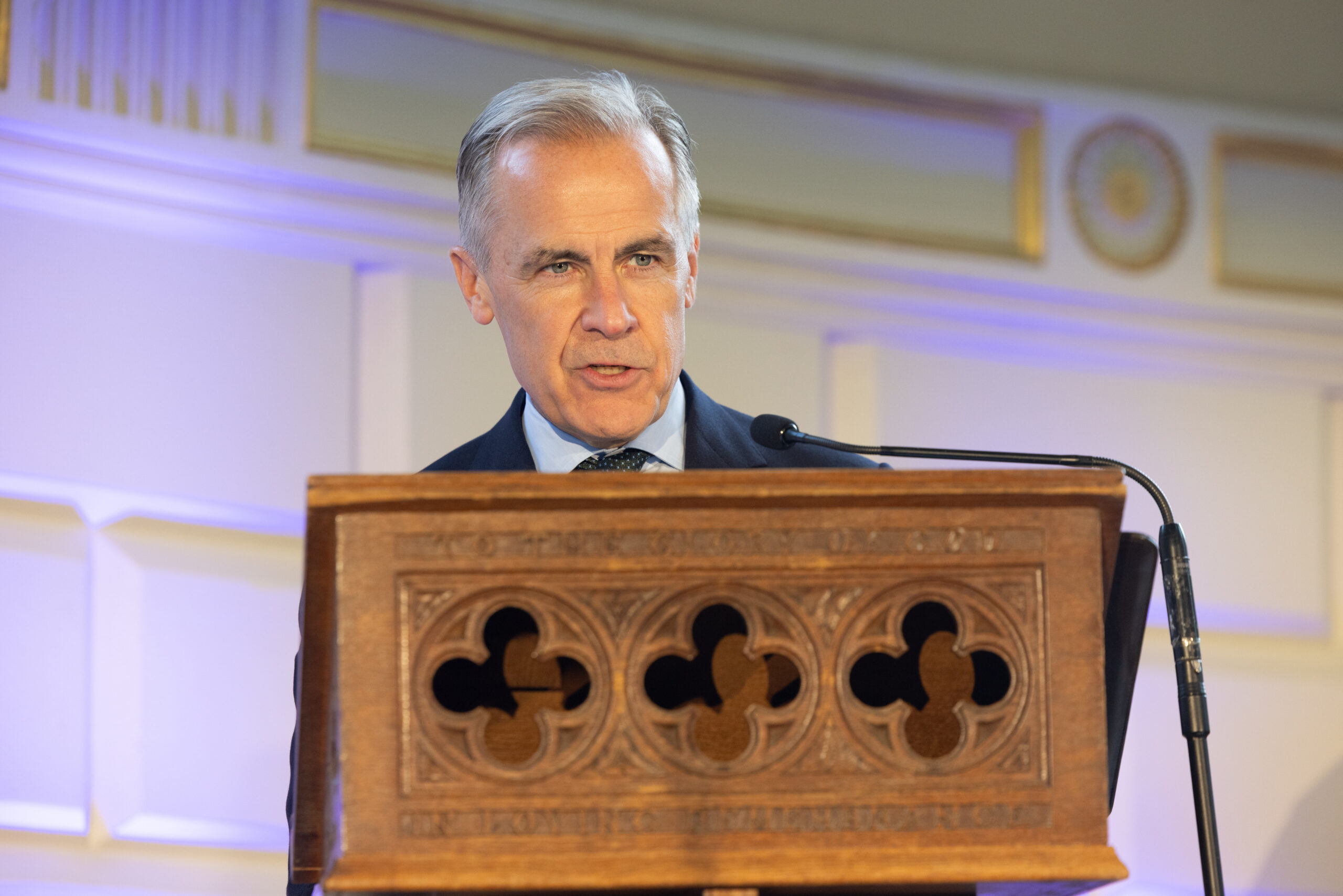
Jennifer Carroll MacNeill, Fine Gael Minister for Health and TD for Dún Laoghaire, has often been noted as a rising star. A strong performer in the last general election and a popular figure within her own party, MacNeill has never concealed her ambition to rise to both Fine Gael and national politics. The choice of MacNeill to deliver the oration at this year’s commemoration of Michael Collins’s assassination at Béal na Bláth — previously delivered by Enda Kenny, Michael D. Higgins, Micheál Martin and Leo Varadkar, among others — has further piqued the interest of the political observers following her career. What’s more, MacNeill’s speech at the site of Collins’s death offers a window into her approach to the revolutionary leader’s contested legacy.
It has often been suggested that a nation cannot survive without its national myths — those reinterpretations and repurposings of the past which shape national identity, offer a sense of purpose and, more often than not, serve to underwrite the current political order. Few events in recent Irish history are as ripe for this treatment as Collins’s assassination in August 1922: the killing of a man, only weeks before his wedding, by the very people he had helped liberate guarantees a sense of pathos, while Collins’s heroism during the War of Independence makes him a rallying point for national pride. Yet it’s just as clear that what Collins died in the service of was Irish partition, which has been a source of divisive political turmoil ever since.
As thorny and challenging as these issues may be, MacNeill’s speech at this year’s commemoration made little attempt to handle them with kid gloves, striking a decisively partisan note. References to Collins were largely confined to the first third of her address, presenting him as a state-builder who laid the foundations of the social institutions and of the political programme now — in MacNeill’s view — being faithfully administered by Fine Gael. Having invoked Collins as the father of Fine Gael’s programme, MacNeill went on to apply his stamp of approval to Fine Gael’s vision for the future, which she described as based on energy security, enduring sovereign wealth, and the removal of the triple lock. Special attention was given to Fine Gael’s fiscal policy: the establishment of the Land Development Agency and the Future Ireland Fund, both under Fine Gael coalition governments, as well as the party’s role in bringing public finances back to surplus after the financial crash and the Covid pandemic, were described as the “new foundation stones” of Ireland’s future. The arc of history may be long, but in MacNeill’s view it bends towards Dún Laoghaire.

What’s clear is that, for MacNeill, this year’s commemoration was less of an opportunity for consensus building and more a political arena in which her own vision for the country could be set out point by point. This bolsters the reputation she has already earned as a no-nonsense figure within her own party. Her confidence in calling for long-term investments in energy security and an end to triple lock neutrality reflects the fact that her political ambitions are known to extend well beyond the next election cycle. When asked by The University Times how she hoped to strike a balance between conciliation and political partisanship, MacNeill was more diplomatic. She stressed that the responsibility for inviting speakers lies with the politically independent Commemoration Committee and that the oration had previously been given by speakers from a multiplicity of political or apolitical backgrounds. The warm reception that MacNeill’s speech received also points to her popularity within her own party: the mood was buoyant among the large contingent of rank-and-file Fine Gael members present, and those who spoke to The University Times expressed their confidence in MacNeill. Yet the Minister for Health was clearly on home turf last Sunday, speaking before a Fine Gael dominated audience, and only time will tell how her ambitions will play out. If one thing is clear, it’s that Jennifer Carroll MacNeill is worth watching.