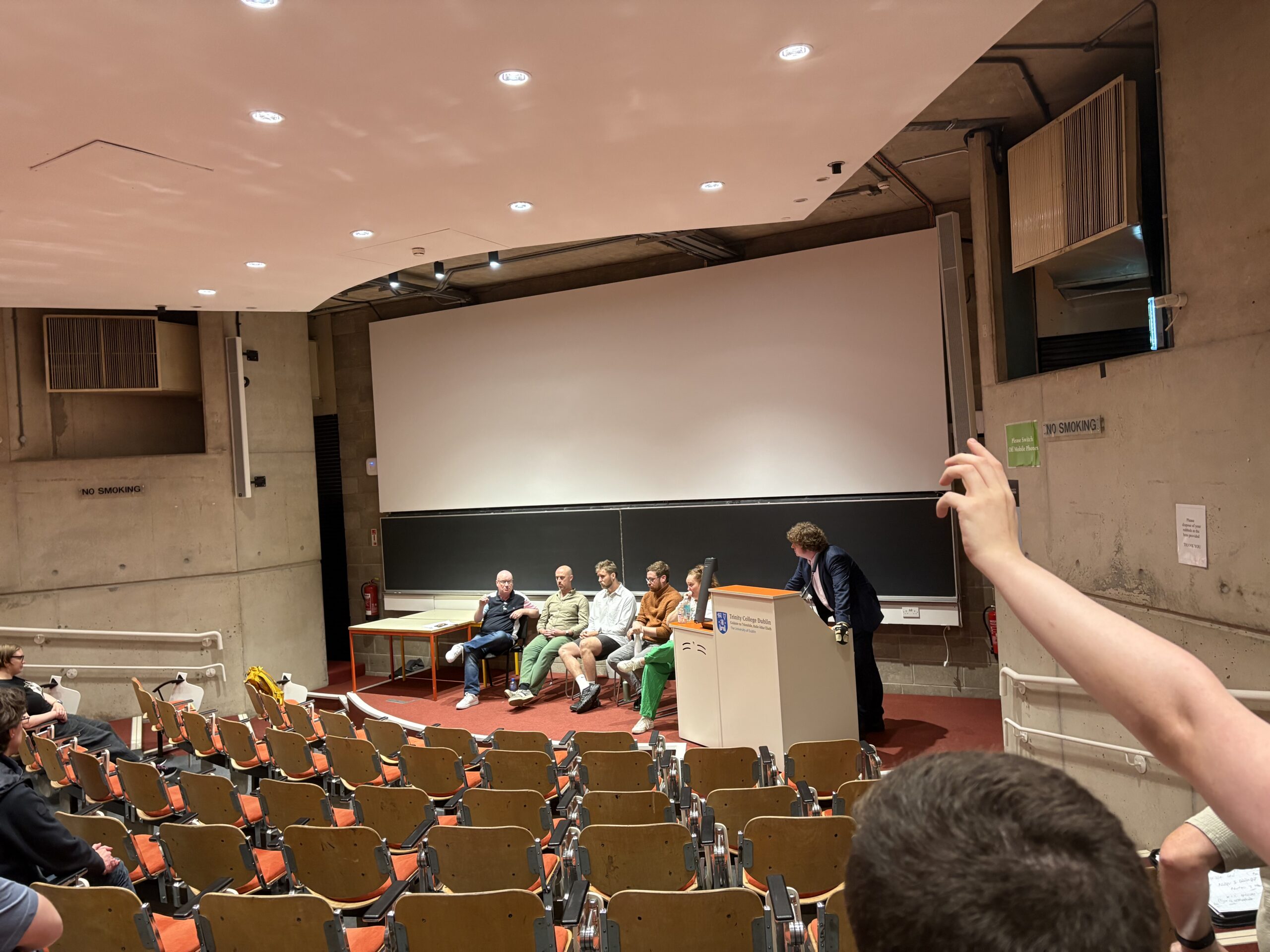

Fórsa Youth held a conference at Trinity that was defined by both vigorous debate and sombre reflections on the ongoing housing crisis. The event was held on Friday, 17th July, and held panel discussions on renters and domestic violence, alongside a youth political debate featuring political representatives including Conor Reddy and Trinity’s Cathal Horgan.
Fórsa is the second-largest trade union in Ireland, representing over 100,000 workers. It is also the largest Irish trade union for the public service.
The conference began at 10:00 am with a call to action from Fórsa Youth Recruitment Officer, Áine Bullock, urging attendees to support the forthcoming vote on industrial action by members of Fórsa Ireland. She indicated that members of the Irish Congress of Trade Unions (ICTU) would also act in coordination with Fórsa. Bullock warned of escalating tensions with the government, stating that a “major public sector strike” could be on the horizon, adding that “things are going to be heating up very shortly” and cautioning that if demands are not met, “we are going to escalate”.

In a press release, Fórsa noted that the Public Service Agreement (2024-2026) had expired, but talks to replace it would not begin until “they start by addressing the cost of living”. Fórsa also said “Public servants are the backbone of our country, but you are paying the price for increasing inflation. That isn’t fair, and it is totally reasonable that we are seeking clarity on a credible approach to pay so that we know talks will deliver for members.”
Director of Campaigns Kevin Donoghue followed, reinforcing Bullock’s message. He highlighted that, alongside pay increases, the protection of remote and hybrid working arrangements remains a central priority. Citing survey data, he noted that the majority of Fórsa Youth members consider the preservation of flexible working conditions to be as important as pay. Closing the opening session, Former Trinity College Dublin Students’ Union (TCDSU) Ents Officer and Fórsa Youth Chair, Hugh McInerney, underscored the scale of the anticipated action.
McInerney warned: “This is going to be one of the most lively, hairy summers in public service memory.”
The conference’s first panel discussion, titled “That’s Rentertainment”, saw five speakers from across the housing sector. The panel featured Aisling Hedderman, a representative of Community Action Tenants Union (CATU); Allan Kelly, economist with the Department of Housing, Local Government and Heritage; Seán O’Neill McPartlin, Director of Housing Policy at Progress Ireland; Paul Gavan, Campaigning and Advocacy officer for the Irish Congress of Trade Unions (ICTU); and Dr Michael Byrne, professor of social policy, social work and social justice at UCD.
Discussion touched on a number of topics, beginning with a debate on the effectiveness of the newest rental legislation, which aimed at issuing long-term tenants with stronger protections whilst incentivising more new building development projects. The debate centred on the question of whether allowing markets to function by minimising profit pressure on investors is key to maintaining supply, or whether more robust affordability measures are required. Hedderman grounded the debate in lived experience, arguing that the new legislation had created “panic” among landlords, contributing to a rise in sudden eviction notices. She explained how theory does not always play out in practice, pointing to enforcement limitations, stating that the Residential Tenancies Board (RTB) are not equipped to enforce the new rules, and the challenges faced by older and lower-income individuals in navigating new housing schemes, particularly due to technological barriers
The discussion was marked by strong participation from the union members in the audience, adding intensity, liveliness and many insights to the dialogue.
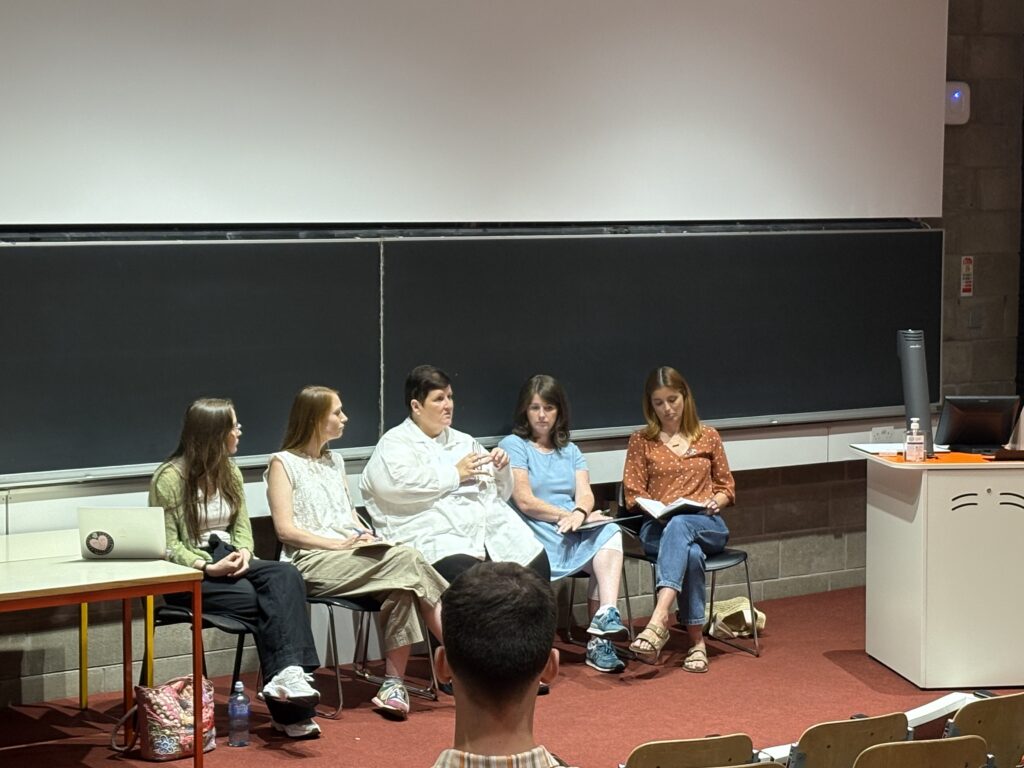
Left-Right: Deirdre Leahy, Patricia Stephenson, Christine Lodge, Rachel Coyle, Linda O’Sullivan. Photo by Harper Alderson for the University Times.
Following the rent panel, Fórsa hosted “The Hidden Crisis” in the Uí Chadhain Theatre, focusing on Domestic, Sexual, and Gender-Based Violence (DSGBV) in Ireland. Linda O’Sullivan of Fórsa moderated the panel, which featured former TCDSU Welfare Officer, Deirdre Leahy; Social Democrat Senator, Patricia Stephenson; SAFE Ireland Interim CEO, Christine Lodge; and Fórsa Policy and Research Officer, Rachel Coyle.
The event opened with each panellist briefly outlining their experience and focus. Leahy kicked off the panel by discussing her time as Welfare Officer, mentioning her experience in fundraising for women’s issues, individual casework, and lobbying efforts on the policy level at Trinity. Stephenson followed, making note of her role in the new Domestic Violence Travel Supplement, where survivors may be granted a weekly or monthly supplement to assist with travel costs (for example, hospital visits or commuting to safe homes). Stephenson also underscored how the supplement is not means-tested for the first three months, because often survivors face financial abuse where their resources on paper may not reflect what they actually have access to. Lodge followed, underscoring the record rates of violent murder of women in Ireland. She specifically pointed to the fact that 7 women were murdered in all of 2025, and to date in 2026, 8 women have been murdered. Lodge identified “an obvious social need” that is currently being met with little change. Coyle followed, highlighting the word “hidden”, noting that the issue is severely underdiscussed, but it “couldn’t be more in your face” in scale. O’Sullivan concluded the introductions by pointing out the level of shame experienced by survivors of domestic violence: “the perpetrator should be ashamed”.
Following introductions, Leahy was asked about what she’d seen in Trinity specifically regarding domestic violence. Given the conference’s general theme of housing, Leahy mentioned the lack of emergency accommodation provided by Trinity, describing, in general terms, a case in which a student needed a place to stay, and all Leahy could recommend was staying with a friend. Leahy also expressed frustration at only being able to signpost information, hoping that students would get something out of it. Discussing the general trends of her term, Leahy also mentioned the incident at UCD where a Medical Student was assaulted and refused the opportunity to resit her exams among other institutional barriers, which lead to a walkout at Trinity.
On specific policy changes, Lodge advocated for a “flee fund” in Ireland following the UK model which provides a one-time payment of £500 to survivors of financial abuse attempting to leave their situations. She also highlighted the shortage of refuge spaces in Ireland, explaining that SAFE Ireland have had to turn away nearly 1900 women from their services this year due to a lack of beds.
Speaking from a legal perspective, Stephenson pointed to abusers’ ability to “weaponise the court system” and the use of counselling notes in certain cases.
The conversation then turned to housing, where Coyle repeatedly stated that “the housing crisis is a gendered crisis”. Her colleague, O’Sullivan, also advocated for the removal of male perpetrators from homes instead of the model where women have to leave, citing women’s need to keep their kids in their school, take care of their pets, and stay in their communities.
O’Sullivan, Stephenson, and Lodge all pointed out that when they’d historically tried to advocate for policy reforms, they’d been told it was a “constitutional issue”. Lodge also noted that when Jim O’Callaghan became the Minister for Justice, he had advocated for the reforms they mentioned. Still, in direct conversations with stakeholders, he has blocked them on constitutional grounds. Stephenson asked, “If he knew it was a constitutional issue, why would he say it?”
Lodge pointed out that it makes economic sense to urgently address domestic violence in Ireland because it costs €2.7 billion every year.
Following the focus on financial abuse, the panel began talking about online sexism and the manosphere. O’Sullivan said, “far right agitators…like the fuel protesters we saw on O’Connell Street…only care about perps who look like them”, which is to say immigrants or people of colour. O’Sullivan also insinuated that among the fuel protesters, there was a high rate of domestic abusers, though there is apparently no evidence to support this claim.
O’Sullivan also called for the implementation of Jennie’s Law (putting perpetrators of domestic violence on a public register) and Valerie’s Law (the removal of guardianship rights from people convicted of killing their partner or other parent of their child). Jennie’s Law was approved by the Dáil on July 16th, and Valerie’s Law passed in the Dáil on July 15th.
The session concluded with remarks from all panellists. Leahy called for more male educators, especially in sex education spaces, pointing to the fact that the Dignity, Respect & Consent Service at Trinity is mostly staffed by and serving women, and including men at the preventative level would reach men where they are. Stephenson called for legislation on Grok AI and its use in the creation of child sexual abuse material (CSAM), an end to the use of counselling notes in court, and better education. Lodge called Ireland’s current domestic violence response a “disjointed and fragmented” “whack-a-mole approach”, and underscored the importance of investment in domestic violence resources and prevention. Coyle ended by saying “Domestic violence is a workplace issue” and “it isn’t about shaming men”. She said “we need more solidarity” because “it’s migrants this week, women next week, and then it’s you”.
O’Sullivan ended by saying the movement needs to become “more radical, more loud” and encouraged audience members to put the Women’s Aid number, 1800 341 900, in group chats and online spaces.
The audience was then encouraged to ask questions. The first audience member to engage stated she was “speechless” after the panel, and asked for more discussion on the UK flee fund.
The next question from a male audience member touched on the radicalisation of young adults in Ireland. He noted that a panellist had stated that children as young as 8 or 9 were being radicalised online, and said that in his experience it was as young as 7. Lodge responded, underscoring the lack of investment in prevention and early education.
The last audience member to participate was male, and said that as a man he was hearing the panellists “loud and clear” and that he wanted to say most men were not like those who perpetrated domestic violence most men “despise” those men. He finished by saying he knew there was more work to be done, and that men had to help out.
Harper Alderson for the University Times
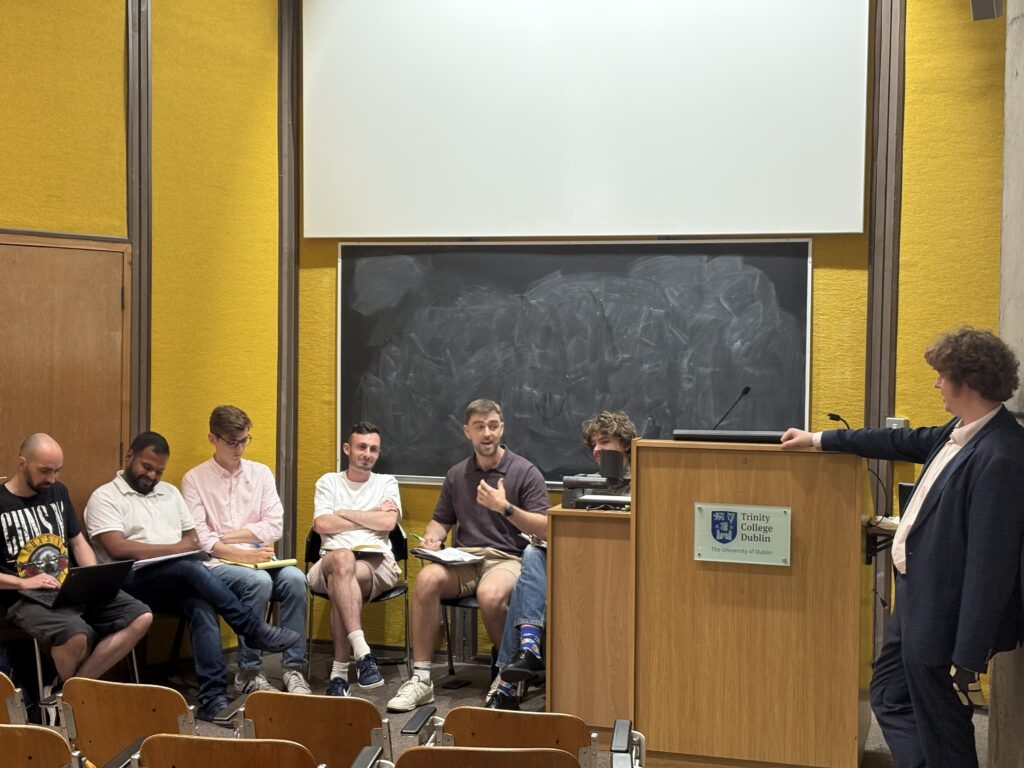
Following a brief lunch break where Fórsa provided sandwiches, tea, and coffee, the University Times attended a Youth Political Debate in the Jonathan Swift Theatre on the subject of the housing crisis.
Debaters included Solidarity Party Councillor, Brian McCarthy; Young Fine Gael Vice President, Kuruvilla George; Órga Fianna Fáil National Council Secretary and former TCDSU Presidential candidate, Cathal Horgan; Sinn Féin Councillor, Ciarán Ó Meachair; People Before Profit Councillor, Conor Reddy; and Labour Youth National Chairperson, Aaron Duke.
Duke opened the discussion by saying “housing is a human right” and listing Labour policies, including adding construction to the critical skills visa and criticising the government for building homes without addressing homelessness. Reddy followed, saying he would “not outline a bunch of policies” and said, “the focus should be on organising”. Reddy said “it isn’t about landlords, speculators and developers”, but rather about creating “genuine affordability” where people can “live decent lives”. He also called for “left unity” and “ruling out the possibility of a coalition with Fianna Fáil and Fine Gael”. Ó Meachair followed, describing “cracking and breaking homes”, where windows don’t open and “postboxes fall off”. Ó Meachair underscored creating the conditions where people can “live in dignity”, advocating for an emergency ban on evictions. Ó Meachair also represents Dublin 8, where he said there is a “hollowing out of communities” because of the “profiteering model of purpose-built student accommodation” in his constituency, where he claimed only 30% of students who sit the Leaving Cert go on to third-level education. Horgan followed by emphasising the education of builders, advocating for a registry of carpenters looking for apprenticeships. Horgan also explained that in 2013, An Foras Áiseanna Saothair (FÁS), Ireland’s former training and employment authority, subsequently split into An tSeirbhís Oideachais Leanúnaigh agus Scileanna (SOLAS) and local Education and Training Boards (ETBs). He claimed that this meant workers had less input on their education, and that curriculum setters knew less about the needs of workers. Horgan was followed by George, who said he wouldn’t “say everything is working fine”, but that Fine Gael was increasing the housing supply and building at the fastest ever rate. Both George and Horgan were met with interruptions from Reddy, who pointed out that both Fine Gael and Fianna Fáil were largely responsible for the housing crisis given they have been in government. Horgan noted that the 2013 split was under a Fine Gael-Labour government. McCarthy closed the introductions by saying the root cause of the housing crisis was the “commodification of housing” and the profit model that manufactures scarcity, and pointed out that successful Irish movements like Repeal the 8th, Water Charges, and Marriage Equality happened “because of mass movements and workplace organisation”.
McInerney moderated the discussion and opened by asking whether it was fair that he had paid €50,000 in rent in the last three years. Reddy began by saying “no”. He was followed by Ó Meachair, who agreed, and McCarthy, who said: “Too many landlords in the Dáil, that’s why rents will never fall”. Following this, the conversation became somewhat hectic after George said the issue had to do with both landlords and tenants and underscored the government’s role in increasing supply; Reddy, Ó Meachair, and McCarthy all emphasised that supply does not mean affordable.
At one point, George responded by saying “Simon Harris is not the Taoiseach right now”, to which Ó Meachair replied, “you’ve had a lot of ministers for housing”, which was met with claps from the audience.
An audience member then asked George and Horgan about whether they supported an eviction ban and the current rate of sale of public land. Horgan said “we are selling too much public land”, and then said he may diverge from his party on an eviction ban because he had “personally heard good arguments for both sides”. Reddy jumped in to inquire about the argument against it, specifically noting the issue of homelessness. George responded to the question by claiming “sometimes we need public land”, explaining the relevant Fine Gael party line, and, when met with some laughter from the audience, said, “whenever there is a crisis, Fine Gael is there”.
The University Times then asked specifically about purpose-built student accommodation. The question asked panellists to speak to their party’s plans for international students who often go into significant debt to afford student accommodation because they have no connections in Ireland and can’t take on 12-month leases. The University Times also pointed out that purpose-built student accommodation is often low quality, subjecting tenants to paternalistic policy. Furthermore, the University Times asked about Erasmus students who face homelessness and are the lowest priority for housing. The question was specifically asked because none of the students mentioned can vote, and often face the most predatory aspects of the market.
McCarthy, Reddy, and Duke all emphasised the role of students’ unions in providing for international students, and advocated for state or college-funded accommodation. Ó Meachair said university land should be used to house students, and again mentioned that “fancy builders” contribute to “hollowing out communities”. He also laughed and said his first mention in the Dáil was James Lawless saying Ó Meachair was blocking all of the new housing in Dublin 8. Ó Meachair also said that universities “treat international students like cash cows”. George was the only one to advocate for purpose-built student accommodation, saying he himself lived in one, and that they attract “global talents”. He also noted that students should be given interest-free loans, and more should be built using public lands.
The final question was on taxes on homeowners and the diminishing power of local authority in Ireland. Reddy said local government is the “worst in Europe”, advocating for a tax on second homes and hotels. McCarthy underscored the failure of the austerity policies from Fine Gael that undercut local government. Duke, who had not contributed too much during the panel, said there should be a tax on all wealth and property. Responding to Duke, Reddy said there shouldn’t be a tax on all homes, saying his “grandma in Dublin” shouldn’t pay exorbitant taxes because wealth from home ownership “is not liquid”. Ó Meachair agreed with Reddy, saying Sinn Féin was the only major party to vote against Dublin City Council’s proposed increase in Local Property Tax and rent increases for council and HAP tenants, underscoring that Fianna Fáil, Fine Gael, the Greens, the Social Democrats, and Labour had all voted in favour. George advocated for all parties to come together to solve the issue, and Horgan said he regretted limitations on local authorities.