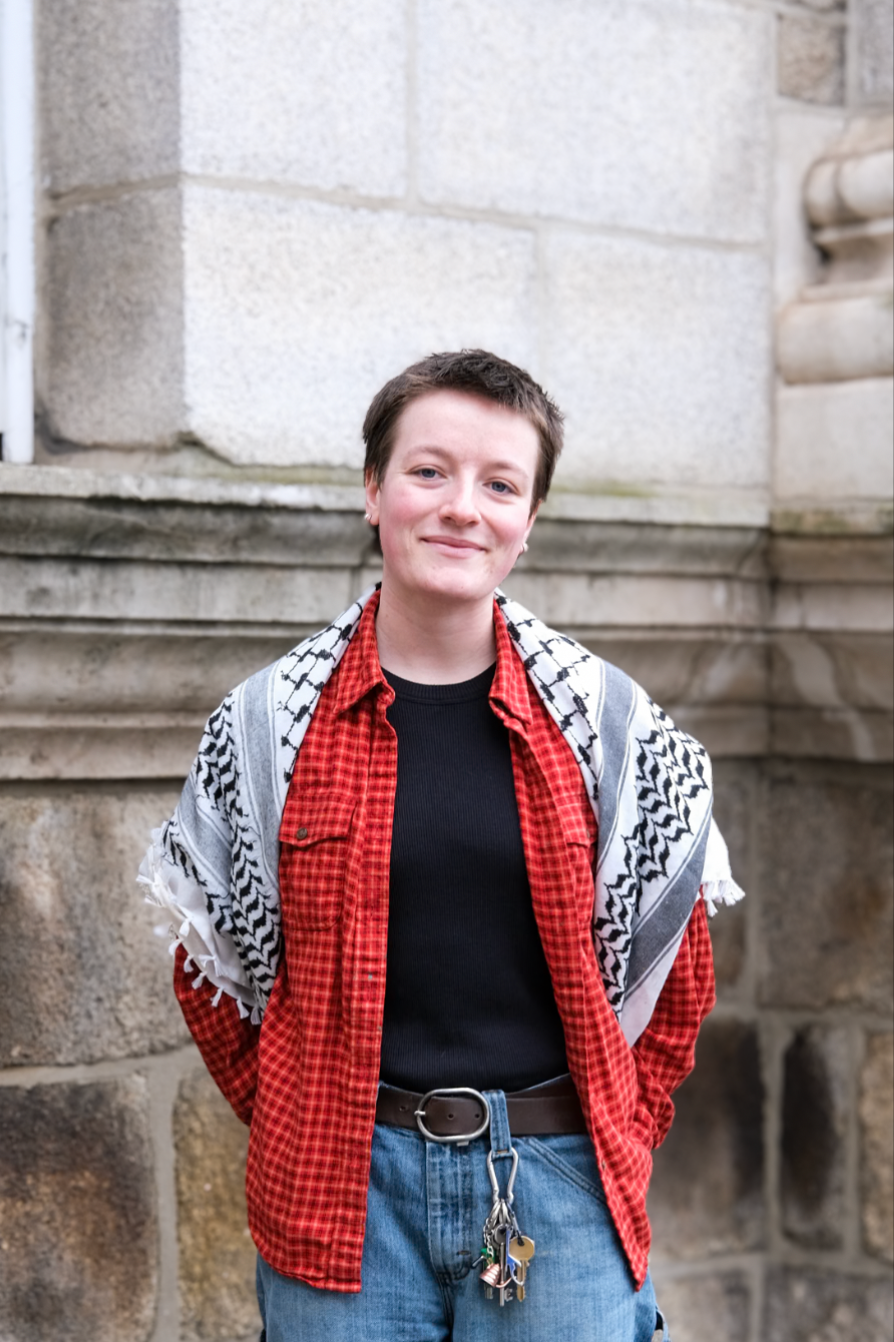
It’s 6pm on a Friday and the arts block is deserted except for a few stragglers coming indoors, shaking out their umbrellas from the rain. I assure Lorenzo Cheasty, a final year Law and History student, that I won’t keep him for long but he smiles and says “take all the time you need”. He is eager to discuss his bid for the Trinity College Dublin Students’ Union (TCDSU) bye-election presidency.
“Students need a united union that provides student welfare supports now”, Lorenzo told The University Times. “With the critical moment that the Student Union is at, with the president’s resignation, with the effigy campaign looming over the Union, and with a lot of uncertainty and a lot of critique weighed at the Union, and the complete lack of regard and lack of provision in terms of student welfare, I think that now is the moment where the fate of the Union diverges.”
Seán Thim’s resignation as president came as “quite a shock” and the prospect of running did not occur to Lorenzo initially. “I took a few days just to think about the whole situation”. He reflected on “the position the Union is in right now” and “the public’s view of the union”. He felt concern over “divisive candidates […] candidates who led the resignation campaign” as well as candidates in support of the Freedom for Students movement, which seeks to implement an “opt in”, a policy to make the student contribution fee, included in our college fees, and which funds the TCDSU, non-compulsory. Lorenzo opposes this. Such a move would “diminish the union’s existing capacity and potential capacity to administer welfare supports and advocate for further provision and further accessibility to college for students from disadvantaged backgrounds, and students in general, because everyone is facing this cost of living crisis”.

“Seeing the candidates, and envisioning what sort of union it would be underneath them […] did shape my decision to run.” He would like to see “a united union being pioneered”, one that “zealously advocates for student resources, that isn’t afraid to use direct action to advance student interests and advance accessibility to college”. An SU that is “stable, but also works at every level for students and student aims”.
Lorenzo cites his personal background and previous experience as TCDSU Housing Rights Officer as reasons for his suitability. “As a Trinity Access Program student who entered [Trinity] through the HEAR pathway, and as someone from a socio-economically disadvantaged background, welfare supports, and accessing College, has always been a visceral issue for me. And it’s something I can see very clearly is being failed by the union”.
As Housing Rights Officer, Lorenzo has helped other students access accommodation, accommodation provisions, and their housing rights. Last summer, he instituted the Lease Transfer Scheme “on the part of the Accommodation Advisory Service” to allow students who have leases for the entire academic term but may be going on exchange for one semester “to transfer their lease, or the other portion of their lease, to a student who is in the opposite predicament”.
“Assisting students on a level where I can really see it matters, I think those are the skills that a president needs, and the perspective that a president needs to have”.
Aside from his role as Housing Officer, Lorenzo has also spent over three years volunteering with the Trinity Access Program. “I’m at every pre-uni event getting socioeconomically disadvantaged students introduced to the union, showing them around, getting them inspired about the great potential that college has to meaningfully change your lives”. He also gives campus tours to students from DEIS secondary schools and sees such experiences as vital in regards to the presidency “because it’s easy to be so disconnected from the realities of students, and that’s not what we need. We need a union who is deeply involved with student concerns, and a union who wants to ameliorate student concerns by any means necessary and any ability at their disposal”.
One of Lorenzo’s main concerns is accessibility. Last year, he launched a campaign to block the Law School’s attempt to “take away lecture recordings, to revise their policy on it”. Lorenzo’s campaign “thankfully” culminated in the Law School maintaining their original policy, “where all students have access to their lecture recordings” so that those who have long commutes into college or additional responsibilities do not miss out as a result.
Lorenzo also plans to tackle “the impact of food insecurity on students” through the implementation of a “social supermarket”; “a student-led, student-run enterprise that is administered by the union where students could go” to buy food and products for free or at a “very low cost”. These have already been instituted in other countries, such as Belgium and France, to great success. “There is a lot of precedent on these enterprises working very well”.
Lorenzo also wishes to establish “proper procedures in terms of union reform”, a code of conduct for union officers, and an ethics committee to hold student union officers accountable, “to guide behaviour and make sure severe violations of student welfare aren’t condoned”. Lorenzo wants to signal to students going forward that the union is “fundamentally in line with student values and student welfare, and that we are deeply concerned about assisting students with accessing education and [with] their general welfare while they’re here at college”.
“I’m not thinking about the stress of the role too much right now, I’m not thinking about the public scrutiny aspect. I’m thinking more about what could be possible in a union that’s devoted to ensuring affordability for students, that’s devoted to breaking down these barriers to education, and that’s devoted to ensuring that the college takes due regard for a wide variety of rights and implements changes that are needed, in terms of Irish language rights, in terms of [abortion provision] and further access to contraceptives, in terms of postgraduate inclusion.”
Lorenzo sees the work of the SU and previous president Jenny Maguire in fully divesting from Israeli universities and companies as “one of the most hopeful things that has come out of the union in recent years”.
After college, Lorenzo is considering a career as a barrister in public interest law. “Litigation has a huge potential to assist students”. An example of this is the case that former SU President László Molnárfi and Threshold took to the Residential Tenancies Board (RTB) to overhaul Trinity’s paternalistic overnight guest policy. This gave students “much more housing rights than they previously had. So I think litigation is a great strategy”.
Lorenzo stresses that ultimately “everything needs to be tangible and needs to be in line with student welfare. It needs to be thought out, it needs to be planned, and we need to make sure, at every stage, that we are working for students”.