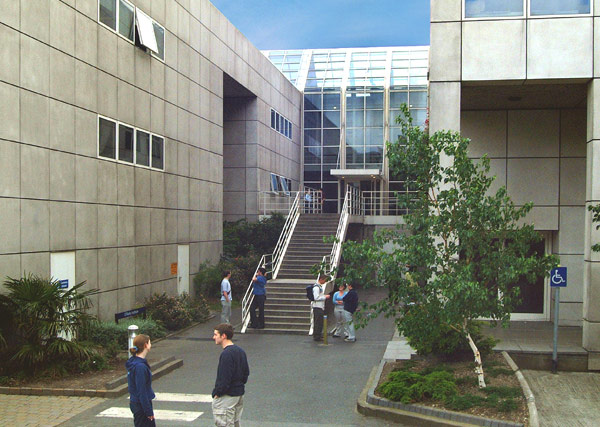

Hustings were opened at 6:05 pm in the Joly Theatre in the Hamilton Building by the Chair of the Electoral Commission (EC), Bailey Armstrong. Armstrong welcomed candidates, alongside Aaron Groome, Chair of the Oversight Commission (OC). Armstrong advised candidates that they would have four minutes at the start to give speeches, followed by questions from the two co-hosts, where candidates would have 90 seconds to respond. She said she was hoping for “fun and good debate”. The candidates for Trinity College Dublin Students’ Union (TCDSU/AMCLT) president are Jacob Barron, Lorenzo Cheasty, Grace McNally, and Callum O’Kelly. Barron was absent from the hustings. When asked by The University Times why Barron was absent, Armstrong said that he had “prior commitments”, and subsequently said that candidates were advised of hustings on “Tuesday of last week and at the campaign meeting”. Armstrong said she was not sure when hustings were “publicly” announced, though it seems that they were announced via Instagram story post on the TCDSU/AMLCT Instagram about two hours before the event.
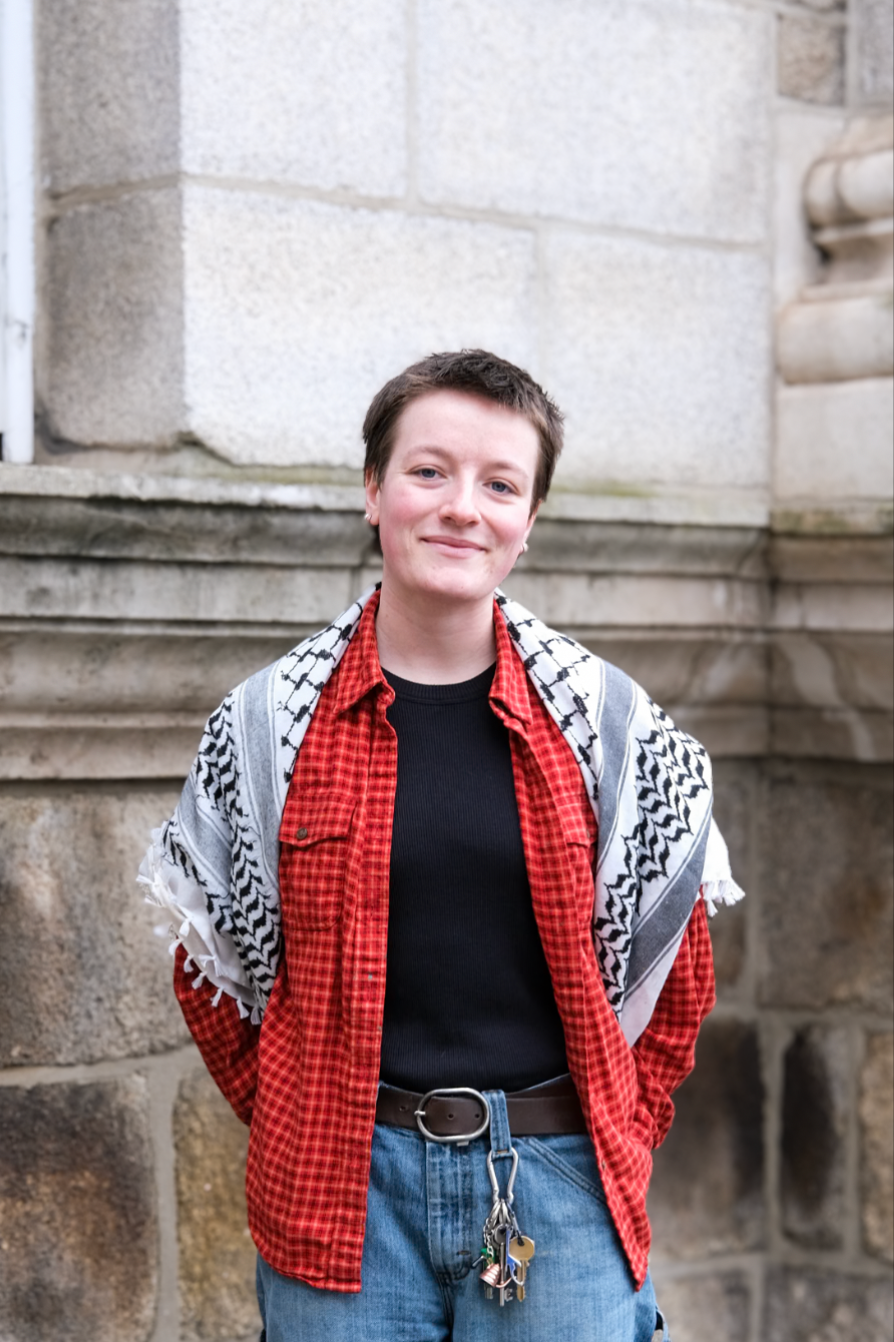
The speeches opened with Lorenzo Cheasty, a final year Law and History student, who is currently TCDSU/AMLCT’s Housing Rights Officer, the Head Photographer for Trinity News, and an Ambassador for the Trinity Access Programme (TAP). He opened his speech saying, “Our Union is divided”. Cheasty then underscored the “crisis in affordability”, specifically noting the cost of housing and cost of living in Dublin. He said he aimed to create a “united, effective, and determined union”. He said he wanted to “guarantee welfare supports and access to education”. As the current Housing Rights Officer for the Union, Cheasty said he had “seen firsthand how the accommodation crisis impacts students”, adding he had experience helping students in “finding and keeping accommodation”. Ceasty also mentioned the “lease transfer scheme” he created in his role, allowing students to transfer leases while on Erasmus or otherwise in need of shorter-term leases. He highlighted that he wanted to “introduce a subsidised accommodation programme like DCU”, and “work to establish a social supermarket like those already in France and Belgium”, in order to “help reduce severe financial strain”. Cheasty also said he wanted to create a “cooperative housing programme run for and by students”. He pivoted then to express frustration at the “complete lack of provision of abortion and contraceptive services”. He then briefly touched on postgraduate integration, expensive Laundry services on campus, and “lacklustre Irish language provision”. He said, “We need to make sure our union is functional”, specifically citing resignations, controversies, and constitutional breaches in recent years. Cheasty said he wanted to “reform how the union operates”, by introducing a “mediation process and code of conduct for union officers” to create “a culture of cooperation and accountability”.
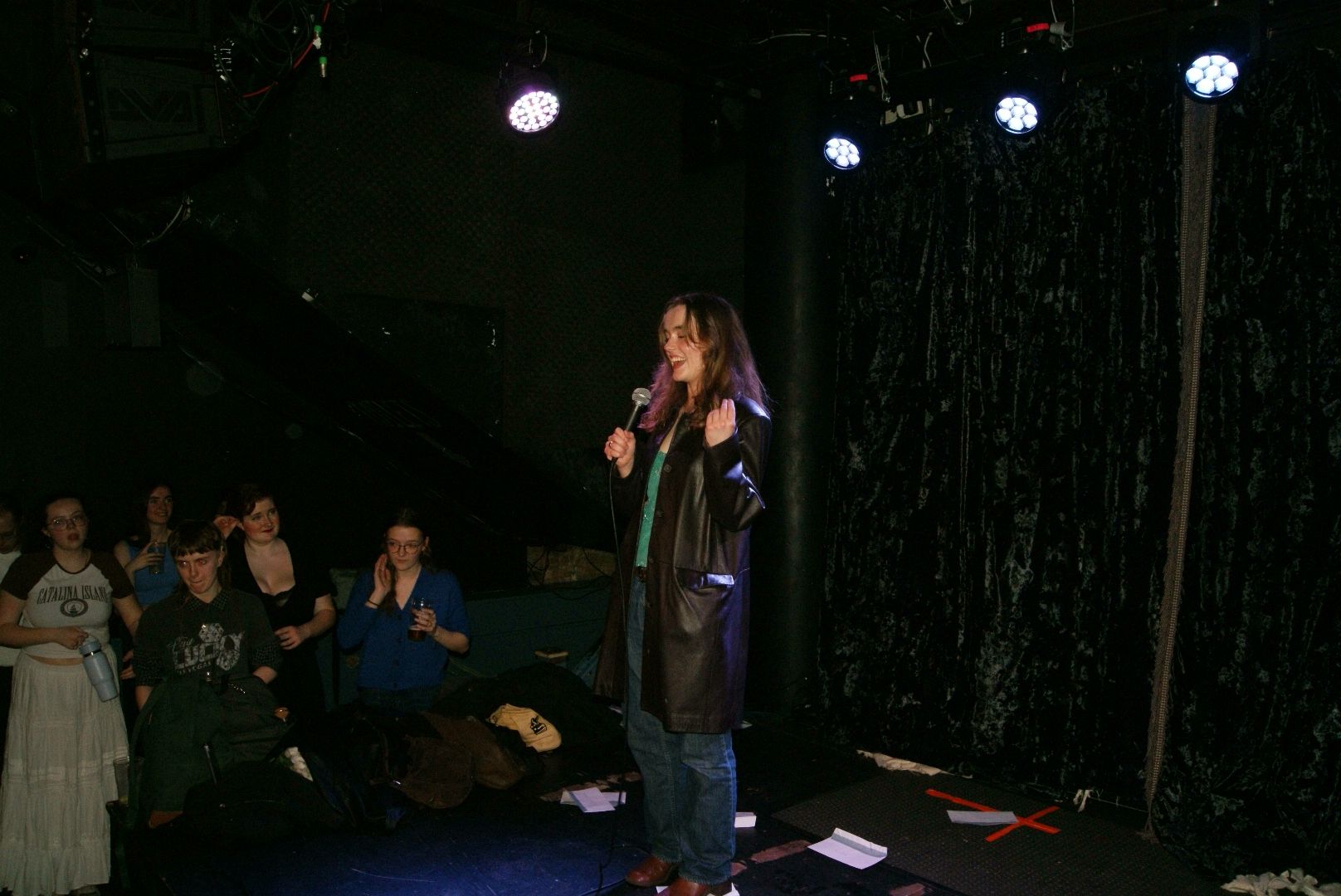
Grace McNally spoke second. McNally is a third-year Nursing student and the current Health Sciences Convener for TCDSU/AMLCT. She is also on the Trinity Boycott, Divestment, and Sanctions (Trinity BDS) committee. Her speech began by discussing her situation last year: without accommodation and on the verge of dropping her course. This was when she first reached out to the Union for help. Soon after, she described organising her first protests. She outlined her platform on the values of advocacy, empathy, persistence, and underscored that she recognised that systems were “broken” and students “were fighting just to be heard”. She reiterated how, as a Nursing student, she was taught to show up for people and to “turn care into action.” She highlighted her activities so far, with 12-hour shifts at St. James’, meetings, and her role as convener. McNally also explained that she recognised what happens when the Union “doesn’t show up” as someone with a hearing impairment and dyspraxia who couldn’t have a LENS report because she was unaware of its existence in her first year. McNally said she wanted to establish and run a Union that has a clear direction and continues its promise of divestment over a Union that “worries about looking good”.
Callum O’Kelly is a second-year BESS student and the current business manager for Trinity News, and spoke third. O’Kelly put forward his message of affordability and continuing the work of building the student movement. O’Kelly promised “a Union that fights to win,” repeating his five point plan to “End the Squeeze” by providing €4 lunches (currently, a toastie at the SU Cafe is €4), making professors accommodate more for working students, ensuring all course materials are free to access, giving more cheap accommodation to TAP students, and continuing the Union’s commitment to BDS by taking over college vending machines and replacing Coca Cola products. When O’Kelly was asked about not previously holding office in the Union and his perceived limited experience in campaigns, given that the president is the Chief Campaigns Officer, he said, “I’m not going to stand here and try to bullshit you. I’ve tried, but I ultimately haven’t been able to.” He said, “As a student, I am also a full-time worker. I work three days a week, and at night I run every side hustle I possibly can”. He added that he hadn’t “been able to get as involved as I would like to”. Continuing, “that’s why in my manifesto I put forward a plan to get more students involved in campaigns as they are struggling to make ends meet”. He said, “I am a TAP student who came to this college in awe of the college itself, and I’ve had to work to be here. That’s why I haven’t been more involved.”
When asked about the manifesto point that she would like to achieve the most, McNally said “hidden fees”, seemingly referring to her push for “Cost of Living Packs that are means-tested by course, recognising that some degrees come with higher unavoidable costs” according to her manifesto. At the hustings, she mentioned lab coats and exam materials.
O’Kelly said his €4 lunch policy, which he thinks will bring tangible change into everyday life for college students.
For Cheasty, “It would have to be the social supermarket”. He called his plan “very feasible, very productive” and said that “a lot of research went into it”. He said the plan, if executed, would be “a beacon for other colleges”.
When asked how she would “refocus” the union after the past few years’ string of resignations, McNally remarked, “Resignation shouldn’t be viewed as a bad thing,” and wanted to encourage sabbats to utilise the mental health services that the Union has fought to get put in place. She also highlighted the need to advertise more the services and supports that the Union offers, returning to an earlier anecdote of her own struggle with burnout that the Union was able to help her work through.
When asked about her involvement in The University Times’ article on union officers calling for the resignation of former President Seán Thim, McNally said that she “came from a professional place”. She cited reports from the OC, routes she had gone through the Union to resolve the issue, and multiple conversations with both Thim and other sabbatical officers. She said she “felt like [she] had to speak out”. She commended Thim for stepping down and “prioritising themself”, adding that she did not know about the mental health element at the time. She also said that the former president had broken the Constitution and mandates.
When asked about resignations within the union of sabbatical officers and part-time officers, O’Kelly said, “The Union focuses too much on the Union itself and not enough on students… our biggest priorities are the safety and quality of life for our students.” He noted the warm room, which he called “sweltering”, and contrasted that with “freezing your balls off in the arts block”. He then said he wanted Trinity to get thermostats “that actually work”.
When Cheasty was asked about how his proposed code of conduct and the creation of an ethics committee would be structured, and how it would differ from the OC and the Board of Trustees, he said, “These are things that are wholly absent from the Union”. On the OC, he said, “The OC investigates constitutional violations” among other duties. Cheasty said there was nothing for “violations of behaviour, for union officers who commit disgusting acts outside of work, or are unsure about how to conduct themselves day-to-day, a code of conduct would be quite helpful for those who don’t know how to behave”. He added that “an ethics committee would make sure this is a fleshed out proposal” and “make the code of conduct actionable”. He ended by saying that he wanted to make sure that “union officers are prioritising welfare, not hurting students”.
Moderators then asked McNally about the feeling of isolation that many TAP students feel coming to College and the pressures which are put onto them by their circumstances. McNally said that she empathised with them as a health science student, saying that her course is generally ignored by the Union and, because of its geographical isolation, is rarely thought of by the student body. This was tied into her previous answer regarding mental health and the need for vulnerability in leadership, alongside proper communication of what services can be availed of.
When asked about the feasibility of his manifesto points, Cheasty said, “We need to show students that we deeply care about tangible change and reforming the union.” Adding, “we need to focus more on bread and butter issues, the cost of living, housing difficulties, and the day-to-day struggles students face.” He again highlighted his social supermarket plan, saying, “a social supermarket is very feasible and has been done in many jurisdictions”, saying there is a “food excess in Ireland”. He said this would “really help with student welfare, and show students we are deeply concerned with their day-to-day life.” Adding, “same with subsidised accommodation”, citing the TAP survey where he said “34% of TAP students said they either didn’t apply for or turned down on-campus accommodation Trinity offers because it was too expensive.” He said “Do it like DCU and give students a fighting chance”. He finished saying, “We need to make the union a comfortable environment, with a code of conduct, equitable dispute resolution, and better procedure”.
Cheasty was then probed about the funds for his plans, specifically the supermarket. He said, “the unique thing about my proposals is that they are already fleshed out”. He noted that the supermarket had already been pioneered in France and Belgium. He added that “there’s already so much food excess that could be redirected to the students’ union”. He also said “subsidised accommodation does not cost that much”, discussing “The cost price of running it minus utilities that students still pay”. He also said, “Cooperative housing is very cheap, cheaper than what we have at the moment”.
When Cheasty was asked why it was necessary to be president instead of Housing Rights Officer to fulfil his manifesto, much of which focuses on housing, he said, “The role of the president is ability, cohesion, and campaigning”. He said on the subsidised accommodation scheme that “my vision is one where we can stage campaigns and hold the college accountable, not only to lessen the price of accommodation, but new accommodation subsidies through our well-crafted plans”. He said this could not be done, but “just a student”, and it required “the [whole] sabbatical team”, and it was necessary to “dedicate a full work day”. He said there is “currently little inter-collegiate cooperation [and] no rights signposted to students”. He added that this was “much more possible and feasible in the capacity of president”.
O’Kelly was also asked about the feasibility of his manifesto promises, and specifically his proposal for €4 lunches, which his manifesto provides no plan for achieving. O’Kelly promised to start a campaign to pressure the college, and stated that he did not want the Union to be subsidising meals, but rather that the college should be expected to provide more affordable meals itself.
McNally was asked by the moderators about her manifesto’s prioritisation of health science students. She said she disagreed with the characterisation and that her manifesto “reflects all students”. She added that some points refer to certain areas sometimes, but “reflect all students in terms of cost of living and solidarity”. She also said that the issues facing health science students are unique and that they are neglected disproportionately.
McNally was then asked about her manifesto commitment to “create a campaign around reforming DR&C (Dignity, Respect and Consent), and the sexual misconduct policy” and its relation to last year’s controversial effigy campaign, which led to the censure of then-president Jenny Maguire and then-Welfare & Equality Officer Hamza Bana and impeachment recommendations from the OC. McNally defended her commitment, saying that she had learned from the campaign’s mistakes and intended to listen to students about the sort of actions that they support.
When asked about the Irish language, O’Kelly pitched a plan to turn one building in college into a mini-Gaeltacht, to make the language more relevant for all students. He said this should be paired with more Irish lessons and a greater emphasis on cultural events. He also said he would “look forward to working with the Irish language officer”. This is, however, not in his manifesto.
Cheasty spoke about postgraduate students and said, “A lot of change has already been pioneered, the referendum on postgraduate integration has already been carried through”. He said there needed to be a dedicated officer space, and said “the watershed moment has happened, the change is on the horizon” and “I would like to vehemently push not just for inclusion and practice, but also getting representatives to reflect that”. He finished saying, “I would do a great job representing postgrads and getting them involved at every level of student life”.
Hustings concluded just before 7pm. Voting will open at 10am on Wednesday, the 26th, and close at 4pm on Friday, the 28th. Polling locations will be in the Arts Block and Hamilton building, with polling also available at select times in TBSI, St. James’s, and other locations throughout the week. Voting will also be available online.