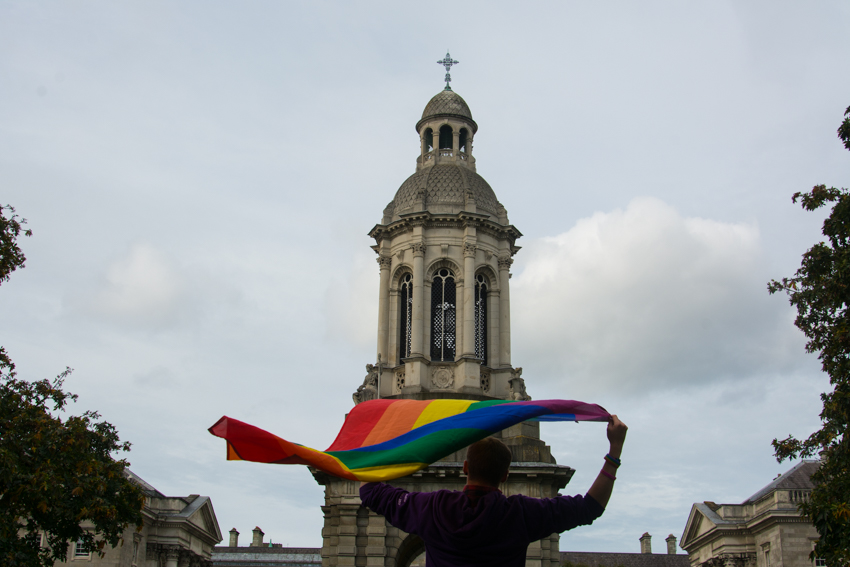

Over the last five years, I have been an advocate for the LGBTQ+ community in the areas of mental health, education, youth participation and digital rights. This has landed me into high places and into discussions with both high level dignitaries and more importantly, young people who, despite having grown up as queer youth in a country which protects gay marriage and the trans community, face obstacles on a daily basis because of their sexuality. I have seen at the coalface the issues affecting LGBTQ+ youth, and this has resulted in me making many observations. I can only comment on my experiences and as such can only speak for gay youth, but many of these issues are felt by all members of the LGBTQ+ community.
When speaking with young people at events, an issue which often comes up is the intersectionality between sexual orientation and identity.
In 2022, I was invited to the UN to speak at the Transforming Education Summit, I garnered a lot of media attention, and this led to many people reaching out to me. From private phone calls with people working in media to concerned mothers over Instagram, they all came to 17-year-old me begging for answers. They mentioned their children, who were questioning their sexuality, but also their identity. There was clearly fear, confusion and uncertainty.
The idea of the binary has set us back for millennia. The notion that you are either a man, and boast all the characteristics that your stereotypical male would have, or rather a female, with all of the connotations attached to femininity, does society no favours. The fact of the matter is that I have seen first hand that so many young people have questioned their gender identity due to this disconnect from a falsified idea as to what gender and self expression are. Many queer youth have questioned their gender when really they were just more flamboyant men or more tomboyish women. This hyper fixation on the binary shuts off an avenue for people to understand who they are.
This in no way negates the validity of someone questioning their gender. Self-questioning is so important, as this period allows for young people to discover their gender identity, and explore what it means to be non-binary or trans. However, the toxicity surrounding the binary forces mental anguish among many people, young and old. If we lived in a society removed from Andrew Tate and the manosphere, and misogynistic expectations of women, perhaps society would be that bit happier?
In June 2025, I was invited to speak with an LGBTQ+ support group at a global consultancy firm where I discussed the media’s illustration of queer youth and its societal implications. Speaking on a personal level, when first introduced to the idea of gay people in the media, I believed that they could either be as masculine as they come, coincidentally happening to be gay, or rather that they were the campest creature to ever walk the earth – not to mention them being hypersexual, with their raison d’être being to have a quickie with the captain of the football team in the forest after dark. And how do you think that benefits young people during their adolescence?
One attendee at the event mentioned to me that he told himself he was not gay for many years. His reason for doing this was not out of toxicity or discomfort with the idea of being gay; rather it was because he did not know any gay people and the characters he saw on television did not resonate with him in the slightest. This is not a standalone incident.
Furthermore, this association of being queer with certain personas inhibits the independence of sexual orientation from stereotypes. It also creates a goal for young people – to act in a certain way or portray this character originally promulgated by heterosexual, male producers in Hollywood. I can most definitely speak from experience that when you are a gay teen in the closet, it is a case of monkey see, monkey do. When I first came out, I was treated differently. I gained a lot of attention from people who did not care about me before. Perhaps this is a different topic, and that we should discuss how to treat people when they come out – something which I have repeatedly done over the last five years.
But the issue at hand here is that due to the inaccurate depictions of queer youth in the media, I felt obliged to take on this bitchy persona – in line with the ‘mean girl’ gay, now known as the demon twink. It did not last very long. 13-year-old me realised that I don’t have the backbone for this attitude.
All of this could be easily avoided if we changed the idea of representation to ensure that queer persons are being accurately portrayed in the media. It is time to stop treating queer people as alien creatures. The truth is that there are certain traits which are more commonly seen in the LGBTQ+ community. Whether this is down to nature or nurture is unknown, but also irrelevant.
Your sexual orientation relates to who you are attracted to, not the clothing you wear or the way you act. There is no need for inorganic personas to be promoted to queer youth. Let us stop creating this narrative that queer people are sex addicts and are the next generation of Regina George.
Representation of any minority group is the first step to destigmatisation, and with an increased push, this can happen. Don’t get me wrong, media representation is vital, but what is the point of it if it is ineffective? If it results in people trying to live up to a stereotype or if it conforms to pre-made conceptions of what a queer person is, it would be more favourable to have no visibility in the first place.
Over the last five years, I have seen it all. The same burning questions coming from ministers to members of society. We are all walking in the unknown. The vast majority of people I have interacted with have been well intentioned and are dying to know the answers on how to support their loved ones. Who knows the answer? That is unclear, but what is evident is that the stereotypes perpetuated through the media are nothing more than damaging for some of society’s most vulnerable people.
We have come a long way. Arguably, society has taken a step back in the last 18 months, but we cannot lose sight of the common goal – creating an inclusive society for everyone. If we want to see change, the media needs to stop compartmentalising queer youth. It is time to rethink how visibility is showcased, and the impact that it has on its target audience.