“Free speech” has cropped up at Trinity this year in two places that are worth paying attention to: as event branding, and as a recurring reference point in student politics. That combination is what makes Students for Liberty (SFL) and the recent Free Speech Forums worth examining, not because it necessarily represents the median student view, but because it helps shape how certain campus disagreements get framed.
SFL describes itself as a “pro-liberty” international student organisation that selects volunteers and provides leadership development training as part of building a global network of “young leaders passionate about liberty.” Its model tends to translate into campus activity that is easy to repeat and easy to scale: tabling, discussion nights, and “open forum” formats. Those formats don’t need a large, stable membership base to continue; they rely on continuity, recognisable branding, and organisers willing to keep running them.
This year, the link between organising and campus politics became more visible because it overlapped with Students’ Union campaigning. In his SU Presidential bye-election manifesto, Jacob Barron describes himself as “the head of the Irish chapter of European Students For Liberty”, and says he helped organise “3 events focusing on promoting free speech on campus this semester”, including one for SFL called “Trinity SpeakEasy” and Free Speech Forum events, organised with friends. The University Times also reported that Barron “recently became a local coordinator for Students for Liberty.” The point of mentioning this isn’t to reduce the forums to electioneering, but to note that once an organiser is also a candidate, the events stop being just another optional entry on the calendar. They become part of the public context in which campus leadership and priorities are discussed.
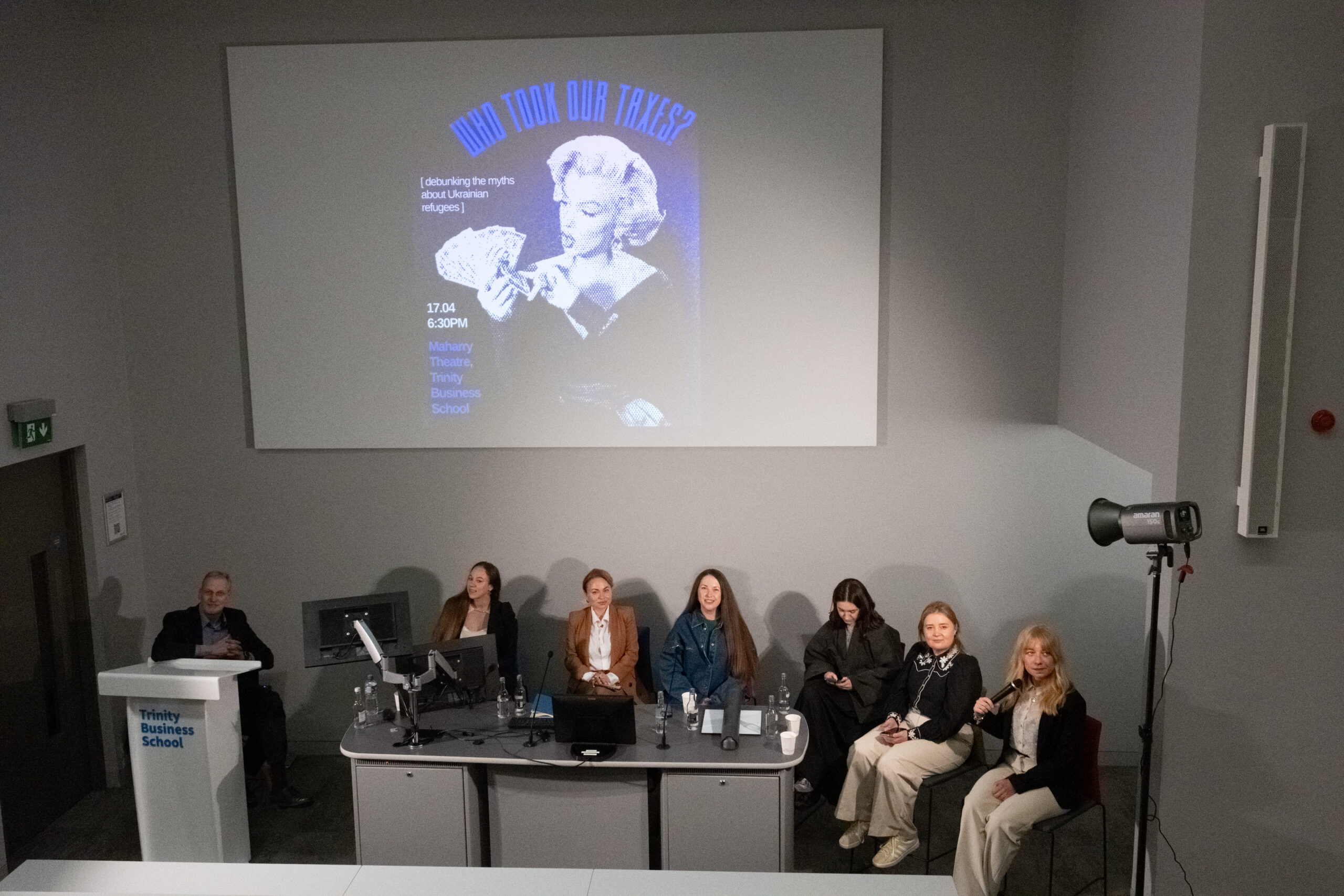
Across this year’s Free Speech Forums and “SpeakEasy” promotions at Trinity, the content is consistently framed as open, audience-driven debate rather than formal speaker programming. Posts describe an “open Forum for discussion and open debate”, similar to the SpeakEasy, and pitched as a space to talk through free-speech questions in Ireland, Europe, and beyond. The themes advertised lean toward flashpoints where speech, protest, and public order collide. Most clearly in a Trinity Free Speech Forum night billed as “What are the Limits of Protest? From Palestine to Patriotism”, which frames the discussion around whether recent Palestine and immigration protests/riots have “gone too far” or are “the only” way to be heard. Even the tone of the marketing (“FREE WINE,” “HOT TAKES”) signals the intended format: informal, provocative, participation-heavy discussion, where the point is less to resolve a question than to test what different people consider legitimate protest and legitimate speech on campus.
So what does “influence” mean in this context? The cleanest split is between participation influence (attendance and membership) and agenda or institutional influence (whether a group becomes a recurring reference point in wider disputes). Participation is hard to infer from the outside. Agenda influence is easier to spot: by November 2025, Students for Liberty was salient enough to appear in a Hist bye-election hustings question, where Barron was asked about association with “the Koch-funded Students For Liberty organisation”. A moment where the label is being used as shorthand in a broader argument about credibility and campus politics.
In that sense, the “free speech” frame rarely stays contained. It tends to pull debates about speakers, protest, and institutional decision-making into a single underlying question: who gets to set the boundaries of campus discussion, and on what grounds?
The risk, for everyone, is mistaking attention for deliberation. “Free speech” branding often invites a moral shortcut: either it’s brave and necessary, or it’s cynical and provocative. But there’s a more structural possibility: campus “free speech” events can become attention engines because controversy is one of the easiest ways to generate visibility. If the loudest disputes get the most engagement, then “success” can start to be measured less by the quality of discussion and more by the volume of reaction.
That’s not a critique of any one group; it’s a critique of a wider campus discourse ecology where complex questions about the likes of speech, protest, welfare and organisational legitimacy get flattened into binaries: free speech versus safety, moderation versus activism, open debate versus bullying. That instinct to compress complicated issues into two teams isn’t unique to Trinity; it mirrors the broader polarised style of political argument that’s been visible in Ireland and internationally in recent years.
If “free speech” is going to be more than a slogan, it should leave behind better rules for arguing, not just better reasons to argue.
— CORRECTION Monday September 15th, 7:55 PM —
The original version of this article described the Free Speech Forums as “SFL-backed” and conflated the two organisations two other times, once in the opening paragraph by not separating the two groups, and second describing them as cohesive under the “three events” mentioned above. The content of the article now reflects the change.