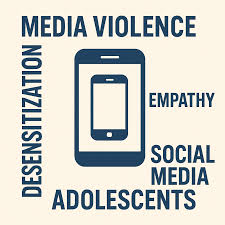

Just the other day, when I pulled up to the Arts Block – coffee in hand, ready for yet another day of discussing the same three events like my life depends on it – I was met with quite somber expressions on the faces of my friends. The following dialogue ensued: “Did you hear that x people died in y?” “No, that sounds awful though.” End scene. This was followed by a prompt shift in the topic of conversation, the tragic news quickly forgotten. It would be redundant and, frankly, boring to just reiterate what everybody already knows – social media desensitises us to real-life tragedy, creating content out of someone’s personal hell. It also wouldn’t be honest to approach this subject with a holier-than-thou attitude, when I know I’m guilty of watching a video of a person getting attacked and then, in the blink of an eye, switching apps to online shop. I do, however, believe that the problem of desensitising ourselves to violence and brutality should be discussed without simply dogpiling on this generation as is usually the case.
It is more than easy to scroll away when you find something uncomfortable, and this is both a blessing and a curse. Nobody wants to bum themselves out when they’re already suffering through having three midterms due on the same day. The issue, however, becomes apparent when you are no longer phased by any harrowing news coming your way through the screen. Outrage has an expiration date. It is a sad truth, but a truth nonetheless. For years now, researchers have related exposure to violence as a source of desensitisation. Studies have shown that youth who grow up with violence are likely to deem it as normal – the bigger and scarier something becomes, the less frightening it appears to us.
Whilst preparing to write this, I stumbled upon a University Times article from 2021, which I cannot help but disagree with. (https://universitytimes.ie/2021/12/the-myth-of-social-media-and-desensitisation/) The author argues that while desensitisation does exist, it is entirely blown out of proportion, since we are currently witnessing an enormous rise in protests and boycotts, which clearly indicates that people do care. Yet, I believe it is fair to claim that both can be true at the same time – activism is at an all-time high, but that doesn’t take away from the apathy of the general public. If anything, I would argue that being involved in fighting for a certain cause desensitises you to it even more. You devote so much of your time to it that it becomes a challenge to take on, rather than a human tragedy.

At the same time, in an attempt not to preach pop-psychology – since I have never taken a psychology class in my life – it would be helpful to take a slightly less intellectual look at our troublesome relationship with tragedy. By now, there is likely no evil in the world that the true crime genre has not been blamed for, yet, in some way, its very contentious existence can also explain much about how we approach human suffering. There is a certain air of fascination to hearing how a tragic event unfolded from the safe haven of your bed. The author of the video might not be authorised to tell it in the slightest, but the eerie sound of their voice more than makes up for it. People love to claim that they watch true crime for “awareness purposes” but that is simply not the truth – there is a disturbing allure to being told a gruesome tale of violence, obsession, and the likes. The problem, however, is in how it is not a tale at all, but rather a human life. When a tragedy is told like a bedtime story, it decenters the real people whose lives were lost. This is exactly where desensitisation lies.
A very recent case which has received fairly little media coverage showcases this very problem. In the city of Billings, Montana in the US, a teenage girl is said to have stabbed her teacher and then herself in an alleged fit of rage over her unrequited love for him. Yet, none of the reasonings for her actions were ever featured in a news article about the case. In fact, no information has really been given at all about who the perpetrator is and what kind of relationship she had with the victim. Despite all of this, social media investigators claim to have found the girl’s TikTok account, identified her over a couple questionable reposts, and have since been theorising on her motives. Not only are none of the claims confirmed, but sensationalising the situation completely devalues the gravity of the event and the pain it caused.
It seems to me that this kind of behaviour is not a sign of people lacking empathy, but rather an issue with the way in which they approach it. The theories and speculations don’t necessarily have a malicious side to them, but instead are a bizarre amalgamation of the desensitised way in which we perceive tragedy and the simultaneous fascination with it. It is difficult to think of how to stop this from happening, other than to simply take your time with it – stop scrolling, take a couple minutes, feel the emotions, experience the outrage. I have personally noticed that when I hear about a tragic event on TV rather than seeing it posted all over my feed, I find myself sitting with it much longer, researching it and looking up the people involved in it – not in a gruesome true crime fixated way, but as if to get to know them as humans. Take a look at the legacy they left behind.
There is really no right way of approaching the onslaught of misery we face every single day. The only solution to the numbness it brings is to just continue caring, in each and every aspect of life – it’s really good for you.