
I still remember my first encounter with vampire media. I was a naive middle schooler who stumbled across their mother’s bookshelf, to be ultimately captivated by a book with a bright, red apple on the cover. That was the moment I became immersed in the misty world of the Twilight saga, where peculiar vampires with porcelain skin and superpowers hang out in the halls of a clueless school. Simultaneously, these figures found their way onto the screen with the series The Vampire Diaries, similarly set in the high school of a peaceful town. As I watched it, I could not help but notice that the vampiristic representation in these two pieces of media is, more or less, identical: attractive vampires able to go out during daylight, empathetically surviving on animal blood, and competing for an indecisive high school girl in a love triangle. Essentially, there was an intense emphasis on the beauty and mystery of these vampires and their love lives. However, what would baffle me later in life was finding out that the ancestor of this “irresistible” vampire trope is a lesbian vampire, Carmilla.
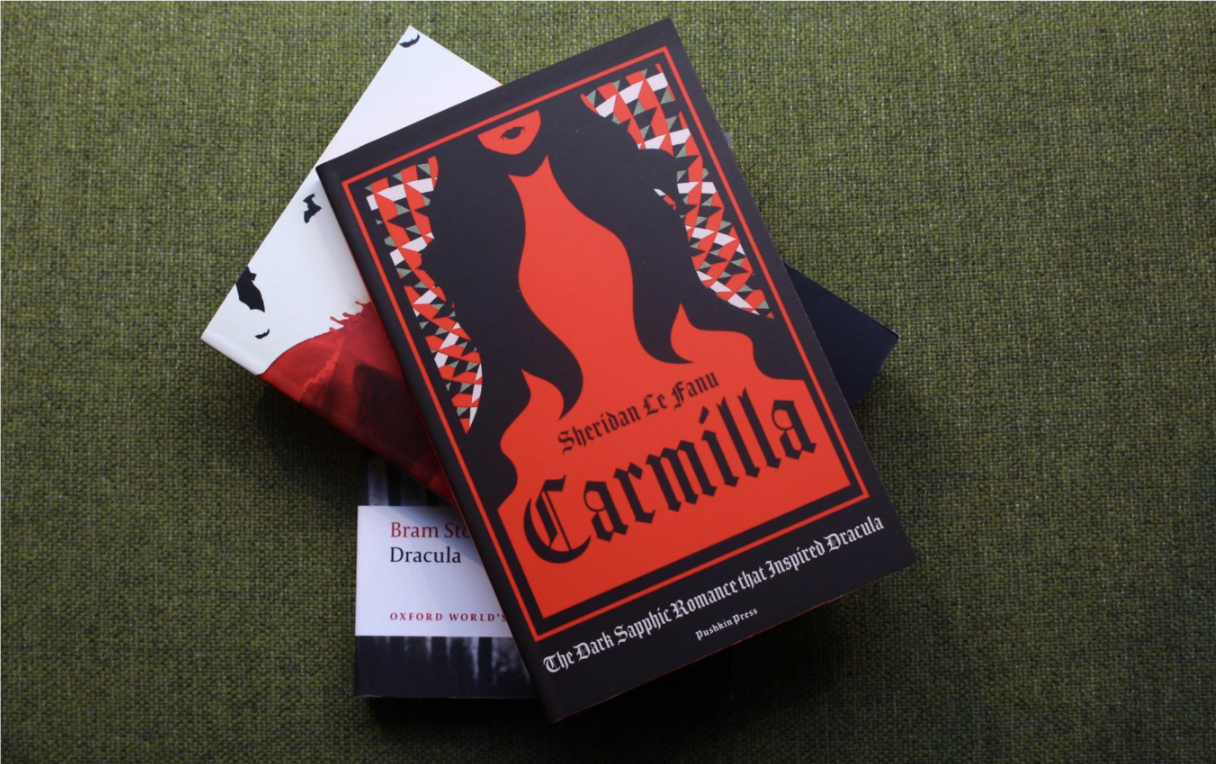
In 1872, Trinity College Dublin alumnus Sheridan Le Fanu published Carmilla, the blueprint for the mysterious, seductive vampire known today. The novel is set in a secluded, ruined castle in Austria belonging to an English family: youthful Laura, her widowed father, and two house governesses. Despite her father’s kind and attentive nature, Laura feels perpetually lonely due to the absence of friends her age. When a carriage accident leaves the charming Carmilla in the care of the English family, Laura finds her long-awaited opportunity for companionship.. During her stay, both girls develop an intense relationship, in which Carmilla throws herself into a flow of advances towards Laura. She embraces, hugs, and kisses her, leaving the girl in a flushed trance, and often chants her love to her: “I never been in love with no one, and I never shall, unless it should be with you”. Laura has nightmares of being attacked by a black cat and a blood-covered Carmilla. During these visits, Carmilla sharply bites Laura on her breast, marking the beginning of her declining health from an erotic bite. Simultaneously, multiple lower-class women in the surrounding areas fall ill under similar circumstances, yet their lives reach an end within three days.
Throughout the entire narration, Laura is incapable of understanding the feelings evoked by Carmilla’s sapphic advances, as she finds herself captivated and repulsed by her. She even questions whether she is a male suitor in disguise, given her sudden, explicit, and love-charged actions.

Le Fanu was sure to include all the characteristics that make us think of “gothic” story: a ruined castle in an isolated area, supernatural elements, women in distress, tyrannical men, the past merging into the present, and overpowering emotions. But he brought it to another level by distorting the usual vampiristic narratives of the time, instead laying the foundations for the attractive, lustful vampire character by way of a female, sapphic creature of the Victorian era. Essentially, he moved the focus from folklore vampires – bloated, decaying corpses returning from the dead to kill their family members and livestock – to seductive vampires inherently linked to sexuality and queerness. The impact of such work can be found in the novel of another Trinity alumnus, Bram Stoker, who penned Dracula in 1897, exactly 25 years after Carmilla was released. Stoker’s narration focused on Count Dracula and the agony he brought to the seaside town of Whitby, England, before being hunted down and killed. Despite the lack of romantic lingering, it would appear that Stoker was inspired by the work of Le Fanu.
I had the pleasure of speaking to Professor Jarlath Killeen, of the Trinity College Dublin School of English, about the influences and similarities between the two literary works. Firstly, they are both narrated in the first person. Secondly, they both feature aristocratic vampires whose aim is to seduce victims in order to access human blood – blending vampirism, sexuality, and psychological hypnosis. Particularly, in both works, the main predatory focus is young women. Lastly, they have the figure of “the vampire hunter” or the “vampire expert” in common, specifically a knowledgeable older male (Van Helsing in Dracula, Baron Vordenburg in Carmilla), who adopts a similar method of vampire destruction. In Carmilla, her death is inflicted by a wooden stake driven through her heart, her decapitation, and the burning to ashes of both head and body. In Dracula, the Count is decapitated and stabbed with a knife, with his body turning into dust.
Evidently, the undeniable similarities between both works of the Trinity alumni lend legitimacy to the claim that Dracula gained inspiration from Carmilla – after all, the novella did pave the way for the popularisation of the lustful and sexual vampire, specifically the female one. From a modern perspective, it is worthwhile to consider whether the novella had any impact on sapphic representation in media today. It is plausible that Carmilla played a part in the ‘Bury Your Gays’ or ‘Dead Lesbian Syndrome’ trope. In TV shows and films, queer people – particularly lesbians – face tragic fates such as heartbreak, abandonment, illness, and death, more so than straight characters. In Carmilla, the alluring vampire is killed by the older men of the town, who violently stake her “sleeping” body in her hidden coffin and decapitate her. The intent behind Carmilla’s destruction was the protection of the innocent girls at home and their recovery. Nonetheless, Laura never seems to forget Carmilla, and instead longs for her despite her father’s attempt to find a “cure”, hence feeding into the unhappy endings of queer characters. This might be the reason why some people believe that Le Fanu penned the novella as a cautionary tale against the dangers of lesbianism and female sexuality. However, many others would argue that the novella has the opposite effect. Carmilla can be seen as breaking out of patriarchal oppression after Vampirism occurred, portraying an out-of-the-closet analogy. Once she died, the obligations and notions of Victorian femininity and sexuality died with her. When Carmilla came back from the dead, she left those constraints buried and introduced herself to a “life” of freedom where she could exist free of patriarchal control, her sole focus on women and courting a specific one. Carmilla captures this concept with an insect metaphor, claiming that alive girls are like caterpillars, but become butterflies when they die. Laura, on her end, is still subject to male authority, yet deems men absolutely useless and incapable in times of need, which explains her attempts to rationalise the intensity of her feelings for Carmilla through heterosexual spheres – questioning if Carmilla is a man – and her simultaneous attraction and repulsion towards the vampire.
Ultimately, popular perception views the novella in a positive light regarding its lesbian representation by Le Fanu, as it conveys a lesbian desire and magnetic attraction that transcends heterosexual norms. And all in all, we may thank Carmilla for laying the groundwork of the seductive vampire trope that exists today.