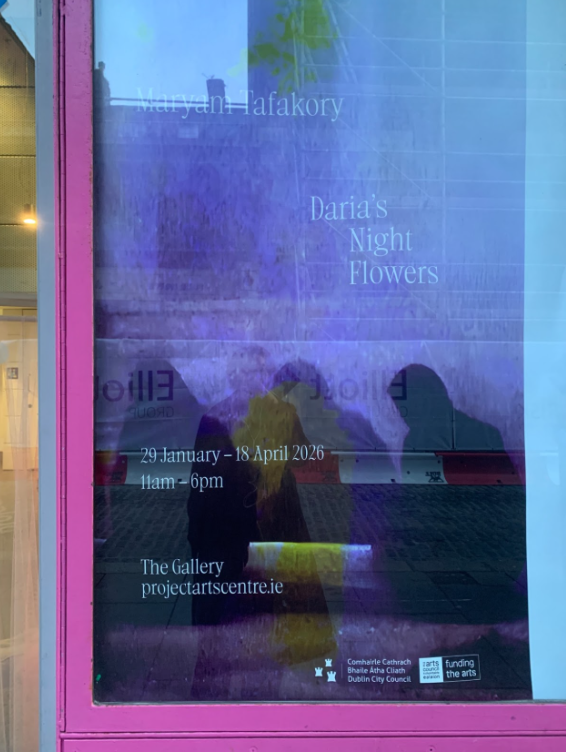

Turning onto Temple Bar’s cobblestone streets, and walking towards Heuston Station, you will find the Project Arts Centre waiting on East Essex Street. Inside lies Daria’s Night Flowers, the recent 15 minute short film from Iranian artist-filmmaker Maryam Tafakory. It is a free walk-in event, running non-stop every Monday to Saturday from 11am-6pm until April 18th. There are also accessible versions playing for those who need it, with a panel outside to adjust the volume to your liking, and narrated versions playing every few screenings.
Tafakory’s films have been widely exhibited, at the Museum of Modern Art (MoMA), Museum of the Moving Image, the Tate Modern and a litany of other galleries, as well as screened at Toronto International Film Festival (TIFF), New York Film Festival (NYFF) and the BFI London Film Festival. Her short Razeh-del (2024) won six Oscar-qualifying prizes, and she was awarded the Locarno 2025 residency and the 2024 Film London Jarman Award. It is refreshing to see the work of an Iranian woman filmmaker who explores women-centric stories being celebrated globally, given the worrying lack of female perspectives in post-revolution Iranian cinema.
In Daria’s Night Flowers, Tafakory’s fictionalised narrative voice-over interweaves with her choice of footage from archives, poetry, and an illustrated book of plant lore, creating a story about censorship, memory and quiet resistance. There are over 20 archival media used in this piece, ranging from Bahram Beyzai’s Killing Mad Dogs (2001) and Mohsen Makhmalbaf’s Gabbeh (1996), to David Attenborough’s The Secret Life of Plants (1995).

This was my first time watching this type of archival film, and I thought I would find it unappealing. If you have never seen one either, I urge you to give it a go, since you have nothing to lose by going to this event, and I believe you will leave just as enthralled as I did. My worry that it would be difficult to follow was unfounded since the narrative is surprisingly cohesive, comprising beautiful shots which are pure visual poetry.
The aural design, realised by Stefan Smith, ensures every micro sound is audible, from the crisp dripping of soap suds, to the dreadful crackle of burning manuscripts flying directly into your ears. The colours of this film are one of its highlights too, with mesmerizing yellows, purples and blues sometimes taking over the screen and sometimes just drifting in in their raw forms.
The non-linear narrative follows Daria, a married woman who writes a novel to the woman she loves about a girl called “Blue” who has the power to disappear. It is a haunting story that I will leave to you to discover, equally timeless and relevant as an examination of Iran’s current political climate. Women are facing a bitter ongoing struggle there, with their basic human rights reverted; not being allowed to travel without the husband’s permission, systematically barred from the majority of jobs, restricted right to divorce, criminalised same-sex activity, and mandatory hijab wearing. Ever since the death of Mahsa Amini at the hands of Iran’s morality police, the country has been wracked with a revolutionary spirit that was last seen in 1979. Tafakory also alludes to the issues the whole country, not only women are facing, such as the notorious morality police, conversion therapy, and the devastating effects of the Iran-Iraq war. Her command of language delivers poignant moments, like Daria’s mother discouraging her daughter from divorcing her abusive husband because “the gentle beatings of a handsome man that leave no trace will not convince any judge”.
At the time of writing this article, the US-Israeli attack on Tehran has hit the news. Daria’s Night Flowers has been made all the more pertinent, as Iranian citizens must now defend themselves against their own totalitarian government as well as foreign violence. I urge you to go see Tafakory’s short, and to support Iranian filmmakers so that they can continue to take control of a narrative which far too many voices want to hegemonise.