
Many of Ireland’s best renowned writers have hailed from Trinity College: Oscar Wilde, Samuel Beckett and Eavan Boland (to name a few) are household names and are venerated all over Dublin. Bridges, statues, buildings and plaques are designated to the memory of these artists; they are mythologised to the point where they are on par with some of Ireland’s folkloric heroes. This complacent acceptance of their legendary status – their solitary genius – has been criticised, and more attention is now being given to their influences and the ways in which their ‘image’ has been produced.
I had the pleasure of sitting down with Catherine Furby, a student who is fascinated by this very question and its application to Samuel Beckett. This semester she is taking the module offered by the English department titled: ‘Beckett’s Contemporaries: Creative Affinities with Louise Bourgeois, Barbara Bray, Suzanne Dumesnil, and Clarice Lispector.’ The aim of the class is to introduce students to writers and artists who were writing concurrently with Samuel Beckett: writers such as the ones listed in the class title.
The class offers students the opportunity to analyse how male writers are raised to a ‘genius’ pedestal throughout their lifetimes. Furby stresses the importance of looking at different perspectives of Beckett’s life who she feels “is hero-worshipped here at Trinity”. The creative projects that have been assigned for assessment offer students the opportunity to contest his works and analyse them in the context of those who wrote around him.

Students have been given permission to use archives of Beckett’s works that are found in Trinity’s library, as well as using various audio-video recordings that have also been made available for this purpose. They were given little guidance and full creative freedom in how they wanted to approach this assessment; with some students opting for staging small productions, and others shooting short films. Furby spoke about the importance of this method and how it allowed her to creatively critique and analyse Beckett’s works in ways that the essay-format would make impossible.
Furby was particularly drawn to their analysis of Suzanne Deschevaux-Dumesnil’s
works. Deschevaux-Dumesnil (1900-1989), Beckett’s partner of fifty years, is a largely ignored figure in Beckett scholarship. She was never interviewed about Beckett, despite the fact that they worked closely together and that her works were often translated by him. Furby comments: “his work only started getting really good when he started writing in French with her.” In 2023 a collection of her works surfaced revealing a short story written by Deschevaux-Dumesnil, titled ‘The F-Story’, which resembled Beckett’s own celebrated Waiting for Godot in both characterisation and setting. It was this knowledge that prompted Furby’s proposition for her creative project.
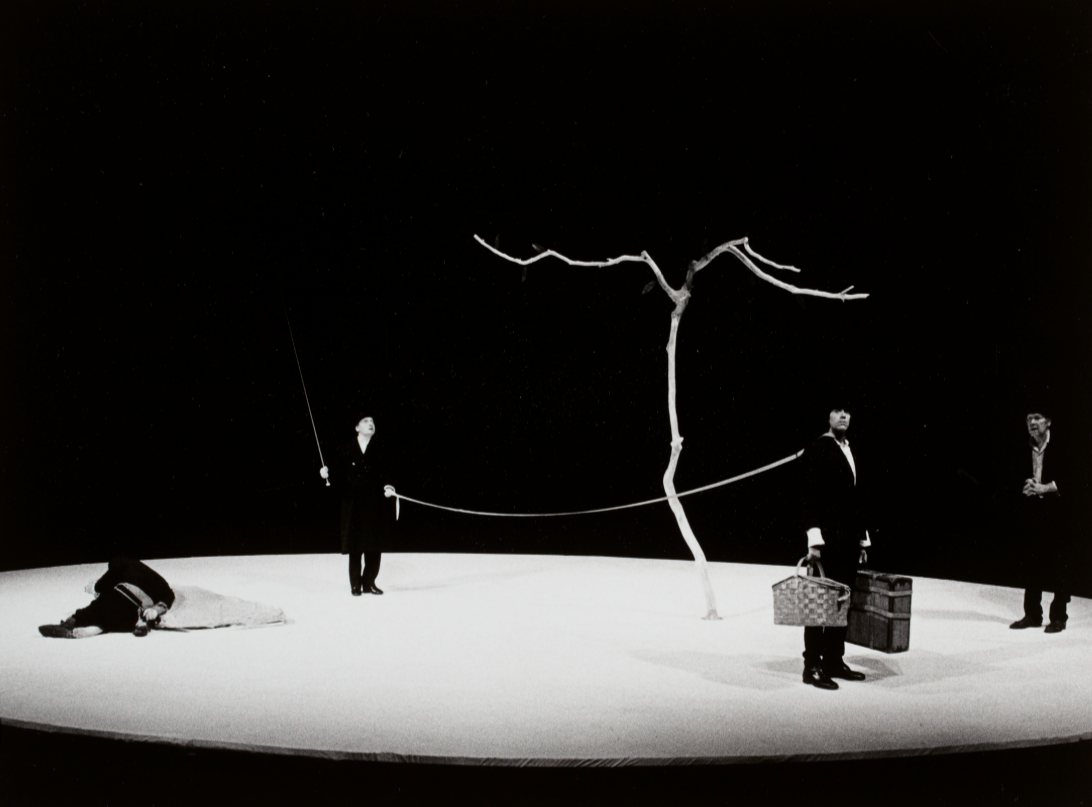
The project involved turning ‘The F-Story’ into a play. Furby takes lines from the short story and combines it with Beckett’s Waiting For Godot in order to highlight the similarities between the two. She mentions that she was “taken aback by how similar it was to Waiting for Godot. [The F-Story] was written while Beckett was working on Waiting for Godot so the date of publication on The F-Story predates Godot.” In her play, she recreates the desolate environment by having her two actors perform in a side-road in Dunboyne with nothing but a grey fence and a concrete building as a backdrop; the only dash of colour is the white of the actors’ shirts and faint green of the moss. Furby names her characters Vladimir and Estragon and dresses them accordingly, with their distinct bowler hats perched on their heads, deliberately mirroring standard practices in the productions of Beckett’s play.
However, she also includes a third character who she simply names ‘Director’, a female disembodied voice who speaks louder than the voices of the male actors. At the beginning, the characters stare into the camera as if waiting for direction. The director then reads out lines from the short story, ‘The F-Story’ that is, and both Vladimir and Estragon move based on what this ‘director’ tells them to do. Furby stresses the importance of the fact that they only begin to move after she speaks. The director discernably represents Deschevaux-Dumesnil and symbolises her role behind the ‘god-like’ figure of Beckett. Furby states that: “it’s a commentary on how she has been largely ignored even though she was probably quite influential and was even potentially the inspiration for Waiting for Godot.”
With this project, she hopes to contest this narrative of Beckett as a solitary genius and highlight the women that made his work and his literary legacy possible. Modules like this indicate a favourable turn in the way in which canonical authors are being introduced, engaged with and taught in university curricula.