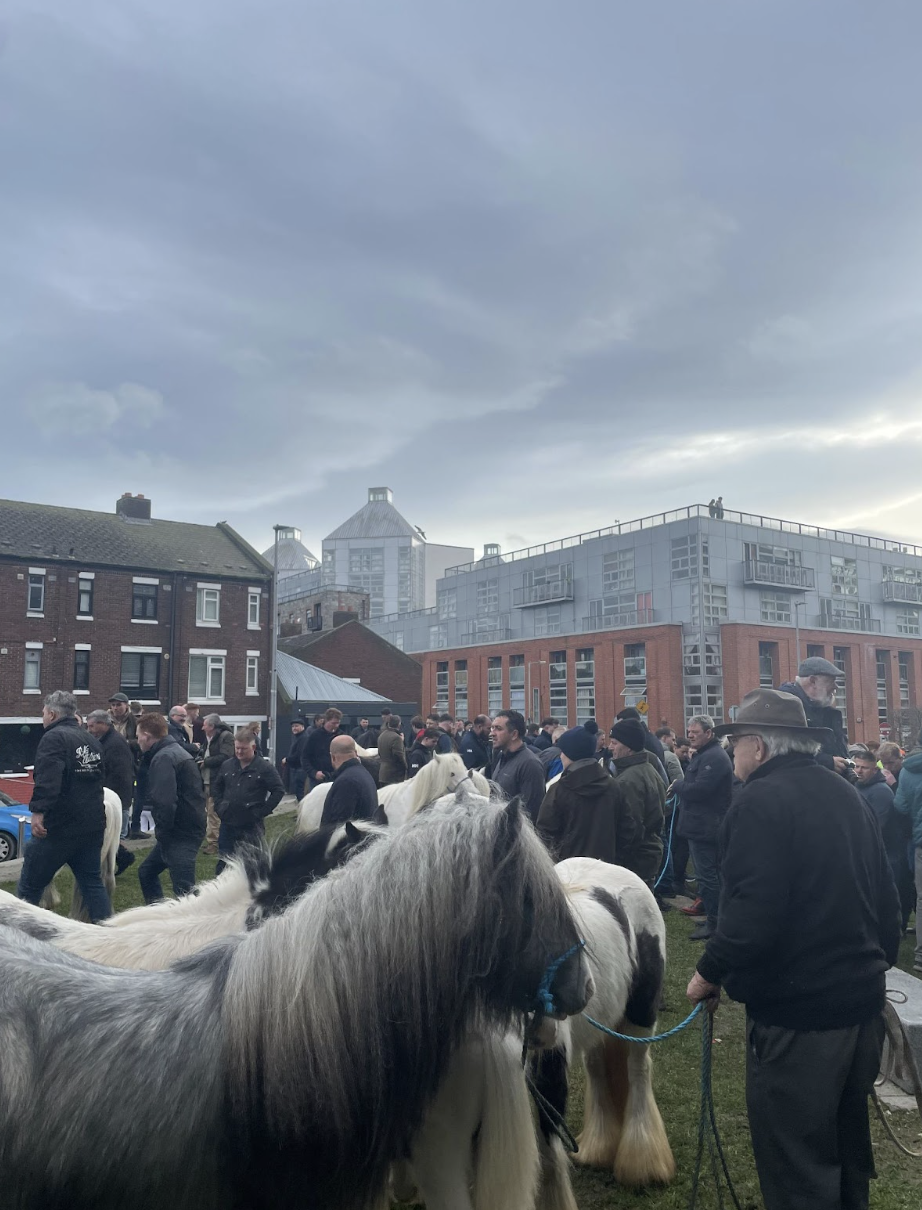

Crossing the River Liffey toward Smithfield on March 1st, you most likely would spot horses cantering along the streets. The sound of hooves clicking against cobblestone is nearly constant as you near Smithfield Square, and the lively atmosphere is pronounced almost immediately upon entry. People are chatting, and children play on the nearby play structure or on their ponies. There is a small Garda presence around the square, and penetrating deeper into the crowd, horses and carriages dominate the space. Periodically, there is a traffic jam or collision between horses, leading to kicking, braying, and some owners brandishing whips.
Horse fairs are ingrained in Dublin’s history, and Smithfield has been a site for trading and purchasing since the seventeenth century. Despite this, and what many attendees argue is a celebration of tradition, countless legal challenges have attempted to prevent the fair’s operations over the years. Bye-laws passed by Dublin City Council (DCC) in 2013 dictate that the event be held bi-annually, and participants must apply for a casual trading license. The council states that it is to “ensure the orderly running and management . . . as well as the safety of all persons attending and the welfare of animals”, but many see it as an encroachment on a time-honoured tradition. Ever since, fair runners and participants have continued the occasion in hybrid form – part fair, part protest in defiance of the DCC regulation.
“It’s part of history. It should be left”, says Graham, a regular fair attendee who has been coming his whole life. He is there with his daughter Jade, and they speak with me about what the horse fair means to them. When asked how it’s changed over time, Graham says that before regulation, in addition to more regular fairs, there were stalls selling horse tack and more general trade taking place. Now, with a police presence, it is different. That’s why they come to protest.
Graham calls over Declan, an older gentleman wearing a cowboy hat, who walks over. He says he has been coming to the fair for over 40 years. They come from the same horse yard in Tallaght, and travel in to “show off the horses”.
“It’s our culture”, he says.
Years ago, there was “none of this around”, says Declan, gesturing to the modern urban landscape, with shops and apartments surrounding the square. There used to be fruit markets and warehouses, as well as weighing scales in the square for horses, he says. “It changed big time.”
When asked what it would mean for them if the city were to shut down the fair, he says, “There would be nowhere else to come to once a month . . . we come here, make friends and sell horses, buy horses. They’re trying to do away with all that”.
Declan identifies the apartment residents nearby as an issue for the fair’s operations. He says they don’t want the horses around.
“They’re trying to close it down, so we’re not backing down.”
He voices, however, that if the Council were to offer an alternative site for the fair, which they can access monthly, they would give up Smithfield. “Other than that”, he says, “we’re not going anywhere”.
Two Garda officers at the fair were approached for comment, but said they had none.
Horses hold a unique place in Irish cultural heritage and folklore, associated with the sun and heaven in Celtic symbolism, companions to warriors in Irish legend, and thought to have the ability to see spirits. “Horse-whisperers” are famed for their supposed ability to tame a horse by whispering in its ear. Despite a rich connection between the island and its horses, Ireland’s recent past has been riddled with equine controversies that have brought the relationship under scrutiny.
An RTÉ documentary released in 2024 exposed footage of “serious animal welfare abuses and cruelty” in Ireland’s only licensed horse slaughterhouse, located at Shannonside Foods Ltd in Straffan. Eleven years earlier, the aptly named “horse meat scandal” had stunned the country. In 2013, the Food Safety Authority of Ireland (FSAI) found horse and pig DNA in a range of supermarket meat products. What ensued was an investigation that revealed, during one round of testing, that some beef products contained up to 100 per cent horse meat. The scandal would later be referred to as “Horsegate”.
From debates over various industries’ ethics and a scandal that sent global shockwaves, Ireland’s centuries-long horse-related traditions have come under scrutiny.
In Dublin, horse-drawn carriages are a tourist staple, emulating a Victorian fantasy as passengers are carried along cobblestone streets. However, much like other cities that feature them, such as New York, the presence of horse-drawn carriages has garnered significant pushback from animal rights groups. The death of a carriage horse in the streets of New York City spurred protests in August 2025, calling for a bill – Ryder’s Law – to ban the industry, which ultimately failed.
Linda Carroll, a volunteer for animal rights group and vegan organisation Sentient Rights Ireland, calls horse-drawn carriages “one of the biggest problems”. She describes going past St Stephen’s Green over Christmas and seeing three horses “all decked out with Rudolph noses”, declaring, “it’s a mockery . . . of a sentient being”.
“With the tourist season coming up now, there’s going to be far more of that.”
She says she is in touch with multiple businesses advertising behind horse carriages, hoping to stop nearby advertising. “Hopefully now they will begin to realise . . . that they shouldn’t be associated with this sort of advertising”.
Legislating carriage drivers, it would seem, is no simple feat. Bye-laws haven’t been amended since the Victorian era, with the Dublin Carriage Act (1853) remaining the prevailing framework.
In addition to horse carriages, Carroll identified sulky racing as another issue. Sulky racing includes attaching horses – she says, perhaps purchased at places such as the Smithfield market – to buggies before racing them. Despite being illegal on public roads, recent incidents, including one where an abandoned pregnant mare died after being left on the side of a road, indicate that they haven’t disappeared.
“I mean, there should be no question. It should be all banned.”
Professional horse racing, she says, “disgracefully is given a tremendous amount of money from the government”. The most recent figures from Budget 2026 indicate that €79.3 million is being allocated to the horse racing sector. The argument in Ireland, however, persists that horse-drawn carriages, the Smithfield fair, and horse racing preserve the city’s past and present culture.
Laura Broxson, founder of National Animal Rights Association (NARA), argues that “just because something is culture . . . doesn’t make it acceptable”. She, along with NARA, is calling for tougher laws and enforcement. Broxson says that, on the issue of the horse racing industry, “around 6,000 horses are killed every single year”.
“Even simple things like minor injuries that horses might suffer on race tracks, they’d rather shoot them in the head than treat them. So they’re disposable.”
She argues that the government should allocate the large funding given to the industry to retire, rehabilitate, and rescue horses. Additionally, certain laws must be implemented.
“There should be complete bans on whipping” and “kicking their sides”, she says, as well as horse bits. “There’s kinder ways to direct a horse . . . than gagging them”.
“The emphasis is always on the profit and the industry and not the animal.”
Existing legislation, Broxson says, is “very generalised” in stating that animals have five freedoms: food, water, shelter, care, and freedom from subjectivity to cruelty or neglect. There is “nothing really specific to horse welfare”, she says, and believes it needs to be updated.
Broxson also cites a high volume of unregistered horses in the country as a pertinent issue. Many horses taken in by the Garda or My Lovely Horse Rescue are often found without microchips or horse passports, and therefore “wouldn’t necessarily be registered as existing”.
“I don’t think there’s a huge understanding of how many horses there are in the country, because they’re not being registered”, she says, and further notes that what we see from welfare groups may only be “the tip of the iceberg.”
Broxson argues that tougher laws and enforcement for horse welfare are necessary, and welfare groups can’t be the only ones depended on “to clean up everyone’s mess, when the government has the millions to make this better and do something”.
“Legislation desperately needs to catch up.”
However, she says it’s an “uphill battle . . . when the main parties want to keep the status quo”, referring to Fine Gael, who she argues are “very happy with things as is”.
“Horses and dogs in this country are like throwaway animals that people feel they can do whatever they want to, and there’s pretty much no consequences”.
When asked if she sees a future where horses can be ethically incorporated into culture, she used a recent New York City proposal as an example of a potential solution to horse-drawn carriages: motorised horseless carriage systems.
“It’s about incentivising, it’s about transitioning, and it’s about also putting welfare at the forefront of this issue, because no horse belongs in Dublin city centre, right?”
Broxson cites the model of the Donkey Sanctuary as an additional example, where donkeys are adopted out, but remain periodically inspected and checked in on.
“If you love horses, you can engage with them in a kind way”.
In terms of the Smithfield Fair, Broxson’s stance is firm: she wants it gone. She says that when ISPCA inspectors have attended, horses are often confiscated without microchips or passports.
“It’s a fair that has free rein, not being policed, nothing’s being enforced. And again, the animals suffer from that. So I’d like to see it completely gone.”
“Cultures and traditions change, people change, society progresses.”
In Irish, the expression “capall le ceansacht” means a horse should be tended with gentleness. While the recent past begs an examination into the welfare and role of horses in Irish society, cultural tradition and connection run deep, and it seems that finding a rational middle ground is as difficult a feat as ever.