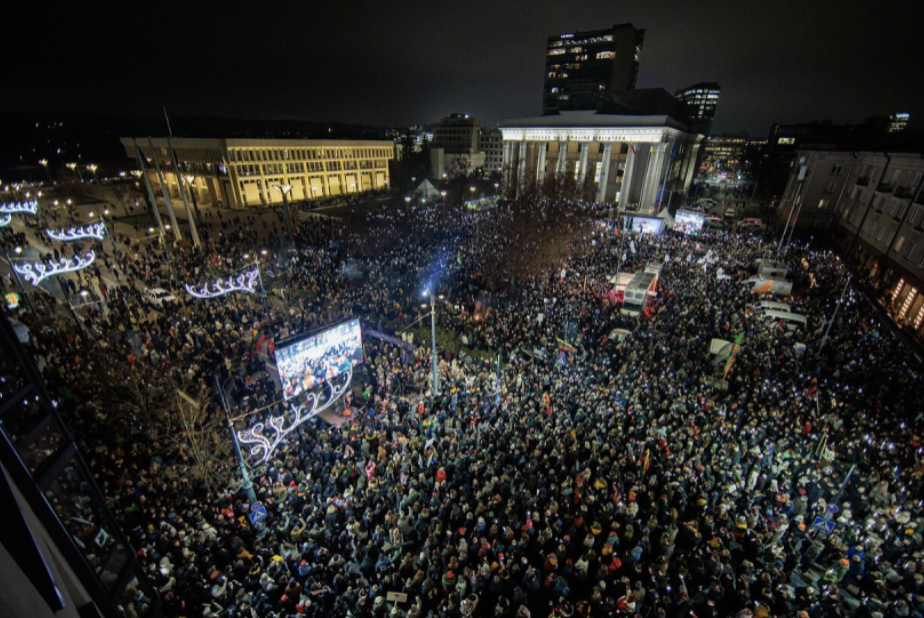

How much do you know about Lithuania? I didn’t have any knowledge about the country or the Baltic region before I went on an Erasmus to Vilnius University last year. For me, Vilnius is quiet, peaceful, and spacious most of the time. However, that’s not what the city was like on December 18th, 2025 when 12,000 people came out to protest for the freedom of the media.
In a nutshell, in October 2025, the leading coalition party in Lithuania proposed a reform which will politicise the national broadcaster, LRT (Lithuanian National Radio and Television), by allowing secret ballots to censor the media output. The potential reform sparked a large public resentment and resulted in an immediate response of a week-long protest outside the parliament.
Attending the protest was the highlight of my Erasmus in Lithuania. It was a Thursday night, with many people arriving at the square at 6pm, just after they finished work. It was the biggest protest I’d ever witnessed. I anticipated attendance would be mainly the young generation, but surprisingly, many people were accompanied by their parents and children. Although there were a large number of participants, it didn’t give me any sense of chaos. People were standing in the areas guided by the volunteers, facing the stage where people leading the protest were giving speeches.
The protest began with a host introducing the nature of the protest, and then a series of speakers went on stage to talk. The people speaking included musicians, athletes, and even a university professor from my school. I didn’t understand what they were saying, but I saw the crowd occasionally cheering and chanting following a speech. In the end, everyone on the square sang the iconic independent song, Laisvė (Freedom). The protest lasted around two hours; after that, the crowd filtered out of the street steadily.
In contrast to the protests I have participated in while in Dublin, and especially to those looking on social media, that protest was exceptionally peaceful. It felt more like calm resilience rather than an expression of anger. I even felt therapeutic after singing the song.
The protest was successful, with the government agreeing to postpone the reform on December 18th. I believe the success of this protest came from the fact that the spokesmen were representing the community and the public showed up in large numbers. The protest demonstrated that people have the power to speak up and engage in political decisions.
That was not the first time Vilnius engaged in a protest in this fashion in 2025. A month before the freedom of speech protest happened, there was a cultural protest, led by the artistic community, in response to the government handing out the position of Minister of Culture to Ignotas Adomavičius, a member of one of the coalition parties, Nemuno Aušra, which is largely criticised as an antisemitic and anti-Ukraine party. The public objected to this nomination not only because of the incapability of the minister, but also that a vital government position can be given away easily without any consultation with the voters.

The artistic community in Lithuania created an iconic stop sign symbol as the unified message of the protest, saying that the culture is on the verge of plummeting. For two months, I could spot the symbol in every corner in the city; it hung in every pub, shop, and people wore them on their clothes. Even now, if you are visiting Vilnius, you can easily find this stop sign. The protests featured art performances around the cities, and pubs were packed with concerts and audiences. On October 3rd, Adomavičius resigned as Cultural Minister as a result of this protest.
In 2025, it’s obvious that protests around the world were getting much more aggressive and were often accompanied by violence, chaos, and social disruption. Currently however, Lithuania still remains a firm believer in the power of peaceful protest, and by appearance, these protests receive decent outcomes under the democratic system. In fact, Lithuania has a great tradition of peaceful demonstrations in its history.
On August 23, 1989, approximately one million Lithuanians, along with Latvians and Estonians, formed the longest human chain in history, the Baltic Way. They demanded independence and freedom from the USSR, and eventually led to the independence of the Eastern European nations. The Baltic Way was formed by unarmed civilians, and they stood up against perhaps the most powerful totalitarian regime of all time, eventually guiding the way to independence and democracy for the nations. Until today, that spirit constructed the Baltic Way is still living within the Lithuanian community.
Democracy in Eastern Europe is facing challenges, and Lithuania is a relatively strong contestant of democracy and free speech in Eastern Europe. Its geographic position makes it the destination of many Belarusians, Ukrainians, and Russians trying to escape political prosecution. However, the Ukraine war and the stagnating EU economy created the ground for powerful individuals to use the pretext of national security to consolidate power and reduce the public’s democratic rights.
Under this era of increasing populism, more individuals are attempting to choose to follow mass leadership instead of engaging in political discussion. Lithuania demonstrated a great example of how to combat this political apathy, a bottom-up movement, in which the political demand was directly delivered from the community. The events in Lithuania may light a hope for those who are losing faith in peaceful demonstrations and once again remind us that democracy shall not be taken for granted.