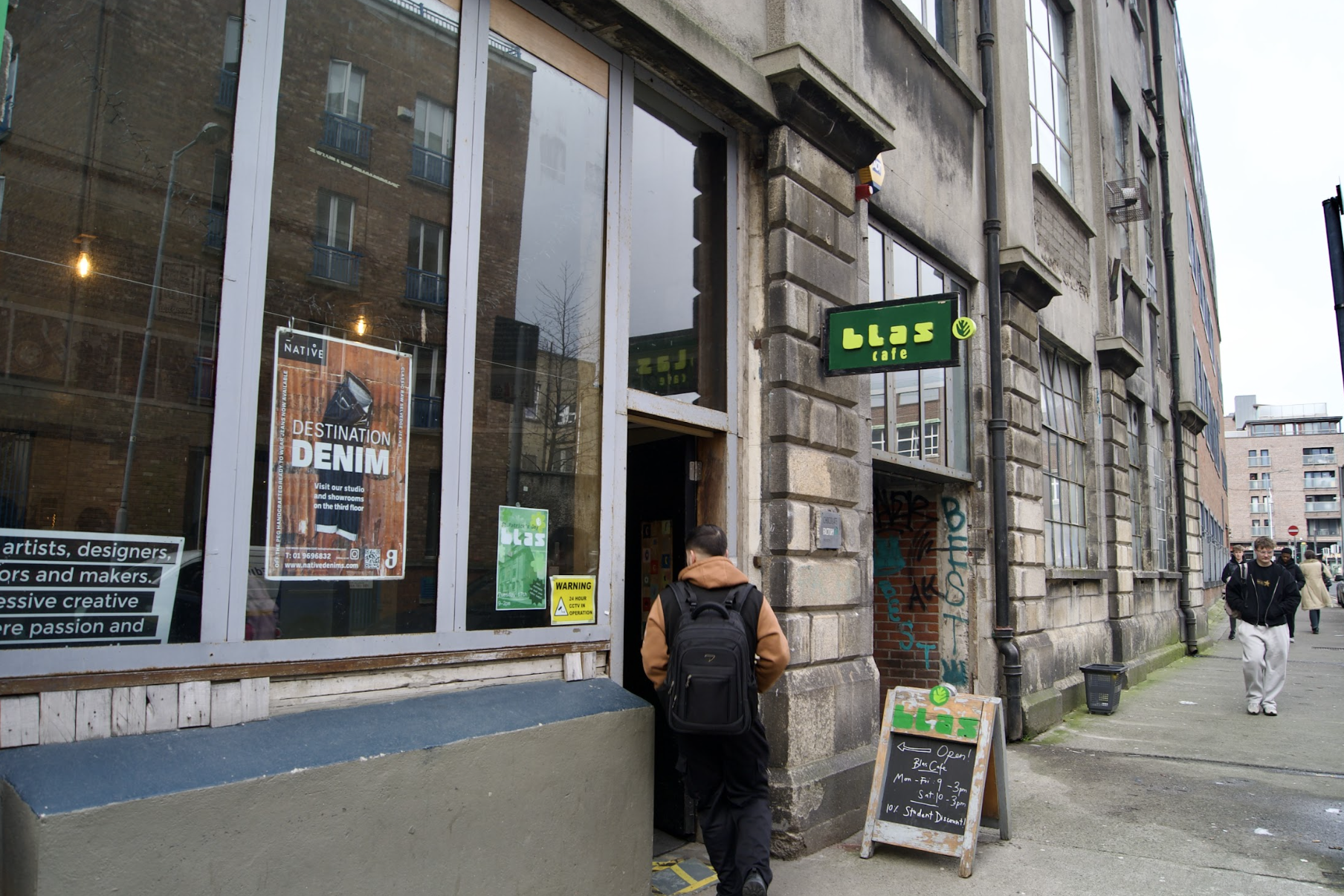

About a 20-minute walk across the River Liffey from Trinity campus, on a quiet road in Dublin 1, Blas Café occupies the bright ground floor of a former factory.
Inside, the cafe shows only traces of its industrial bones: large factory windows let sun into the open, table-filled room and exposed kitchen. The space is part of the old Williams & Woods Chocolate Factory, the oldest poured-concrete building in Dublin, which once produced Toblerone and Mint Crisps, and now hosts a creative complex of small businesses and artists.
Tucked away in an alley off Parnell Street, Blas feels far removed from the street’s traffic and looming retailers. Just around the corner, Moore and Capel Streets are beginning to wake up as vendors and restaurants open for the day.
On a Wednesday morning at Blas, people are chatting over lunch or sitting down with their laptops and a coffee. Hassan Lemtouni gets up from his spot at a table in the corner to help pack a shipment of coffee and pastries headed for a nearby community centre.
Lemtouni opened Blas, which he owns with partner Owen Williams, in 2014. Back then, he says, Dublin 1 was barely recognisable as the developing neighbourhood it is now.
Lemtouni is originally from Marrakesh, where his brother runs the Metouni (lamb cooked in a clay pit) restaurant that their great-grandfather opened four generations ago.
When he was 17 years old, Lemtouni left Morocco for Paris before eventually finding his way to Minneapolis. There, he studied while working as the head chef of a Hilton Hotel before moving to Athens, Georgia.
In Athens, Lemtouni began a family, found a new community, and opened his first business, a restaurant called Marrakesh Express. Though it had roots in the Moroccan cooking that had followed him from Marrakesh, the new restaurant evolved within the music scene of Athens, located near a university and right next door to the iconic 40 Watt Club rock venue.
Lemtouni remembers feeding and befriending artists like Sean Lennon, Nirvana, REM, the Smashing Pumpkins, and Phosphorescent, while the restaurant’s own kitchen crew at one point included Azure Ray’s Orenda Fink and Neutral Milk Hotel’s Jeremy Barnes. In fact, Lemtouni can be heard as the closing vocals on Phosphorescent’s song “Coat Check Dream Song.”
Since the beginning, art and food have been intertwined for Lemtouni. Like Marrakesh Express, Blas remains a gathering space frequented by both students and local creatives.
“Art has always been a part of it”, he said. “In a way, I kind of started that journey with food with the arts. It was a joy to enter that.”
In the cafe’s early days, he says, students came from the nearby Technological University Dublin (TUD), but now they arrive from across the city (Lemtouni hopes more Trinity students will make the walk north).
After Athens, Lemtouni moved to New York City. First to Williamsburg — where he remembers paying $200 in rent to share a warehouse space with seven artists — and then to Carroll Gardens, where he opened up a home design store. It wasn’t until he and his wife, a Dublin native, moved to the city in 2012 that Lemtouni began thinking about the food industry again.
Blas came two years later. Feeling a lack of community spaces like those he had frequented in Brooklyn, Lemtouni saw a hint of the borough’s regrown warehouses in the Chocolate Factory’s industrial space.
“I felt that Dublin had not that many cafes, not that many offerings for people, you know” he said. “My daughter was young at the time and there was no space where you could actually go socialise with people. And then I came across this building.”
In the Dublin 1 of 2014, cafes like Blas were few and far between, and Moore and Capel Streets were absent of many of the vendors and small businesses that now line the streets. You’d have been hard pressed to find good Indian or Middle Eastern food, Lemtouni recalled.
Over the last 15 years, Lemtouni has watched and become part of what he describes as a multicultural revival in the area.
Moore Street, for example, “was kind of a dying thing . . . it’s not the same as it used to be before, [new food establishments in the area] added a lot.”
The neighbourhood’s new cultural and culinary landscape is the product of an influx of immigrants who, like Lemtouni, brought their own flavours and ideas to the city, as well as of Dublin locals who left the island for places like New York or Australia and came back.
Blas is part of a rising coffee and cafe scene that Dublin has experienced over the last decade, and that Lemtouni says is indebted to these diasporic outgrowths.
“The diversity that Ireland’s experiencing, especially Dublin experiencing in the last fifteen years, I think it’s showing through food”, he said. “That’s part of the multiculturalism that’s happening in Dublin 1 and also in Dublin in general, or Ireland in general.”
Just walk down Moore Street, he noted, and you’ll find a Polish grocery store next to a Thai or Vietnamese restaurant.
These restaurants and stores not only benefit immigrants looking for a piece of home, but also foster connection between Dubliners. They let people “discover who you are and where you’re from . . . it’s a good cultural connection”, he says.
Blas revolves around this ethos of food as connection. Its menu has influences from Morocco to America to Mauritius, and changes based on who is in the kitchen and where they’re from.
The cafe’s evolving menu and community reflect and respond to Dublin 1. Lemtouni sees Capel Street as on its way to becoming something like the Chinatown of Dublin.
“And me personally, I’ve fallen in love with Dublin 1 because it has such a strong history. And it reminds me so much of Chinatown in New York City . . . there are certain things that were preserved and are cherished, people are holding onto them.”
Like New York’s Chinatown, Blas and its neighbourhood indicate a tension in the city between “holding on” and new growth. Growth from newfound cultural and culinary diversity, but also from rising prices and new private residential and commercial developments.
“It’s accelerated in the past few years . . . it’s become impossible for people,” artist Gabby Dowling says.
On a Friday afternoon, Dowling is here meeting friend and writer Vincent Woods for coffee. Woods and Dowling have been living in the neighbourhood for over 30 years, and gathering at Blas nearly since it opened 12 years ago.
“It’s a nice, easy atmosphere”, says Dowling. “I love the brightness, I love the light”, Woods continues.
As the neighbourhood continues to change, they keep returning to the cafe.
“There’s nothing to replace the spaces that used to be there, and that’s the case time and time again,” Woods says.
Privately-funded hotel, apartment, and retail developments, they say, mean less affordable housing, less community spaces, and less spaces for artists.
A few blocks away, studios in the old Hendron’s Building warehouse were overturned when the property was sold with plans to develop it into apartments and retail space. Even closer, across the road from Blas, Dowling’s own residence and studio on Henrietta Street is one of a few that were just recently sold to property developers.
The lasting presence of the Chocolate Factory’s spaces for artists and small businesses stands out against this landscape – it’s “another positive aspect” about Blas and the building, Dowling says.
Blas is deeply connected to the community of resident artists who work in the building, and the local creative community that includes people like Dowling and Woods.
On the cafe’s right-hand wall, two rows of brightly colored portraits each depict a member of its crew. The portraits were done by Steve Doogan, one of the building’s artists, who is currently across the room with a cup of coffee. While I talk to him, Lemtouni sits below a red-and-orange painting of himself, where he leans against a wall and looks thoughtful.
Many local architects, musicians, filmmakers, and artists are longtime regulars at Blas, Lemtouni says. One playwright, he remembers, used to lay papers out across the cafe’s large reclaimed wood dining tables, drafting a script that later went on to debut at The Abbey Theatre.
From the beginning, Blas has tried to be “part of this community [of Dublin 1], not against this community”, Lemtouni noted. “Within a year or two of opening, we became a part of these neighbourhoods.”
The cafe maintains prices below market and has developed mutual relationships with nearby businesses: Lemtouni buys Blas’ meat from FX Buckley on Moore Street, and produce from a vegetable market that recently moved from its former location in Smithfield.
“[Blas] is a cultural hub that the neighbourhood benefited from; that changed the landscape of the neighbourhood, but without taking over the neighbourhood,” Lemtouni said.
Once a year, the former factory workers of the old Chocolate Factory gather for an annual reunion at Blas. And every week, the cafe delivers pastries and coffee to a community centre around the corner at cost.
“And that’s kind of how we show how we care about the community and how we care about these people”, Lemtouni said.
“It’s a creative, welcoming space. We never tell people to get out of here.”