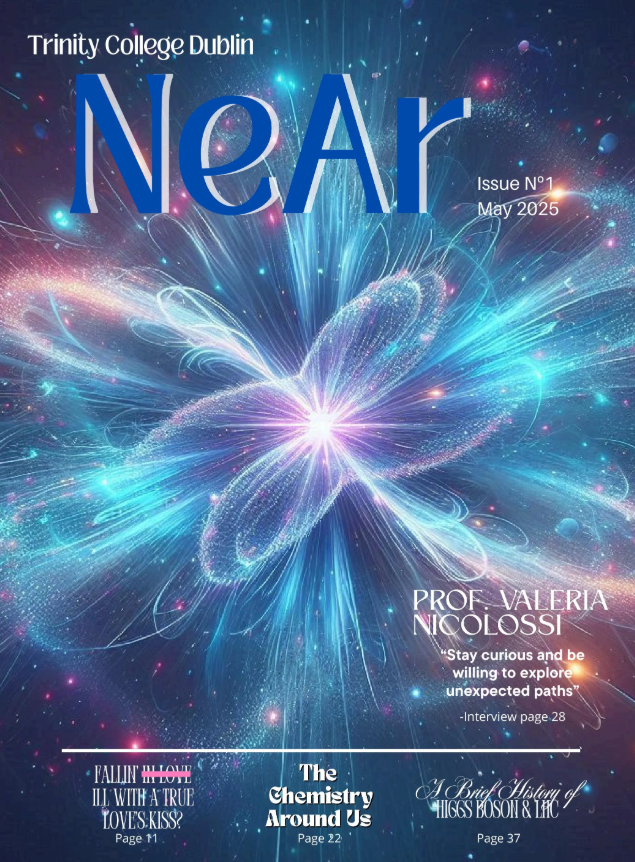

On February 25th, 2026, Trinity’s first science magazine, NeAr, celebrated its first anniversary. The University Times sat down for an interview with Carmen García Barajas, the founder and editor of NeAr, a Senior Fresh Biochemistry student.
Carmen, previously a writer for Trinity News’ SciTech section, felt there was a need for a science-only magazine on campus. As such, she left and started NeAr. With the help of Dublin University Science Society, she managed to pull together a team of science students, each working on their respective sections of the magazine, and published their first issue online.
Since then, the paper has been consistently requesting funds for printing paper magazines, and it has recently received funding from Trinity Publications. NeAr is expecting to publish its first paper edition by the end of this semester, which will further diversify the reading materials for students on campus.

Carmen is passionate about creating a magazine that every student can find knowledge and joy in reading. NeAr has integrated a wide range of disciplines in the selection of articles. There are Biology, Chemistry, Physics, and Engineering sections, which are technical articles explained in plain words without any insider jargon. There’s also the Curiosity Corner, a fun facts section with articles explaining, for example, why we cry when cutting onions.
NeAr has tried to select topics closely related to students’ lives. For example, an article titled “Infectious Mononucleosis – falling in love with a true love’s kiss” by A Jimmy, discussed EBV, “a herpesvirus that is commonly caught by 15 to 24-year-olds that spreads through kisses and other forms”. NeAr aims to give all students something accessible to read during study breaks, no matter what major they are studying in university.
NeAr believes their magazine also has a strong potential to write about social sciences through the lens of natural science. “I want to point out that everything is connected (to science), like a new medicine may have an impact on society and politics”, Carmen emphasised. It would certainly be delightful to see the science-allergic people of the arts block being able to read about science in a lighthearted way, and relate that knowledge back to their studies. NeAr potentially bridges the gap of misunderstanding between science and humanities students, and opens up opportunities for collaboration across disciplines.
When talking about AI and the impacts on the magazine industry, Carmen was very affirmative that AI writing is not accepted in NeAr. “You are in college, you have to write”, she affirmed. It was a truly reassuring statement to hear from a science student, knowing that many magazines have already surrendered to the AI craze.
Despite the magazine having lost its prime time as the cornerstone of university life as compared to 30 years ago, she doesn’t see magazines as a “falling industry”. Carmen believes that “the paper is really important to us; we like to have it, see it, and smell it, these things make us humans”. Overall, she feels very passionate and optimistic about the future of NeAr and the general magazine industry.
Carmen was not the first person who had the idea of creating a Trinity science-focused publication, but overcoming the obstacles in their way made NeAr the first fruit to ripen on that tree. For example, she learnt how to create the website for the magazine, designed the graphics, and applied funds from “everywhere possible”. The establishment of NeAr is a great example of actualising the creative initiatives in Trinity; commitment and proactive learning being equally important to passion.
When asked about how students can participate in NeAr, Carmen said, “Everybody is welcome”. At the moment, the paper has a burning need for graphic design artists, photographers, social media assistants and website creators. NeAr is, undoubtedly, a great platform for students motivated to write about science to publish their articles, no matter their major. If you want to take part in this rising Trinity publication, you can easily contact NeAr via their Instagram.
Finally, Carmen concluded, “Without all the people who have participated on the project this would not have been possible, and that consistency, determination and surrounding yourself with people who support you are key to moving forward with such an ambitious project”.