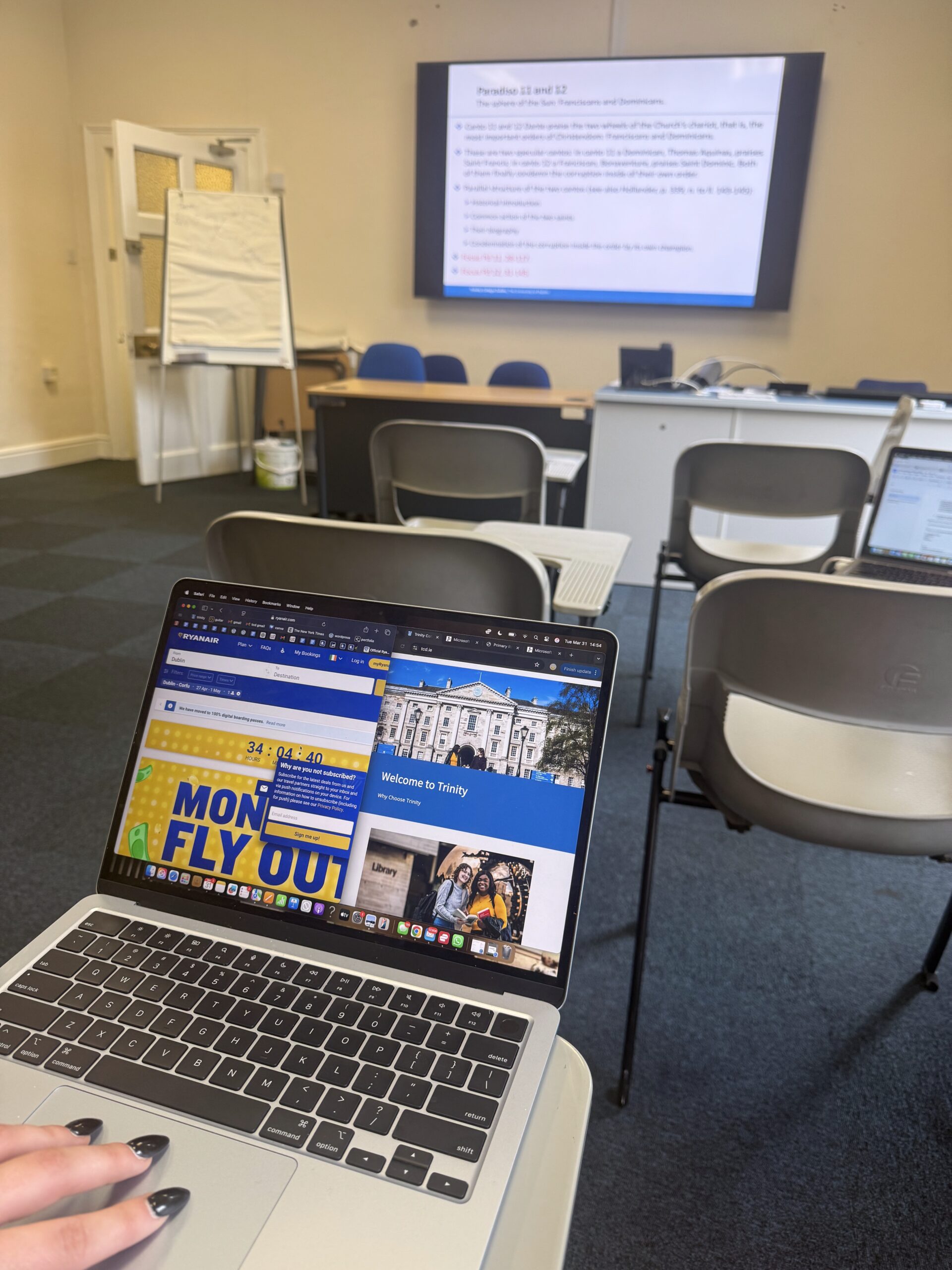

There is a disconnect between Trinity College Dublin as an institution and its students that is no longer subtle. It announces itself quietly, glow by glow, screen by screen, in lecture halls across campus. Phones hum beneath desks. Laptops are tilted just enough to grant plausible deniability. Scrolling has become so normalized that it barely registers as a breach of etiquette. As the price of tuition, accommodation, and living in Dublin continues to climb, what does it mean to invest thousands of euro in an education if it’s only half-received?
Let’s start with a simple question: why do we go to college? No, really, let’s investigate that together. For some, the answer is straightforward: job prospects, stability, leverage in an increasingly precarious labor market. Fair enough. For others, the motivation is less linear: To please someone (perhaps a parent, a grandparent), to fulfill a promise, explicit or implied, To justify sacrifices already made. Many students arrive at Trinity carrying an invisible ledger: pride on one side, guilt on the other. Pride in having made it here, one of Europe’s most prestigious universities; guilt baked in over the circumstances, suffering, and labor of others who made that possible, and the pressure to not let it be in vain. However, it’s becoming more and more ambiguous whether it’s the education or just the degree we’re after.
All of this collapses into a familiar image: you (yes, you), seated in a Trinity lecture theatre, phone propped against your laptop as the lecturer drones on about — what was it again? Cell anatomy? The Cold War? Thomas Aquinas? Plusquamperfekt? The content almost doesn’t matter. The posture does. The body is present, tuition paid, attendance logged.

Walk into almost any Trinity lecture and you’ll encounter a dense ecosystem of “second-screen” activity. Doomscrolling. Online shopping. WhatsApp group chats. Email replies drafted, deleted, and rewritten. Flight searches undertaken with more focus than an exam. It sometimes feels as though Trinity students will do literally anything besides listen. This is not a moral indictment. I am no exception. My own lecture habits have ranged from the familiar Instagram–email–Ryanair rotation to, on one memorable occasion, watching an entire silent film from start to finish while a lecture unfolded in the background. A strange choice, perhaps, but a revealing one. Nobody settles into bed on a Sunday evening with a glass of wine to escape into a silent film. The lengths we go to tune out say something important about what attention has become.
It would be tempting to frame this as a failure of discipline, a generational flaw, or a symptom of laziness. That narrative is comforting in its simplicity, but doesn’t hold up under scrutiny. As the Associated Psychological Clinic (APC) illustrates in its June findings: algorithms, notifications, and interaction features are not passive, but calibrated to create holes in us that weren’t there before for the content they offer up to fill. Furthermore, they nullify the nuance university education strives to impart in favor of the far more lucrative sensationalism fueled confirmation bias. Your attention has been bought, and as long as you remain convinced you enjoy the stream of slop flowing your way, the tech and media companies cash in. In this new content economy, attention is currency. The issue is that the response is misaligned. Universities, Trinity included, continue to operate as if sustained attention is a default human setting rather than an increasingly scarce resource. The result is a quiet contradiction: students are paying unprecedented sums for an educational experience they have been systematically trained not to fully inhabit.
There is also something uniquely dissonant about this at Trinity College Dublin. Trinity trades, in part, on an image of intellectual prowess: oak-paneled libraries, ancient manuscripts, caps, gowns, sword wielding schols, and other traditions stretching back centuries. The campus itself seems to demand reverence. And yet, there is a profound discrepancy between this edifice of scholarly allure that draws students from all over the world, and the behavior we exhibit once we’re in the door. Attendance becomes symbolic rather than substantive. Being here is no longer synonymous with engaging.
This raises an uncomfortable question: what exactly are students paying for? Access to knowledge? That has never been cheaper. PDFs circulate freely. Lectures are recorded. Entire degree programs exist online at a fraction of the cost. What universities offer, in theory, is something harder to digitize: intellectual community, mentorship, structured time for deep thinking, spaces that encourage sustained attention and meaningful exchange. But when lectures become background noise to scrolling, that promise begins to erode.
There is also the pressure of productivity. Many Trinity students are not just students. They are working part-time (or full-time), applying for internships, maintaining extracurriculars, managing visas, or simply trying to survive Dublin’s rental market. In that context, a lecture can begin to feel like an obstacle rather than an opportunity—another hour that could be optimized, multitasked, or repurposed.
Still, none of this resolves the central tension. Education, at its core, demands sharp attention and critical thinking. This is not satisfied by the scattered, background kind, but sustained, uncomfortable, sometimes boring attention. The kind that doesn’t immediately reward you. The kind that asks you to sit with confusion, complexity, and ideas that resist easy consumption. Our issue is
that if we continue to get by merely posturing as students, we will inevitably forget how to learn. When that happens, it will be a fundamental loss not just for individual students, but for the institution itself.
Perhaps the most unsettling part is how little this is discussed. The glowing phones are visible to everyone: lecturers, tutors, students alike. And yet, there is a tacit agreement not to name the problem. To do so would reveal the ugly truth of this phenomenon: that it is an addiction, and beyond that, naming this would hold us accountable and obligate us to change our habits, rather than let us remain in our ultimately self destructive dopamine spiralls, able to convince ourselves for the sake of one reel, one item added to cart, that we’ll watch the recordings and check the lecture notes, when in reality, the internet and AI engines simply make any real, hard learning far too easy to circumvent.
The issue is not just payment but opportunity cost: what happens to the value of an education you are only partially present for? Our workarounds won’t hold forever; they may only be forestalling failure, which we can only hope won’t come back to bite us later in our professional lives. College seems to have shifted from being a site of intellectual transformation to one of credential accumulation. It might mean that attention has become a luxury rather than a baseline expectation.
I do not mean to call for a ban on phones or shame students (if you know me, you’ve likely seen me putting in my share of heavy lifting on my Instagram reels degree in the Ussher). It is, instead, an invitation to take the problem seriously. This is a collective issue that requires a recalibration of norms and an end to our mutual enabling. As attention continues to fracture while we keep showing up to school, the questions become more urgent: What are we really paying attention to, what, exactly, are we paying for, and do we as a society even still value college beyond its aesthetic ideal? If so, what would it take for us to collectively “lock in?”
It’s up to us scrollers to decide whether or not the institution of higher education is something fundamentally worth preserving. I like to think that however lost we are, deep down we believe it that is, and that is what keeps us showing up.