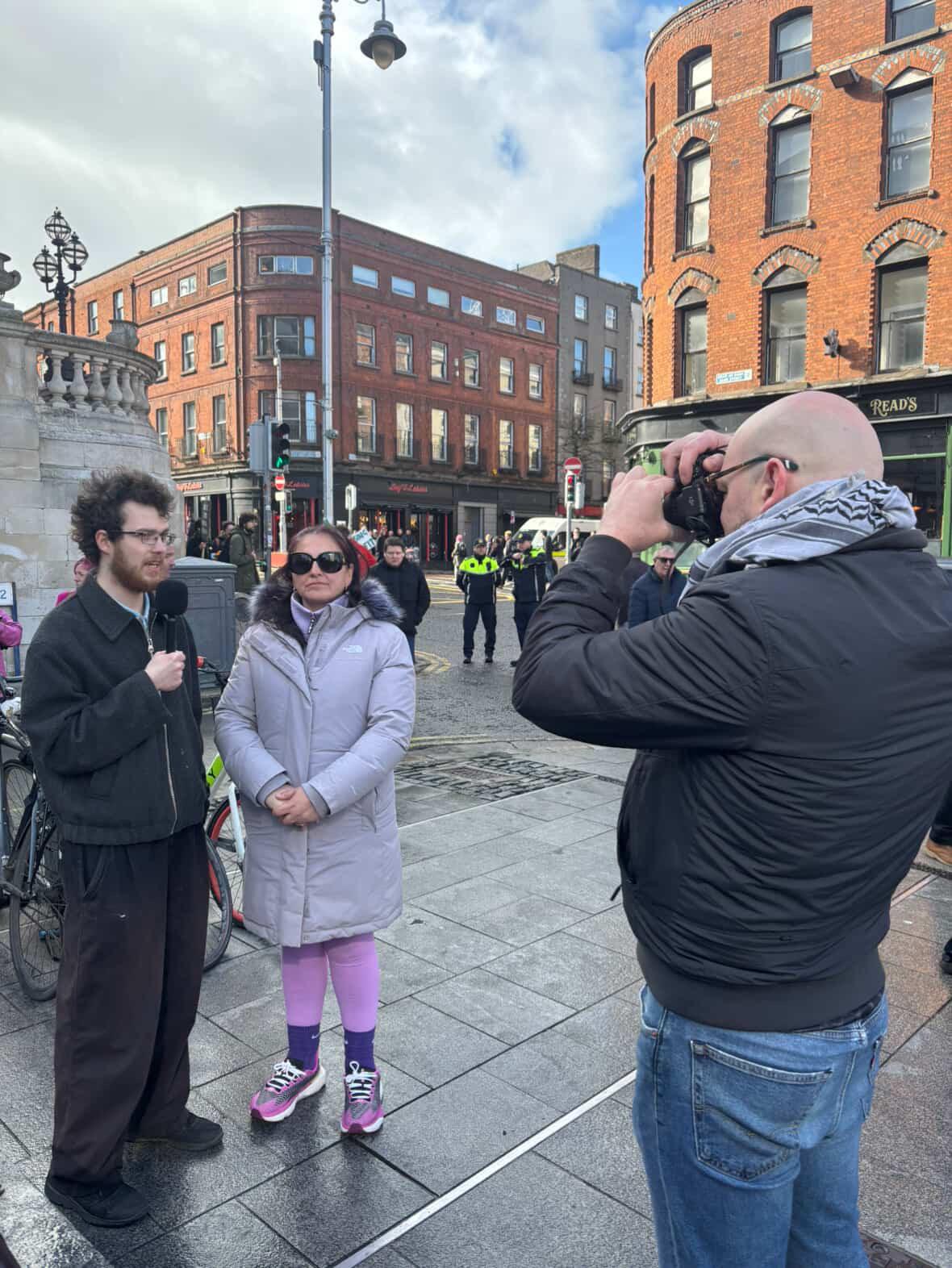
On the last Friday of February, I found myself in a café in Smithfield in the company of three young filmmakers. Surprisingly punctual, Bella, Na and Robin were all wrapped in a wonderful combination of modest confidence and confident modesty. Friends and classmates, they are Senior Freshman film students at Trinity, busy editing their short films at the moment. Responding to a call sent out by the DU Film Society, they had submitted scripts which got picked up for funding and are now in post-production. Each of these films is slated to be screened at the Film Society’s much awaited annual film festival on March 29th. I spoke with Bella, Na and Robin about all things short films, from their cinematic inspirations to the logistics of getting locations and budget problems.
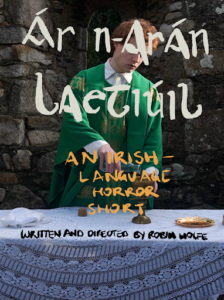
We started our roundtable with Robin, whose short Ár n-Arán Laethiúil is a “squashed version” of the feature they have been developing for a while. In line with the current wave of folk terror, their film is an Irish language religious horror centred on a priest. Bella’s film Things Are Lost and Forgotten but Oh My Gosh, They Remain! had a similar process, in that its script also snowballed from an idea she had for a feature. “It is a drama, basically”, she explained, “about two friends reconnecting after some crazy stuff has happened”. Robin was quick to ask if the friends are gay and Bella confirmed that they indeed are. This has emerged as a leitmotif in Bella’s work. Our third filmmaker, Na’s approach was a little different. The idea came to her almost organically, during a walk over the summer; set in a bar, her film Process is about a man and a woman having a conversation but we don’t know the nature of their relationship. Already very short (3 minutes), she had envisioned it being “a lot snappier and more abrupt”. Stopping herself after telling me that the man wants to see if the woman, who is a professional actress, can cry on command, which she does by closing her eyes and reliving a happy memory, Na came close to letting the cat out of the bag and sharing the ending to her story. “I’m just saying that the conversation isn’t what you thought it was”.
Na’s film instantly reminded me of the opening scene from Celine Song’s 2023 Past Lives. While she was inspired by some modern romance films, Na was significantly influenced by the “transcendental slow style” of Southeast Asian cinema (“because I am Southeast Asian, guys. In case you can’t see”, she kindly stated for the readers). The iconic Hong Kong director Wong Kar-wai’s In the Mood for Love (2000) was a big aesthetic ideal, especially in its “use of red and gritty ambient lighting”. In terms of acting style, Na mentioned Todd Hayne’s Carol (2015), because of the film’s heavy reliance on subtext conveyed through subtle physicality. She also looked to the world of music when conceptually building the film; Lord Huron’s The Night We Met and Nicole Atkins’ A Little Crazy capture the dream-like atmosphere of her story.
In contrast to Na, Robin went down the road of naturalism. Thematically, they were inspired by the Irish language folk horror Fréwaka (2024), a film whose director, Aislinn Clarke, they got to interview by virtue of being in the Art Kino Youth Jury. They listed a few other Irish films, “slow-moving and realist” but described the horror of Fréwaka as “unique”.
Bella’s influences were also quite thematic; “Emma Seligman comes up in everything I do”, she said, and Seligman’s debut Shiva Baby (2020) was important specifically for the relationship between Bella’s two protagonists. “It was in part based on the lead characters of the movie, Danielle and Maya, who are exes, which is not the relationship of my characters but the dynamic is similar”. Just before writing the script, Bella also discovered A League of Their Own (1992), which “makes [her] angry every time [she] watches [it]”. Marriage is a pivotal subtext in her short and the fact that Challengers (2024) was a major stylistic influence only further attests to that. She said, “Guys, sometimes everything comes back to that one scene, where they’re all making out in the bedroom.”
All three showed an inclination towards subtextual engagement in their films, complimented by loquacious characters. “My movie’s a very talky movie. They’re mostly just talking the entire time. And I frame the dialogue to make it seem like a conversation that you’re dropping in on”, Na said, to which Bella responded: “You don’t say everything you’re thinking. You’re always conversing through more than just language”. Both wanted their actors to be talking verbally as well as physically. When I asked them to elaborate, they said that there are two languages in every film, the one within, between the characters, and the one without, between the narrative and the audience. Robin described their work as “strange and staged, but intentionally”. Generically absurdist, their film argues for “subtext within symbolism”. This made me curious about their casting process and choices.
Robin told me that they sent out a call for self-tapes and got great responses, one of which came from Fionnán Morley, who stood out to them. His interpretation of the priest character was very different and interesting, and Robin decided to adapt it as is for their film. While Robin didn’t have anyone specific in mind for the role, Na knew exactly who she wanted for her film. While writing the script she envisioned Raina Weinberg, an actress she had previously seen in a production of Chekhov’s The Seagull (playing Masha), as the female lead. Na’s male lead, Rhys Mannion, came from a read-aloud peer review session that she did as part of her screenwriting class. Bella also had some people in mind but none of them ended up in the film. She too sent out a call for self-tapes, finally getting her actors through friends’ recommendations.
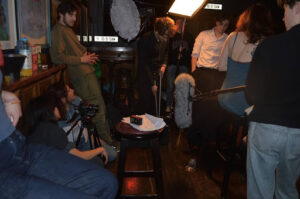
When I asked them how they went about working with friends as cast and crew members, all three gave me very professional answers. They agreed that everybody came to set with a level of professionalism and an understanding of the stakes. Most of them, including Bella, Na and Robin, had previously worked on theatre productions with DU Players, and that experience greatly helped with the assignment of specific roles and overall work dynamic. While this meant that some production practicalities were easily handled, there were still others that created complications. Robin, for instance, shared their experience of trying to get permission to shoot in an abandoned church. After contacting several county councils, they finally heard back from Dún Laoghaire-Rathdown, who initially demanded an insurance of €6.5 million. Trinity Insurance (“shout out to Tony”) came to the rescue but the council ultimately let Robin shoot for free since they’re a student. Na similarly had to jump through hoops to be able to shoot in a bar on a small budget. The topic of finances elicited strong reactions from the filmmakers. They raised some concerns about the disarray and lack of responsibility shown by the DU Film Society. They were immensely grateful that the society had presented them with the opportunity to make these films and hoped that all issues would be resolved, timely and amicably.
We ended our chat by talking about the experience of being on set and making films as a student. Robin told me that people don’t realise “making horror films is really funny and really silly”, to which Bella said, “making a movie is both a trade and an art, it’s hard work”. Na was especially appreciative of the trust that everyone showed in her and each other, and the three of them collectively still couldn’t believe that people wanted to spend time working with them on their films.
While our conversation was regularly interrupted by the hiss of the coffee machine (and a cranky child), the three of them were authentic, playful, and extremely kind throughout. So much so that they said ‘hi’ to the recording app on my phone, addressing future me, before answering each and every question. It was a joy listening back to the interview recording, so to Bella, Na and Robin: hi, and thank you so much for giving me your time.
Letterboxd Favourites:
Robin
– Fréwaka (2024)
– The Holdovers (2023)
– Fantastic Mr Fox (2009)
– All We Imagine As Light (2024)
Bella
– Bottoms (2023)
– Y tu mamá también (2001)
– The Watermelon Woman (1996)
– Kajillionaire (2020)
Na
– Casablanca (1942)
– The Shawshank Redemption (1994)
– Incendies (2010)
– When Harry Met Sally (1989)
Ár n-Arán Laethiúil
Writer, Director, Editor, Director of Photography, Set Designer: Robin Wolfe
Assistant Director: Marianne DuBois
Assistant Cinematographers: Luca Bradshaw, Francesco Schiavio
Sound: Luca Bradshaw
Costumes: Natalia Gloc
Lights: Ben Holland
Cast
Priest: Fionnán Morley
Things Are Lost and Forgotten but Oh My Gosh, They Remain!
Writer and Director: Isabella Kolb
Assistant Director: George Donnery
Producer: Josephine Radcliffe
Director of Photography: Martha McKinney
Lights: Na Nguyen
Sound: Megan O’Connor
Costumes: Fiona Lin
Music: Fiona Lin
Behind-the-Scenes Photographer: Robin Giosu
Cast
Penny: Lea Bazon
Erin: Thea Dixon
Process
Writer and Director: Na Nguyen
Assistant Director: Josie Radcliffe
Director of Photography: Therese Askarbek
Editors: Na Nguyen and Josie Radcliffe
Assistant Cameras: Martha McKinney and Bella Kolb
Sound Recordists: Megan O’Connor and James Bryan
Gaffer: Marko Rudyi
Lighting Assist: Hugh Andrews
Producer: Holly O’Connor
Costumes and Props: Ioana Haratau
Music composer: Fiona Lin
Publicity: Maia Kelly Murphy and Amber Kelly
Stills Photographer: Maia Kelly Murphy
Production assistant: Luca Bradshaw
Post-production Assistant: Robin Giosu
Cast:
Lucy: Raina Weinberg
James: Rhys Mannion