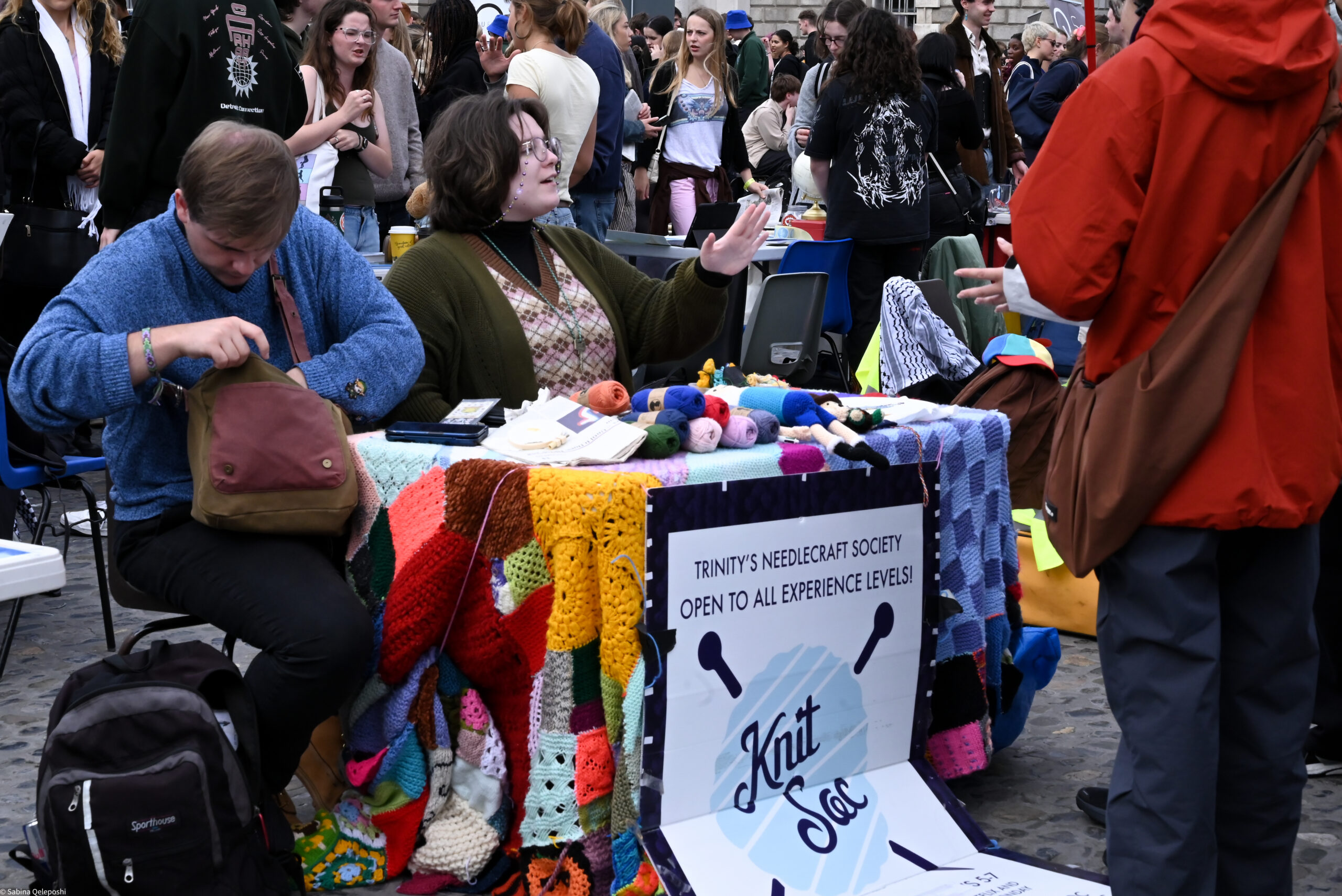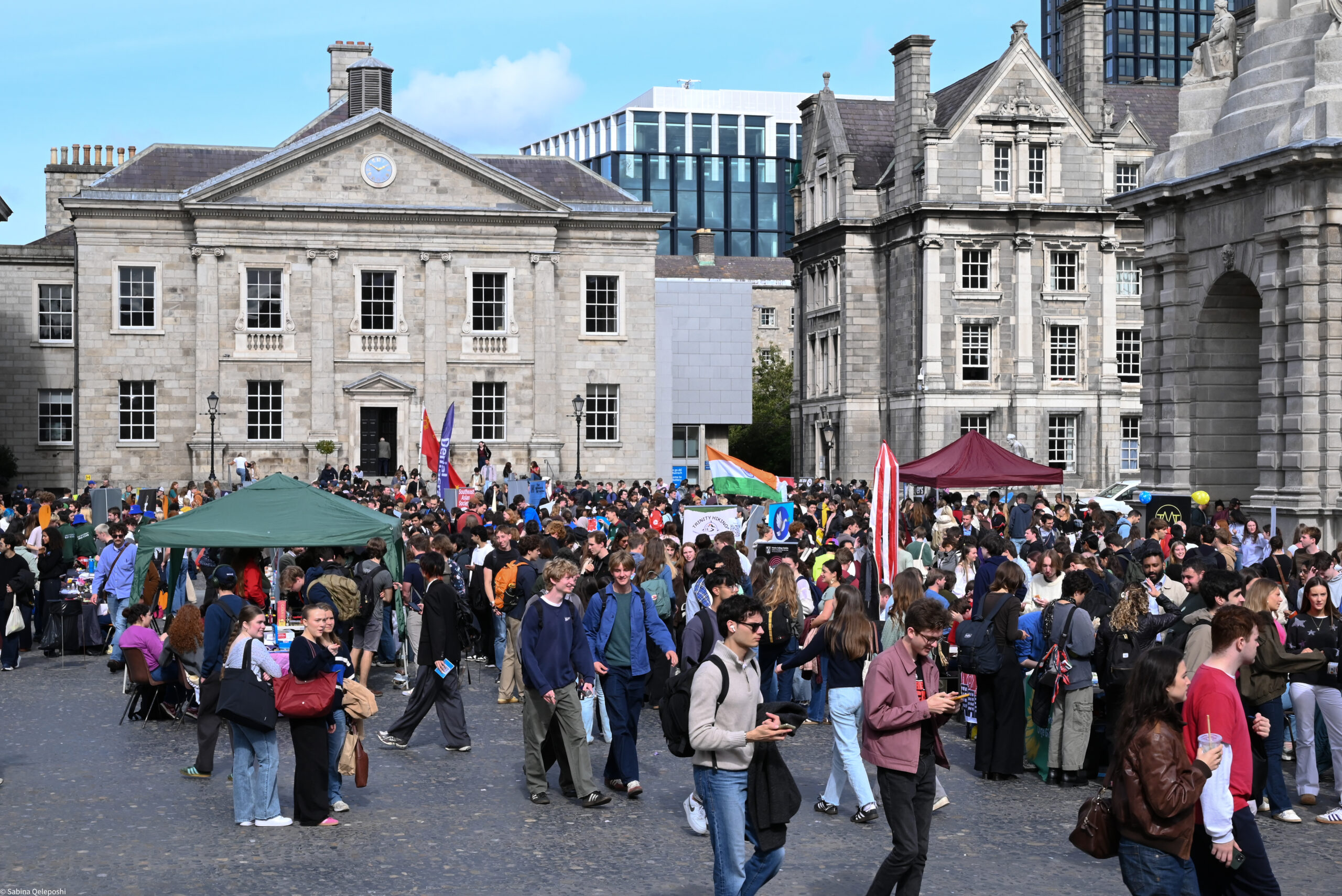

Trinity College Dublin is home to over 120 student societies, including the oldest student society in the world, the College Historical Society (the Hist). From the Pirate Society to the Trad Music Society to the Christian Union – there truly is something for everybody. Or almost everybody.
Every year, students who identify gaps in the societies on offer will seek to fill these gaps by establishing new societies. There is a multi-step process for societal recognition as set out by the Central Societies Committee (CSC). The process of setting up a new society is time-consuming, as well as tedious, and yet this process is something that 15 groups on campus have pursued this year to bring their society vision to life. The fifteen proposed societies are as follows: Access, Arab, Art History, Chinese, Commodities, Darts, First Love, Global Health, Greek and Cypriot, Labour, Men’s Health, Mental Performance and Wellbeing, Paediatric and Children’s Health, Southern African, and Surgical Societies.
The CSC was established in 1970 and is “the governing body of societies” at Trinity. Run by students, the CSC is “the sole body on campus with the power to grant recognition to societies”. The CSC is currently chaired by Conchúr Ó Cathasaigh – this is a sabbatical position that oversees the remaining 11 members of the Executive team.

The CSC sets out three main steps in establishing a new society. Firstly, 300 signatures must be collected. Secondly, a constitution must be written, and thirdly, each proposed society must give a five-minute presentation to the CSC Executive and answer their questions. After this last step, the Executive votes and thus the society proposal is either dismissed, or is granted provisional recognition. Following 18 months of provisional recognition, the society will become a full member of the CSC with voting rights and eligibility for grants.
The CSC presentation day for proposed societies took place on February 21st, and all proposed societies have since heard the verdict of their submissions. I spoke to spokespeople from three of these proposed societies to hear how their attempt at recognition panned out.
Speaking on behalf of the Proposed Dublin University Art and Architectural History Society are Abigail and Hanna.
The pair decided to establish this society because, “We want to allow students to engage with the arts ecosystem on campus, across Ireland and internationally. We knew there was an interest, since we heard about previous proposals, so we thought it was high time to make it happen.” They also expressed, “We felt a sense of disconnect between art and architectural history and the College community despite its accessibility and interdisciplinarity. There are so many different sides of art history that we think everyone can find interesting and enjoy, whether it be more theoretical or practical.”
The proposed society went through the initial stages of gathering 300 signatures and drafting a constitution, bringing them to the final stage; presenting to the CSC Executive, which they described as “the make or break event of our society”. Despite the pressure, they shared that “in the end, thankfully, our work paid off”.
“Our presentation went quite well as we received an email from the CSC informing us of our provisional recognition as long as we make some amendments regarding our constitution . . . We are currently in the process of setting everything up via the help of the CSC and in the upcoming weeks we will be opening sign ups and holding our very first AGM. We are quite excited to begin our journey and bring art and architectural history closer to the college community”, Abigail and Hanna shared.
Speaking on behalf of the Proposed Southern African Society is Megan, a Senior Freshman Law student from Zimbabwe. Going into the process, Megan shared that, “We expected the process to be lengthy and challenging, as setting up a society is a serious task and having a long process can separate the societies which would not take off from those which would.”
Despite this, the team was determined to go ahead with the process. Megan expressed that “Trinity needed a Southern African Society mostly because there currently is not a society that is specifically focused on the Southern African Region (which is the 11 southern countries in Africa), and so we wanted to provide a society which gave southern Africans (including ourselves) – by birth or by generational connection in any form – a taste of home and an opportunity to share and celebrate their individual cultures, as well as to give other non-southern African students the chance to learn more about the cultures and even find a sense of home in the society.”
The Proposed Southern African Society collected 300 signatures, formed a constitution, and presented it to the CSC Executive, however their proposal was denied. As Megan expressed, “We are gutted at this decision.” She explained that, “Unfortunately our proposal was rejected ‘due to major concerns regarding overlap with the Afro-Caribbean Society’ and our proposed Southern African Society, as ‘differentiation or distinction remained unclear’. There were also concerns about the interest of the student body that were apparently raised.”
Megan reflected positively on the experience, saying “it was a rewarding experience to work together and we managed to collect well over 300 signatures so it was comforting to note that there were lots of the student body who were supporting us along the way!”
From the Proposed Arab Society is Dana, a Senior Freshman Physics student. When asked why she believed Trinity needed an Arab society, Dana replied, “I think that, like for any minority group prevalent on campus, there needs to be some sort of representation for Arabs anywhere. It’s a very misunderstood, reduced-down identity and there needs to be more awareness of the different experiences of being Arab.”
“I also think there are many similarities between Irish and Arab culture, history and politics. I think it is important for this to be realised. On the individual basis, it makes people more open-minded and less desensitised to Arabs, contrary to what mainstream media accomplishes. On a much larger scale, small steps like this help combat this recent rise in anti-immigrant sentiment . . . A cultural society further humanises people which is extremely important”, Dana shared.
Dana described the establishment process as “a bit intimidating at first”, however, “when you approach it bit by bit it isn’t all that bad”. She expressed that “The writing up of the constitution and other bureaucratic processes required more attention to detail. Especially when forming a cultural society, intentions can get misconstrued, appropriation of cultures can occur, and unintentional generalisations can be made. And so these factors had to be discussed and accounted for in order to introduce the society as a secular and inclusive one, for the purpose of celebrating different cultural experiences.”
For the Proposed Arab Society, the vision became a success. As Dana shared, “We are glad to announce that we so far passed many of the hurdles in officialising our society. A few tweaks to our constitution have been made and we are awaiting approval. After this we hope to be starting our first events of this renewed society!”
It seems that the journey to starting a new society, despite being lengthy and demanding, is worth the time and effort. Trinity’s society count, as impressively high as it is, continues to grow.