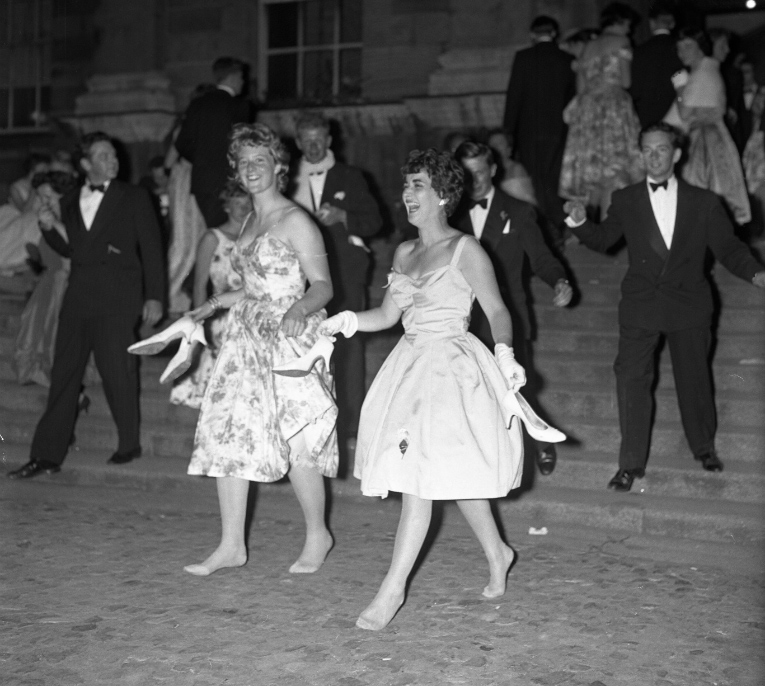
Boasting a past repertoire of artists as eccentric as its attendees — from The Smiths to Dizzee Rascal, Hot Chip to Hozier, and even a cheeky visit from none other than Mary Robinson (both as President, and as a thrifty student covertly scaling a wall in a ball gown) — it is clear that Trinity Ball has something special going for it, something uniquely appealing to performers and audiences alike. As Dublin’s most exclusive event, and Europe’s largest private party, it is undoubtedly the zenith of the college’s social calendar, sparking anticipation amongst prospective attendees year after year.
Its exclusivity is no surprise, given its close ties with Cambridge’s prestigious May Balls, esteemed annual fixtures since the 1830s. Lavished with opulence and sophistication, these require a white tie dress code from their attendees (or black tie at a push), feature luxurious banquets and the generous provision of ample champagne. The University Times, having previously taken “a cursory glance at the 1929 menu … markedly written en français”, noted “such appetising culinary delights as chicken aspic and jellied turkey”.
Thankfully, that is where Trinity appears to have drawn the line when it came to hosting the first official Trinity Ball in May 1959. While capturing much of the essence of the august Cambridge events, Trinity’s equivalent would apply its own distinctive charm, creating a more relaxed atmosphere — less feast, more festival, with the addition of considerable debauchery, as documented in almost all records of Trinity Balls past.
Reminiscing on his experiences of the Trinity Balls of the 60s, David Norris, former senator and civil rights activist, recalls “suckling pigs being roasted on a spit” and cards with information on performance times, but more importantly, the location of a “team of seamstresses” in the Elizabethan Society’s Room 6 who would more than happily repair ladies’ snagged and sullied ball gowns.
Trinity Ball would steadily wander away from sophistication towards fun with the 1970s’ new musical era, as evidenced by the Clash’s performance in 1977 and U2 in 1979. The 1981 Trinity Ball would welcome The Cure for their first-ever Irish gig, while The Smiths would make what was (in the words of Labour Party Leader Ivana Bacik) a “legendary” appearance in 1983 (one can only imagine what the formidable frontman Morrissey had to say of the whole spectacle).
However, it is Public Enemy’s headline performance in 1988 (the year zero for hip-hop in Ireland) that has been immortalised in TBall history as perhaps the most memorable of them all. For journalist Kieran Cunningham, who was on the Ents planning committee that year, “there was a real sense that Public Enemy’s visit was breaking new ground”. Following a “damp squib” of a performance on the cricket field on the afternoon of the ball, Cunningham recalls Public Enemy’s reluctance in the hours leading up to the main event. Having caught glimpses of students in their finery, “it quickly became clear that they would be playing that night to a bunch of white people in tuxedos and ball gowns”. Concerned for their self-image, there were “tense negotiations” before a compromise was reached: the band would play, but there were to be no photographs. “Student security workers actually had to go through the crowd and collect cameras.”
One student (named Trevor Butterworth of all things) was granted an exemption and thus captured on camera the iconic performance. Cunningham recalls: “There weren’t many around to witness it, but what we heard wasn’t the sound of a band, it was the sound of a movement.” Public Enemy’s Chuck D and Flavor Flav, clad in full combat dress — something that the Trinity authorities had taken great issue with, considering the event’s proximity to recent paramilitary violence in Northern Ireland —wielding fake guns, and pontificating on the Troubles, would delight the sons and daughters of middle-class Dublin who, in their frocks and dicky bows, threw their balled fists to the night sky, singing “Fight the Power.” (Ivana Bacik was simply gutted to have missed this one.)
The 1989 TBall welcomed Liverpool indie band The La’s, while the mild May of 1992 saw then little-known Jeff Buckley play Trinity’s Front Square stage in what was his first-ever European show. Having watched RTÉ’s Late Late Show from beginning to end (in the company of manager Michael Mary Murphy’s parents and a pack of Mikado biscuits), Buckley left the Dublin suburb of Deansgrange for Trinity’s elated grounds and populated cobblestones, arriving, as Murphy remembers, “wearing a Sex Pistols t-shirt and the type of red plaid suit jacket that a 1950s comedian would have worn”. The crowd was the largest he had ever played to, a fact that rendered Buckley “excited, focused and deeply pensive”, according to Murphy.
The high spirits of that year’s TBall attendees would be matched if not trumped the following year by The Prodigy, who gave an electrifying performance underneath the Campanile as firework sparks cascaded from the bell tower onto Keith Flint, thrashing below, who only just managed to avoid ignition. One TBall-goer in attendance that night claimed the performance marked “the official arrival of underground British rave culture in Ireland”.
Appearances from various acts such as The Specials, The Divine Comedy, and hordes of DJs would keep TBall attendees dancing for the remainder of the 90s, while Tindersticks greeted the millennium, headlining the Trinity Ball of 2000. Some of the big names of the Trinity Balls of the 2000s included Supergrass, Ian Brown and Pete Doherty with his band Babyshambles (who was accompanied on stage by model and then-girlfriend Kate Moss). The pair were later seen with Shane MacGowan in the early hours, propping one another up in the morning mist as they disappeared onto Nassau Street. The 2010s saw the likes of Dizzee Rascal, Rizzle Kicks (who will be welcomed back this year), The Streets and Basement Jaxx join TBall’s eminent back catalogue alongside Tinie Tempah, CMAT, and Two Door Cinema Club the following decade.
This year, Rizzle Kicks will headline with performances also from The Academic, Khakikid, Juicy Romance, and national treasures Jedward. As this year’s attendees cross under Front Arch — high heels in hand, champagne and/or Buzzballs consumed — to see the sedate grounds of Trinity transformed, they will revel in the experiences of students and layers of glamour past as this iconic night in the Trinity calendar takes its place among the many before it.