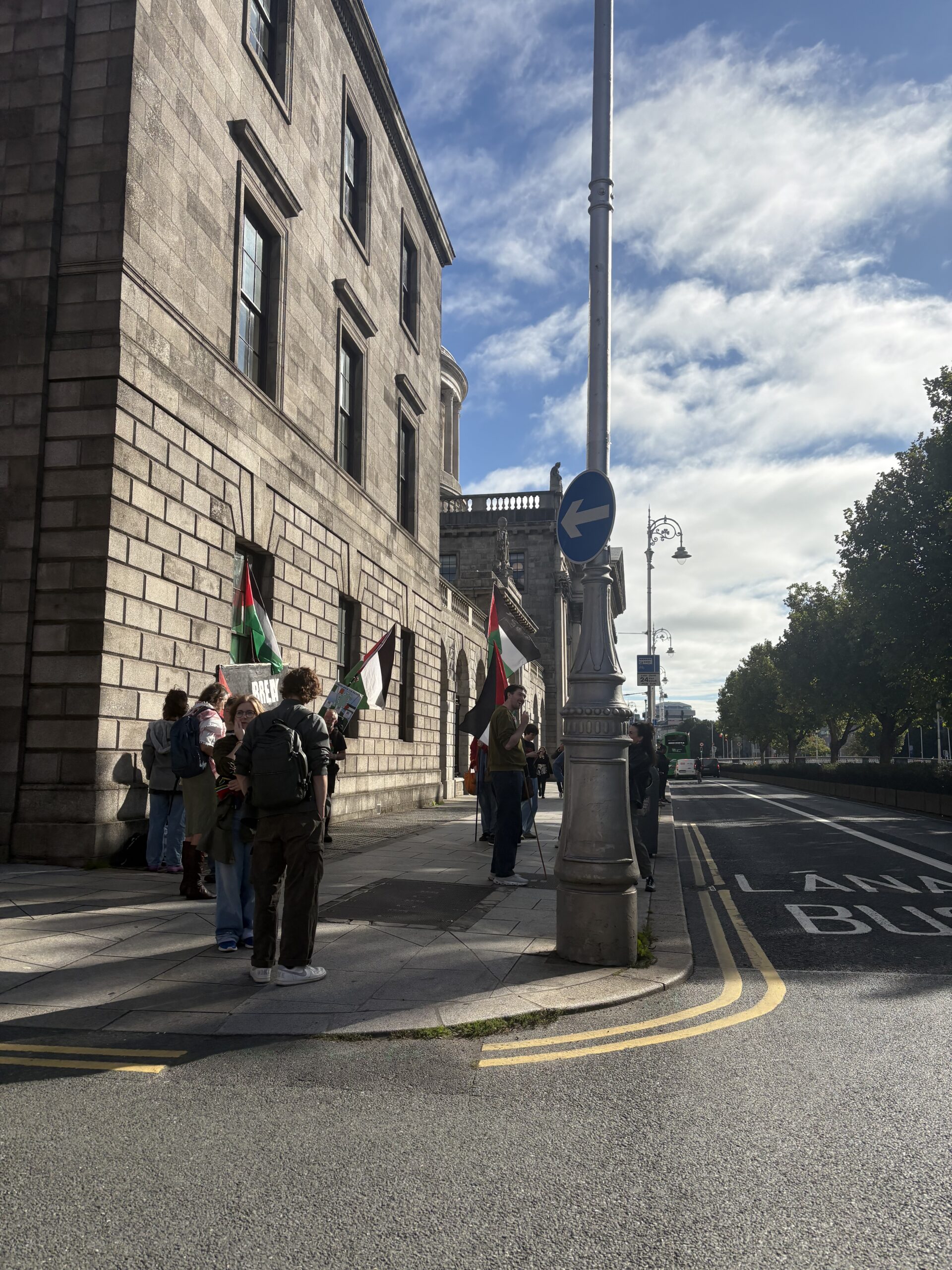

Today, the High Court heard Gazan student Hafez Alrayyes’s case for Judicial Review, and the judge expedited the matter to a telescoped hearing, which combines the judicial review and the substantive hearing. The original judicial review would open up a pathway for legal challenges to Minister of Justice Jim O’Callaghan’s refusal to grant Gazan students visas.
The state sent a representative for the challenge. This case was the only one to have a representative from the state. Judicial review is the first stage of permission from the High Court for challenges against the government, where a judge grants “leave” or permission for a case to move to a substantive hearing.
So far, the state has refused 115 student visas for Palestinians, and granted only 50. According to a briefing paper seen by the University Times provided by Helping Irish Hosts, as of August 23rd, of the 61 visa applications from Gazan students, 52 have been refused.

Today’s case was heard by Mr Justice Conleth Bradley.
Hafez Alrayyes’s visa was refused by the Department of Justice after he applied for a student visa to study at Trinity.
The legal challenge is being undertaken by Phoenix Law Solicitors, and Alrayyes is being represented by Blinne Ní Ghrálaigh and Eamonn Dornan. Ní Ghrálaigh is known for participating in South Africa’s genocide case against Israel in 2023-2024 at the International Court of Justice. She was also on the legal team of the Croatia-Serbia genocide case in 2015 and the Colstom Four trial in 2020.
The legal challenge is against O’Callaghan for refusing to grant Alrayyes a visa to study at Trinity, despite having a fully funded scholarship. The refusal was on the basis of a lack of original documents, despite the infrastructure in Gaza making it impossible to get original bank statements or to go to a post office to send original documents or appeal.
When Alrayyes’s case was heard, it was explained that he was successfully evacuated from Gaza to Spain, but still aims to study in Ireland. It was also confirmed that Trinity wrote a letter giving Alrayyes until November 2nd to start his course at Trinity, though the course started last week. This is new information, and follows a protest at the Department of Justice where students thought the deadline had elapsed for study to begin. According to email correspondence seen by the University Times, UCD has placed the deadline at September 28th, and said that their admissions policy does not allow for students to start later than the third week of their programme commencement date.
Before the case was heard, students gathered outside of the Four Courts with flags to show support. This included Trinity College Dublin Students’ Union (TCDSU) officers and Trinity Boycott, Divestment and Sanctions (BDS) Chair, Seán Radcliffe, among other supporters.
Phoenix Law’s statement said, “The Minister, we say, is well aware of these practical difficulties and has simply ignored them in the context of students’ applications. There is an unignorable irony in the fact that Ireland intervened in South Africa’s genocide case against Israel at the International Court of Justice, but cannot recognise the issues that a genocide would pose for students providing original documents in a visa application.” Adding, “The application before the court will be for leave to apply for judicial review and is grounded on our view that the Minister’s position is irrational, unreasonable, and fails to react to the necessary urgency of our client’s situation and is discriminatory.”
The state representative opposed because Alrayyes’s representation amended their statement this morning and said they needed more time. Judge Bradley suggested that the matter “might be easier” if telescoped. Ní Ghrálaigh said she would not oppose a telescoped hearing, but also noted the severe time restriction. Judge Bradley then gave the state until lunchtime Friday, September 25th to make their submissions so Ní Ghrálaigh had time to respond, and maintain an expedited timetable.
In a statement to the University Times on behalf of Minister O’Callaghan, it was noted that the Minister “is acutely aware of the grave humanitarian crisis in Gaza, and this Department continues to work closely with our colleagues in the Department of Foreign Affairs and Trade to ensure a coordinated national response to this situation. This includes working with Irish citizens and their families who may require visa assistance.”
Ní Ghrálaigh also made sure to mention other students, seemingly attempting to remind Judge Bradley that while they represent Alrayyes, the impact of the challenge extends to all of the Gazan students who are currently being denied.