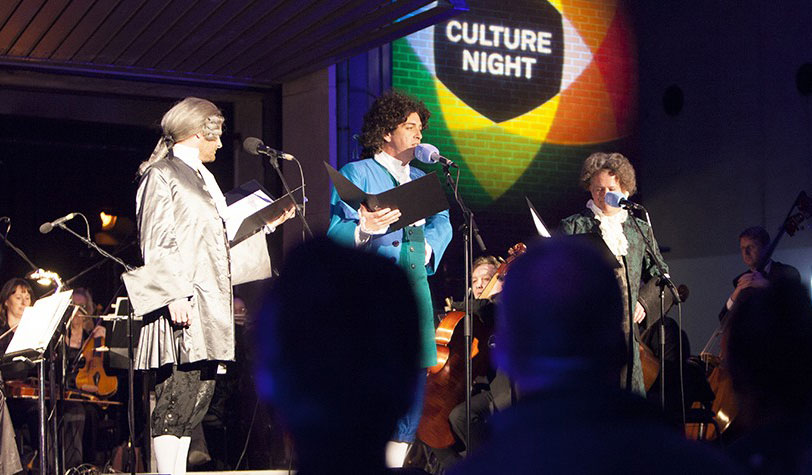

With the passing of Culture Night last month, the creatives of Ireland left a lasting impression on all those in attendance. With nearly 2,000 free workshops, events and performances hosted nationwide, the weekend left a spotlight on the rich cultural reserves of the country.
The Irish cultural scene has always held deep roots. From traditional Irish music, mastery in stained glass and céilí dancing, Ireland has historically offered broad and diverse forms of the arts. In recent times, Ireland has slowly shifted further and further into the global spotlight, from the explosion of Irish artists like Fontaines DC and Kneecap selling out stadiums to the dominance of Irish names of the likes of Jessie Buckley and Andrew Scott at the Box Office.
Trinity itself is an epicentre for the arts. Student writers and illustrators can contribute to student-led publications like the Misc and Icarus magazines or Trinity Film Review. Stage-bound students can join the Theatre Society, the VDP panto or DU Players. The annual exhibitions held by the VisArts Society give students the opportunity to submit and display their artworks.

Within the University, student creatives are afforded ample opportunities to pursue their passions. However, has Trinity life curated a community that misrepresents the reality of working in the arts in Ireland? Despite their omnipresence in Irish society, some would argue that the arts have consistently been left out of the agendas of policy-makers. With the recent news that the Culture Card failed to make the cut for the 2027 Budget, can students have confidence in the Government to support the arts once they leave the confines of VisArt’s “paint and sips” and TradSoc’s seshes?
The aforementioned Culture Card was a proposed plan to encourage young people to engage in the arts. The scheme was simple, giving all 16-year-olds a ‘culture card’ worth €100, which would allow them to avail of the cinema, theatre, and other cultural activities. While the policy could be seen as reassurance of the government’s commitment to the arts, its €7,000,000 price tag led many critics to argue the money would be better invested in an alternative. Regardless of its contentious nature, the culture card was ultimately omitted from the finalised budget for 2027.
But is the scrapping of the culture card reflective of the general treatment of the arts in public policy? Promises of support dangled like a carrot before being snatched away to prioritise other public interests. Perhaps not. While the culture card proved to be unsuccessful, BIA is another, better-received scheme, which was successfully integrated into the budget in hopes of making the lives of Irish creatives easier.
BIA, or the Basic Income for the Arts, is a scheme which provides a weekly payment of €325 to selected artists for a duration of two years. The scheme would aim to free artists from financial pressures and the burdens of creative monetisation that come with the pursuit of creative fields. However, after speaking with full-time visual artist Martina O’Brien, the BIA isn’t the state-issued silver bullet it may initially seem like.
As a full-time visual artist, O’Brien is very familiar with the BIA and reflects on some of its shortcomings in an interview for the University Times. With only 2,000 spaces offered, she feels the scheme simply can’t keep up with the number of artists applying for it, with seemingly “more and more and more” applicants every year. Furthermore, the selection process is not merit-based but rather “luck of the draw”, and even with the small chance of being chosen for BIA, all support only lasts for three years before you, in her words, “fall off a cliff”.
The treatment of disabled artists on BIA is another cause for criticism. When receiving BIA, the weekly payment is assessed as self-employed income, which in turn results in a large reduction of financial disability support from the state. The lack of intersectional oversight in the BIA’s policy means it only serves as smoke and mirrors for disabled artists.
With so much discourse circulating on the government’s treatment of the arts, the question of how students feel about the matter and their confidence in a future in the arts should be at the centre of the conversation. Caoimhe Howley, a Senior Fresh Law student, is an active member of a trad band and has a long history in music and the performing arts. While she feels “there are definitely some supports and opportunities” provided by the state, like the partial funding of Ceoltas, a non-profit cultural organisation which focuses on promoting and preserving traditional Irish music, there is “definitely significantly more that they could be doing”.
There is no clear answer as to whether the future of student creatives will be left in good hands, but it is a fair assumption that many artists, both young and established, feel uncertain. While both the Culture Card and BIA indicate the arts are featured on the Government’s agenda, critics could argue that their flaws and lacklustre implementation imply they have been heavily left on the backburner in favour of other areas of policy. Nonetheless, dialogue around it, events like Culture Night, and the blossoming contribution of Trinity students to the arts all help push the conversation toward policymakers and, hopefully, will stabilise the infrastructure of the Irish arts.