
In 1729, the Irish author Jonathan Swift published “A Modest Proposal”, a satirical pamphlet in which he proposed a solution to poverty in Ireland: impoverished families should sell their children as food for the wealthy. His deliberately grotesque proposal presented human suffering as an economic problem rather than a moral failure. Today, his satire provides the basis for “Everyone Should Have a Home”, an exhibition at the Centre Culturel Irlandais (CCI) in Paris that examines Ireland’s housing crisis through contemporary art.
Bringing together ten artists, the exhibition examines Ireland’s housing crisis through film, photography, painting, sculpture and installation. Mould collected from damp apartments is used as an artistic material; abandoned housing developments and materials display the aftermath of economic downturn, and ordinary doormats feature messages aimed at holding politicians accountable. The exhibition, which closed on October 28th, explored both the inaccessibility of housing in Ireland and how art brings this reality to an international audience.
Located behind the Panthéon in Paris’s Latin Quarter, the CCI promotes Irish culture and heritage through exhibitions, film screenings, literary events, performances and debates. Its Médiathèque, a public multimedia library dedicated to modern Ireland, and its Old Library, which contains more than 8000 volumes, preserve Irish cultural heritage in France. The centre also houses historical archives documenting the Irish Colleges in Paris from 1316 to 1999 and provides accommodation for Irish students studying in Paris and cultural professionals undertaking work abroad. It is a space aimed at fostering connections between Ireland and its diaspora while introducing international visitors to Irish cultural life.

The building was once the Irish College, established to educate Irish students who faced restrictions on Catholic education at home. Its origins date to 1578, and the present building was completed in 1775, continuing to help Irish students and clergy for generations, despite being seized during the French Revolution. Later accommodating Polish seminarians, it underwent a €14.5m restoration funded by the Irish government before reopening as the CCI in 2002.
A building originally created for Irish people who had to leave Ireland to pursue an education now hosts an exhibition about Irish people who struggle to afford to stay.
The exhibition’s title comes from the song “Everyone Should Have a Home” by Martin Leahy, a singer and housing activist from West Cork. Mary-Ruth Walsh, one of the exhibiting artists, explained in an interview with the University Times, Leahy travelled to Dublin by train every Thursday for 200 Thursdays to protest outside political offices.
Walsh, whose work forms a central part of the exhibition, has spent much of her artistic career examining the relationship between architecture, public space and the people who inhabit it. Originally trained in nursing, she later studied at the National College of Art and Design in Dublin and Goldsmiths in London. Her practice spans drawing, painting, film and installation. Through “guerrilla architecture”, Walsh creates structures in public spaces that draw attention to how architecture shapes people’s lives and, in particular, whose needs architecture actually serves.
Her installation “A Modest Proposal — Paris” establishes the exhibition’s engagement with Swift. Alongside Kevin Higgins’s poem “A Modest Proposal to the Housing Minister”, it emphasises the distance between political rhetoric and the lived experience of housing insecurity. Swift’s original satire exposed the cruelty of reducing human suffering to a problem of economic calculation. In the exhibition, that same critique has contemporary significance — when housing is treated primarily as an investment or a measure of economic performance, the people who need it the most become secondary.
Walsh’s interest in the connection between architecture and human need is seen in many spaces outside the gallery. In 2000, she installed an architectural intervention outside Ireland’s National Archives. She kept it just below the size that would require planning permission. Today, it remains there. The Archives retained the structure and even moved it slightly when the building was being cleaned.
The exhibition itself emerged from a similar concern with the experience of homelessness. Walsh explained that the exhibition’s curator, Nora Hickey M’Sichili, had wanted to develop an exhibition addressing the housing crisis and homelessness. During and after the Covid-19 pandemic, both Walsh and Hickey M’Sichili had become increasingly conscious of people experiencing homelessness around the CCI and elsewhere in Paris. Walsh described feeling a “deep empathy with people who don’t have the privacy, the warmth, the shelter, and the comfort of a place they can call home.”
The exhibition’s accompanying pamphlet expands on this — “A bed to sleep in, a roof over one’s head; these are basic needs. Ensuring that everyone has a sustainable place to call ‘home’, where they can rest and build their lives, is both an ethical and an economic necessity.”
By approaching the housing crisis through several different artistic mediums, the works expose the effects of Ireland’s housing crisis directly.
Avril Corroon’s “Spoiled Spores” is a piece made from cheese produced using black mould collected directly from damp apartments in London and Dublin. She uses these materials to display the conditions in which people are forced to live. The work draws attention to the consequences of poor-quality housing as a source of harm.
Niamh McGuinne’s “Hammartia” refers to the “Mica” housing scandal, in which defective building materials have left homes vulnerable to serious structural damage. John Lalor’s “Ruthless Landscape” looks at the aftermath of Ireland’s 2008 property crash, with paintings of unfinished, abandoned housing developments.
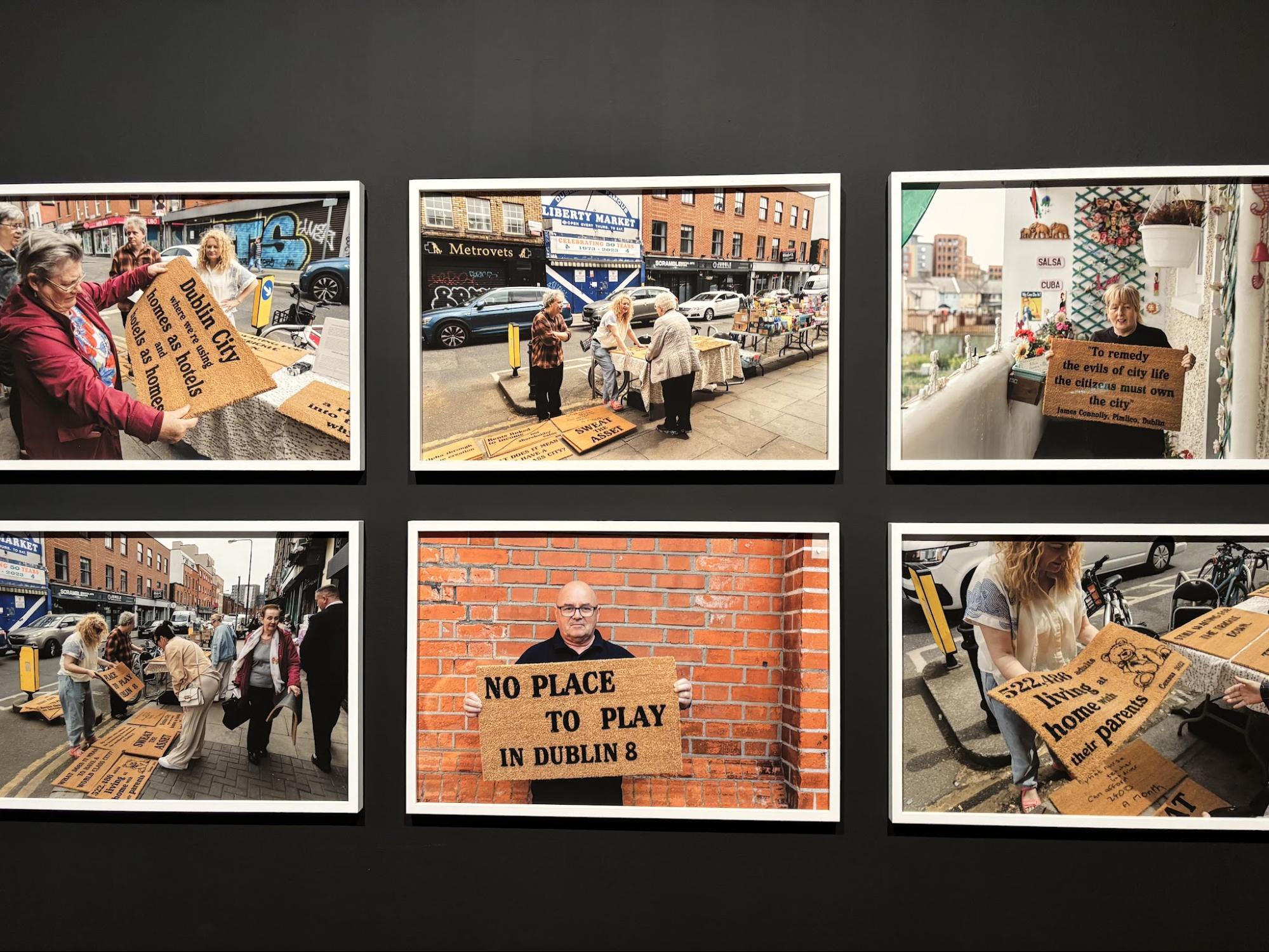
Other artists focus on the political language surrounding the issue. “School of Thought”, the collaborative work of Augustine O’Donoghue and Conor McCabe, presents doormats bearing important messages — “No place to play in Dublin 8”, “Dublin City where we’re using homes as hotels and hotels as homes”, and “What nurse teacher bus driver can afford 2400 a month”.
The aim is to hold politicians accountable through these messages. The reference to nurses, teachers and bus drivers is particularly striking as it emphasises that cities are often inaccessible to the very people who keep them functioning. Eva Richardson McCrea’s film “The Decameron / Na Deich Lá” examines co-living as an increasingly common reality. The work invites consideration of how shared space is often not a matter of choice. Across these different mediums and approaches, the exhibition makes us confront the housing crisis through the everyday spaces and materials that surround us.
Walsh was enthusiastic about the exhibition’s range, praising Hickey M’Sichili for bringing together works that contain “humour”, “tragedy” and “conceptual” approaches across different forms of media. The use of such a wide range of materials offers an unconventional way of exploring the housing crisis.
For Walsh, the fragility of these materials is especially important. She describes some of her works as “temporary sort of mini architecture”, often using cardboard and paper to create structures that appear vulnerable and provisional. Their impermanence contrasts with the expectation that a home should provide lasting security. “The medium of housing, I think, is something that, it fascinates me.” As she puts it, “I think we all think that where we live, the house will be there hundreds of years, but most likely it won’t.”
This concern also relates to her interest in the possibilities of building houses with fungi. “I just hope we can grow houses from fungus,” she said, describing the potential to develop fungal materials that could be solidified, insulated and used in construction. The idea offers a different way of imagining housing and the natural world. We should consider the possibility of homes being grown from organic matter, rather than relying exclusively on conventional building materials, she said, describing it as “sort of an organic approach, where houses could be grown and added to.” Walsh is interested in the connection between the visible structures that provide shelter and the less visible networks of mycelium beneath the ground. Her suggestion introduces a very interesting possibility into the future of housing.
The exhibition offers Irish people living in France a way to connect to Irish political realities through art. Exhibitions that bring political issues into different settings allow members of the diaspora to encounter these issues through the perspectives of contemporary artists. This is part of the wider impact of Irish cultural centres around the world. For example, The Irish Cultural Centre in Hammersmith, London, brings communities together through music, theatre, literature, visual art and educational programmes. Such institutions preserve cultural connections and introduce new audiences to Irish life. The CCI similarly creates opportunities for Irish artists to share their work internationally and for people in France to engage with contemporary Ireland. For Irish people in Paris, it offers a way to remain connected to concerns at home. It also creates space for conversations about both public policy and everyday experiences of Irish people.
The building’s past as a place of refuge for Irish students is significant. Centuries after its establishment, it continues to provide a home for Irish students abroad, now also giving space to artists questioning why it is so hard to find a home in Ireland. In Paris, this carries added importance. France is facing its own housing crisis, with rising rent and growing difficulty accessing affordable housing accommodation in many cities, particularly Paris. The circumstances are not identical. However, the political message of this exhibition resonates in both countries and many others worldwide.
The exhibition demonstrates how cultural institutions can connect the diaspora with contemporary Irish politics while opening those issues to new audiences as well.