
Trinity’s student body has often been regarded as notably politically active, with students proactively engaging with a number of causes on both grassroots and students’ union levels. This activism is met with a variable response from the college, a response which, in recent times, has largely been positive and engaging.
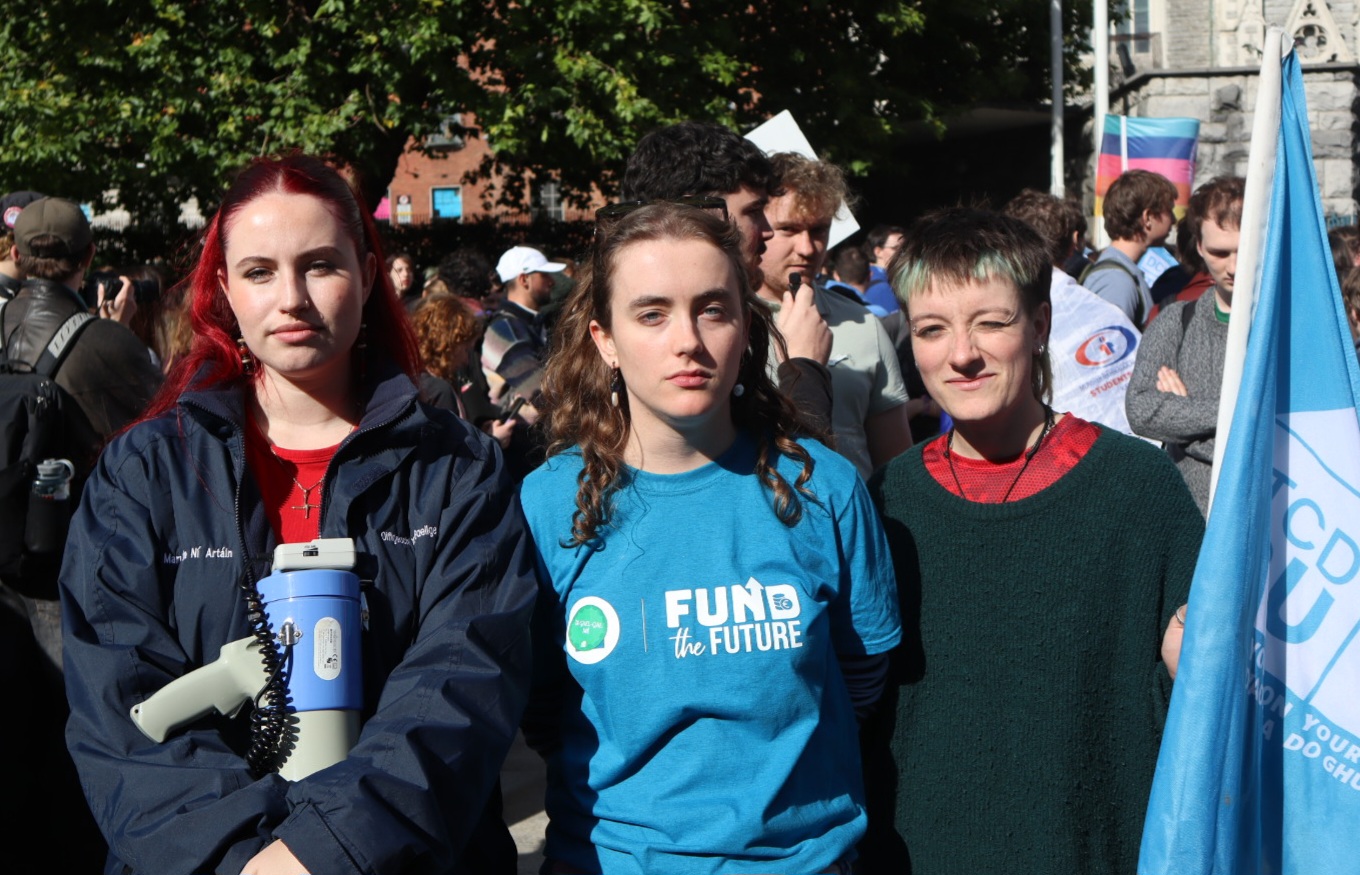
This October, the “Fund Our Futures” National Student Demonstration was officially authorised by Trinity. In a college-wide email, Vice-Provost and Chief Academic Officer Professor Orla Sheils excused any absences for students wishing to participate in the protest. Trinity’s relationship with student body activism has recently been marked by similar endorsements from the college. Regarding the denial of visas for Gazan students, an issue spearheaded by pro-Palestine groups, including Trinity’s own, the Vice-President for Global Engagement encouraged students to lobby government officials in an email sent out in August.
Recent communications would therefore suggest a harmonious relationship between the activism of Trinity students and the College itself. To what extent is it the case that student activists find themselves and their causes adequately supported by Trinity?

The answer is, of course, highly mutable. It is worth noting that the channels of communication between the student body and the College are plentiful. The Trinity College Dublin Students’ Union (TCDSU/AMLCT), for example, has regular meetings with staff from the college board. Further, representatives from the union take up places in meetings of the 24 different academic schools that make up Trinity.
TCDSU/AMLCT President Amy Kennedy said that on practical issues, the university is generally quite reliable.
“Issues like furniture [and] heating” are met with a positive, “quite good”, and helpful response from Trinity. This, according to Kennedy, is in part due to several established institutional routes through which students can raise practical problems with the college. For example, Trinity and the SU share an informal agreement that allows the SU to ask the College to send out emails excusing student absences when TCDSU/AMLCT-backed protests are taking place. While the agreement is unwritten and simply based on precedent, it does demonstrate how student activism may be institutionally supported.
On more nuanced and less physical issues, negotiations are made somewhat more complicated. Trinity Boycott, Divestment and Sanctions (BDS)’s participation in the “Let Them Study” campaign is one instance of collaboration between student activism and Trinity endorsement. The campaign aims to secure previously rejected student visas for a number of Gazan students who hold places to study at a variety of Irish universities, including Trinity. It should be said that the bulk of activism for this campaign, or the public campaigning, has been done by students. The blockade of the Department of Justice in September, for example, was undertaken by a number of student representatives, including the majority of TCDSU/AMLCT’s sabbatical officers. While Trinity Global, in the aforementioned email sent out in August, referred to the situation as “deeply concerning” and pledged to work alongside the Irish Universities Association on the matter, it is debatable to what extent they are passing on responsibility to the student body.
Chair of Trinity BDS, Seán Radcliffe, spoke of the mixed engagement from the college. Positively, Radcliffe noted the registration extensions offered by Trinity to affected Palestinian students, meaning students whose visa rejections are overturned can start their studies after the deadline. On the other hand, Radcliffe, who has spoken at other Irish universities as part of his role, highlighted the relative difficulty of cooperating with Trinity in comparison to other universities. Their engagement, according to Radcliffe, is often easier to secure when NGOs and other official (read: non-student) bodies get involved. Perhaps the issue, more than anything, is that student-led activism is perceived as less legitimate.
Regarding the “Fund Our Futures” campaign and protest, demands for closing the funding gap in tertiary education were shared by both students and institutions. Provost Linda Doyle publicly endorsed an opinion piece calling for an extra €190,000,000 in government funding to be put towards universities ahead of the 2027 budget. In the case of “Fund Our Futures”, where the goals of students and Trinity were aligned, Trinity’s support of the SU campaign and protest was evidently backed by sufficient action. Kennedy noted the presence of the Provost at the march, which took place on October 1st, as well as Trinity members of the IFUT (Irish Federation of University Teachers).
However, Kennedy also called for more “consistency of activism across the board”. On issues where student campaigns could cost the college money, Trinity is more reluctant. In the campaign leading up to the recent ending of Trinity’s exclusive pouring contract with Coca-Cola, discussions initiated by the SU with the college were slow. “They were apprehensive talking about that”, said Kennedy, who pointed out that on issues such as tender, “we [the TCDSU] have to be a little bit tougher”, because their campaigns may “damage their [Trinity’s] competitiveness on the market”.
Moreover, there is an issue of the individual versus institutional when it comes to cooperation. “We have great allies in the staff”, said Kennedy; “it’s just institutionally in the policy-making”. Where good relationships may be forged between members of the Trinity board and SU, translating these relationships into supporting college policy is another matter. This discrepancy leads to support for student activism being “sporadic”, at least to Kennedy.
The matter of follow-through is identifiable particularly regarding other BDS movements. When Trinity agreed to divest from the state of Israel in 2025, it did so “on the back of student activism” which culminated in the five-day encampment in May 2024. Yet Kennedy argues that in some instances, the college is guilty of “backpedalling”, particularly regarding Trinity’s continuation of the Dual BA programme with Columbia. Both TCDSU/AMLCT and BDS have repeatedly called for the university to end the programme over the contentious matter of pro-Palestinian activism at Columbia University. To Kennedy, the Dual BA is an issue where the college has “got to put your money where your mouth is”. Currently, there are no plans to end Trinity’s collaborative programme with Columbia.
It is worth examining what issues Trinity will concede on, and what they are willing to be combative on. The latter normally constitute areas where the college generates revenue or establishes links to bolster Trinity’s academic profile. Ultimately, this creates a minefield for student activists to navigate: how should the college engage with student protest without compromising how it functions on a global scale?