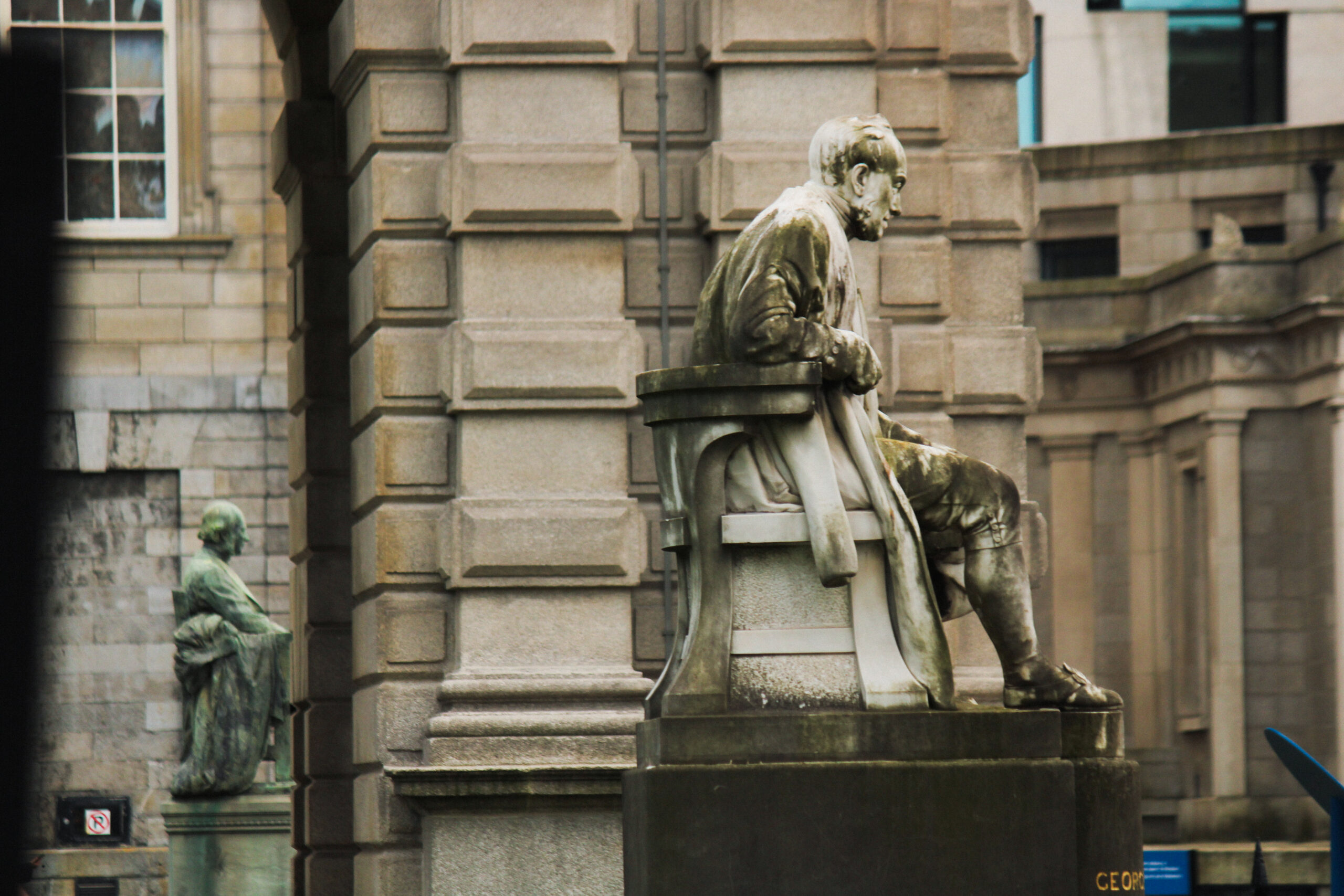

The quintessential Trinity student braves the cold of November to smoke outside the Arts Block, holding a (rolled) cigarette between fingers that extend from fingerless gloves. They own a pair of Doc Martens and have read Marx, or at least claim to (just don’t push them on the details, yeah?). The quintessential Trinity student also considers themself a leftist and faces pejorative accusations of champagne socialism during the annual post-Christmas dinner political argument. But, contrary to popular opinion, this perception is not accurate; these individuals do not represent the majority but rather make up a small part of the student body who just happen to be particularly visible on campus. How is it that our perception of the majority — or socially accepted external opinions — influences our ability to present ourselves as individuals; and more specifically, to share our political beliefs?
The college years offer a chance to experiment: new interests, new people, new experiences; and during that time, it is perhaps from the exchange between students that we benefit most. But exchanges, especially those involving political beliefs and values, rely on confidence and require a respectful audience. In an increasingly divisive political atmosphere that has seeped into student life, how comfortable are those considered outside of Trinity’s left-leaning echo chamber sharing their views? To quote Aristotle: “It is the mark of an educated mind to be able to entertain a thought without accepting it.” One’s opinion cannot be verified unless first challenged. Without meaningful discourse and a consideration of opinions which contrast our own, how can anyone be confident in their political beliefs?
James McCullen, Chair of Trinity People Before Profit, shares his experience of Trinity’s political atmosphere: “There is a decent variety of perspectives, but the majority of viewpoints are encompassed in an echo chamber”, one he sees as “liberal in essence, left-wing in appearance”. Holding views that are further to the left, McCullen considers himself outside of the “echo chamber”. He refers to the general perception of Trinity’s political majority: “A lot of people who might find themselves quite comfortably in the political discourse would view themselves as very left-wing, but I would argue that there is a dominant liberal, [and] incredibly individualistic viewpoint when it comes to politics.” Speaking on the importance of discourse, McCullen says: “Ideally, there should be a very lively and open expression of political views.” Instead, he feels as though “people themselves are afraid to go against the tide. They will self-censor their positions; they won’t stick to their principles. Instead, they’ll just agree with what the crowd is saying.” Could it be that the wise students of Trinity College have fallen under the liberal spell of a malevolent majority?

In recent years, politics has witnessed a significant shift towards division and acerbic personal attacks on political opponents. McCullen refers to the increasing fragmentation, as well as a broader deterioration of political consciousness: “Things have become more crass, more messy in a sense.” He refers to what could be seen as performative politics and its futility; calling people out on social media under the guise of activism; and the threat social media represents to individuals sharing splinter views. In terms of discourse between different societies, McCullen calls for a “more concerted effort” to improve campus discourse.
Max Grasso, Chair of Wolfe Tone Cumann (Trinity’s branch of Fianna Fáil), is unsure as to whether a political majority or echo chamber exists in Trinity, feeling instead that left-leaning views get more attention because their holders “shout the loudest”. He went on to describe these people, who he sees as being part of a small group rather than a political majority, as “quite troubling; they’re very far to the left [and] they seem to hold some sort of campus influence where they can position themselves to shout the loudest”. But does this inaccurately convey Trinity’s political majority as a result of some abstract force rather than a genuine social pattern contributed to by students who consciously form their own political opinions, which just so happen to fall in line with the majority?
Personally, Grasso has no problem sharing his views, but suggests that he is part of a minority that engages politically: “There’s quite a strong disengagement from politics.” Grasso is strong in his belief that there is a need for more political discourse on campus and describes his willingness to converse with just about anybody. When pushed on this, however, he mentions his lack of interest in “toxic” discussion and anti-democratic discourse, which he will not tolerate, thus suggesting, and fairly so, that there is “a line” when it comes to political discourse. In terms of intersocietal relations, Fianna Fáil has a “positive” relationship with Trinity Social Democrats but has little engagement with other groups, particularly with those Grasso and other members of the society would see as extreme left, namely the Workers’ Party TCD.
Mia Frishberg, President of Trinity’s Jewish Society, is resolute in her belief in the existence of a political echo chamber in Trinity. Frishberg says that she has seen very little political discourse, “And if there’s any sort of dissent, it is treated as a character flaw of someone who disagrees, rather than political conversation.” As somebody who would consider herself to be “more on the right wing than a lot of Trinity students”, Frishberg is “very uncomfortable” sharing her views and identity in Trinity — particularly having seen the experience of friends with similar beliefs. She mentions the treatment of one of her friends, who is very publicly right-wing, “a little more extreme” in his views than her: “People take it as an opportunity just to bash his character, to say rude things about him as a person just because his politics don’t necessarily agree with theirs.”
Trinity is very strong in its solidarity and support for the Palestinian people during Israel’s continued genocide, and there can be a conflation between the actions of the state of Israel and the Jewish faith as a whole. I put this to Frishberg, wondering if it had affected her comfort in sharing her Jewish identity. Her reply was: “In a way, I don’t blame people fully because I understand that the Jewish population of Ireland is so small that when you see something that’s outwardly Jewish, even when you see a Star of David: if you’ve only seen that star on the flag of Israel, then you will conflate the two.” This attitude was particularly obvious to Frishberg during Freshers’ Fair: “People would walk by our booth and laugh, or take photos, or sort of nudge their friend and say, ‘look, look!’ It was almost like we were zoo animals. That was so sad to me [but] ultimately, we realise that the fact that that kind of sentiment exists is the reason we exist, is the reason that it’s so important to have a space for Jewish students on campus.”
Trinity’s Jewish Society is entirely apolitical. Next week, they are planning a social event with the Arab Society: “No discourse, just human, cultural, bonding over hummus.” However, Frishberg does believe that political discourse is also crucial to improving the experience of students who find themselves outside of the political echo chamber. In terms of her own experience, she says that the vast majority are “very open” to discourse. Like Grasso, she draws the line at disrespect when it comes to discourse: “If someone wants to enter a conversation, and their only intention is to be rude or tear us down, I don’t see any purpose in [it].”
Trinity’s political majority is elusive; too liberal for McCullen; for Grasso, too extreme; for Frishberg, too closed-minded. So then, who is represented by it? Does Trinity’s echo chamber really exist, or could it simply be a way for those who do not feel represented by it to opt out of real discourse; an excuse to dismiss those who disagree as irresolute and ill-informed? Or is it true that Trinity’s political atmosphere is dominated and repressed by an overbearing majority?
Regardless of one’s opinions, there is, and will always be, a need for open discourse. If things are to improve, if students are to feel more comfortable sharing their views irrespective of where they fall on the political compass, it will be as a result of a concerted effort to engage with contrasting opinions. A closed mind is one that cannot be expanded.