
You may have gotten it through your letterbox: the government’s “Be Emergency Ready” booklet. Launched by Minister for Defence Helen McEntee on August 28th, the campaign saw 2.2 million booklets posted to households around Ireland with the aim of providing “information and advice in case of emergencies”.
This campaign seems to be a reaction to the EU’s Preparedness Strategy launched last year, which aims to achieve 72 hours of self-sufficiency among populations in the event of “unprecedented threats”.
Before one begins reading the booklet, its very design catches the eye: eighteen pages, coloured ink, a gloss finish, and stapled at the spine. Objectively, a nicely made booklet. What we know about nice things is that they often come at a price – especially when they are produced at a scale as large as 2.2 million copies. But what information could be so important as to warrant such a widespread public campaign?

The contents are basically exactly what you would expect them to be. Keep a food and water stash, have power banks and torches, know where your important documents are. Nothing particularly enlightening.
But the revelation of the booklet lay not in its words but rather in its indication of government concern. What had seemed like an innocuous public safety booklet in fact conveyed a sobering reality … there is a material threat of national crisis, and our government is preparing us.
The Irish government is not an anomaly in this action. The Netherlands, Sweden, Finland, and Denmark have all rolled out similar campaigns, with the Swedish booklet making express reference to war, a term notably excluded from the Irish version. There is express reference in the Irish booklet to “storms, flooding, cyber attacks, and disruptions to critical supply chains”, which would make sense considering the recent devastation brought by Storm Éowyn and the HSE cyber attack in 2021, as well as Ireland’s general propensity for flooding, power outages, and water cuts.
Although it is not expressly stated, war is nevertheless subtly suggested throughout the booklet. In an increasingly militarised world, it would be naive to deem war an impossibility.
As a militarily neutral country, the thought of war in Ireland seems unimaginable. However, our neutrality is limited to a military scope; if anything, Ireland is famously unneutral in terms of the humanitarian assistance it affords to nations in need.
In his speech at the 81st United Nations General Assembly this September, Irish Taoiseach Micheál Martin condemned Russia and Israel and expressed solidarity with Ukraine, Palestine, and Sudan, which is reflected in the humanitarian aid given to these nations from Ireland. According to government figures, Ireland has given over €670 million to Ukraine, €144 million to Palestine, and €35.3 million to Sudan in humanitarian aid to date.
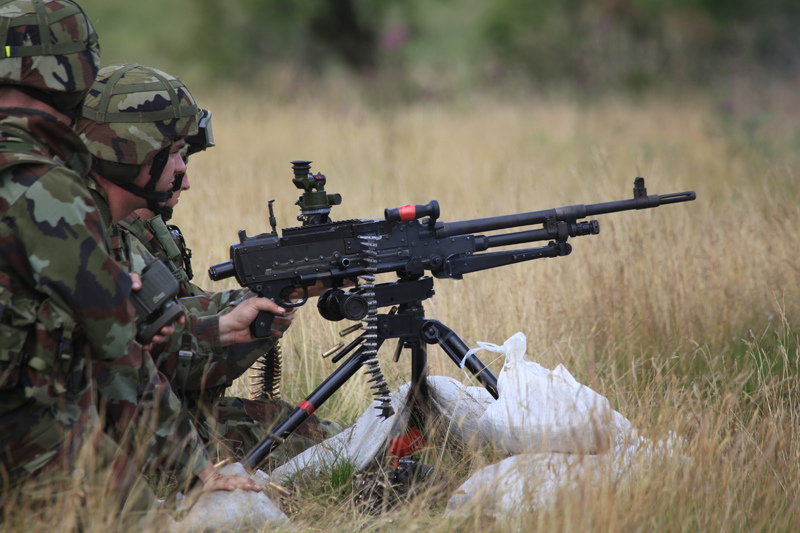
Furthermore, Ireland engages in United Nations Peacekeeping missions around the world, where members of the Irish Defence Forces are deployed to unstable regions as “generally infantry units, lightly armed for their own defence only”, according to the Irish Defence Forces’ website. Currently, there are approximately 100 Irish peacekeepers in deployment across Lebanon, Syria, Mali, Bosnia and Herzegovina, and Kosovo.
The website goes on to explain: “United Nations Peacekeeping helps countries torn by conflict create the conditions for lasting peace. […] In addition to maintaining peace and security, peacekeepers are increasingly charged with assisting in political processes; reforming judicial systems; training law enforcement and police forces; disarming and reintegrating former combatants; supporting the return of internally displaced persons and refugees.”
Ireland engages in this international deployment through the triple lock mechanism. This mechanism requires domestic cabinet approval, parliament approval, and a UN mandate before Ireland can deploy more than twelve soldiers on an international mission. As such, the permanent members of the UN Security Council essentially have the power to veto international Irish Defence Forces deployment.
Former independent TD and soldier Cathal Berry believes that neutrality is used to excuse Ireland’s naive defence policy. “We don’t recognise how vulnerable and exposed we are”, Berry shared in an interview with DW. “I don’t think we’re neutral, I think we’re just defenseless.”
According to Irish Times figures from September 2026, 68 per cent of people support Ireland’s current model of military neutrality, with 44 per cent of people wishing to keep the triple lock and 34 per cent wanting it gone.
In terms of party stance, the 2025 Irish Times figures reflect that the majority of Fine Gael wished to abolish the triple lock and Fianna Fáil seemed split. Opposition parties were strongly in favour of its retention. More recently, there has emerged an impetus to host a referendum on the issue. The argument in favour of removing the UN aspect of the triple lock is dominated by the government parties, Fine Gael and Fianna Fáil, demonstrating how these parties have mobilised a united front on this issue over the past year.
These government parties argue that lifting the triple lock will not alter Ireland’s pledge of military neutrality, but rather ensure that decisions on the deployment of Irish military forces are left solely to the discretion of the Irish people to the exclusion of the UN. In a Dáil debate on this issue from September 23rd, the government acknowledged that Ireland cannot rely on its geographic isolation for security, being the highly globalised country that it is.
Ireland’s defence spending is exceptionally low by EU standards, or by any standards for that matter. In 2026, Ireland’s defence spending was €1.5 billion, which translates to 0.22 per cent of GDP — the lowest rate in the EU.
Ireland’s defence capabilities are low and limited. Putting military neutrality to one side, Ireland does not even have the ability to defend itself from attack with the current lack of defence funding and infrastructure.
Even hosting the EU presidency for six months of this year has stretched Ireland’s defence capabilities to the maximum, with our country relying on military aid from the UK and France, without which security standards could not have been met.
In our increasingly militarised world, Ireland’s reluctance to militarise is admirable in some respects but strikingly naive in others. Our current reality is that Ireland is vulnerable to military threats and could not defend itself if an attack materialised. Ireland is not politically neutral, and hence not removed from world conflict.
The “Be Emergency Ready” campaign appears to be the government’s soft launch of the possibility of a military threat. It is one (albeit small) step in the direction of becoming a country with strong defence measures and a prepared population.
For a booklet that says very little, it certainly does convey an awful lot.