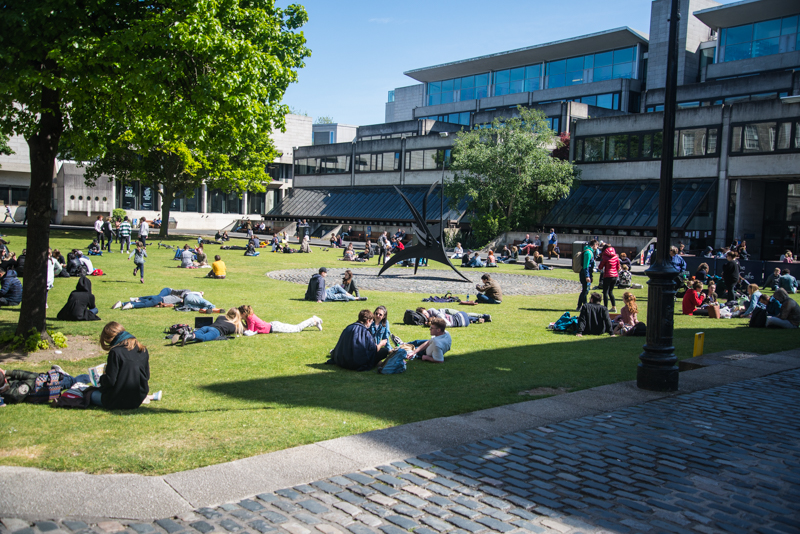

So here you are, in a very decent college, aren’t you lucky? You have the opportunity to receive a 3rd level education, an opportunity to shape your mind into something important and wonderful. And then, let’s say it begins in the Arts Block, as these things do. Four friends, damp coats steaming, coffee cooling. The chat is easy – lectures, essays, what to do later, what to do at the weekend – until someone says something like, “Can I ask a slightly political question?” There’s a bit of a shift, or a nervous giggle, and all that’s happened is permission requested for a thought, on a campus built for debate of any kind. That small interaction tells a much bigger story.
So, do Trinity students feel free to write, perform, or speak about awkward, unpopular things? Thankfully, we have societies that chew on ideas for sport. The student press still takes big swings. Yet there’s a quieter habit running underneath – people talk themselves out of talking. Not because security is going to pull the mic, but because the social cost feels high and the room can turn cold in a heartbeat. We have a lot of ladders to speak from but a lot of reasons to climb down.
The old map of left and right doesn’t really help to understand the landscape here. What matters now is how we speak, how we organise, and how strict the boundaries get.

I want to make sure this comes off as an analysis of the political energy in this college. The basics of dignity are settled; these conversations are still worth having.
When people say “too left” on campus, they usually don’t mean “wants better housing or climate action.” They mean a style of politics that treats every slip like a sin and every conversation like an inspection, shifting the focus from outcomes to etiquette. You get long lists of must-say and must-not-say posters, covered in disclaimers, along with a general sense that the real test is whether you know the script. Then the backlash kicks in, and some critics roll their eyes at any standard at all, as if basic respect were optional. That’s the loop.
It starts from a good place, protecting people who get hurt most often. But the centre of gravity shifts. The work becomes proving you belong to the right crowd, not making the world less sharp for someone else. Rules multiply. They stop being guides and start feeling like barriers. The mood tilts from curious to administrative. You see it when a clumsy phrase gets the same blast as actual cruelty, or when a debate or lecture spends more time on pre-clearance than on ideas. That’s how a politics built for care turns stiff.
With the access our young and impressionable minds have to the abundance of often shockingly poor media, this type of dynamic isn’t surprising. For instance, your Explore page learns your tells and serves the same dish back, just a little hotter. That’s how the “too left” posture gets turned into reflex, and the mirror image happens on the right or far right. Short clips reward snap verdicts over slow thinking, while Stitches turn disagreement into a crowd sport.
The other pressure is the terror of being wrong in public. Trinity is a talkative place, and talk sticks. A clumsy word in the GMB or a half-baked take in print can linger longer than smoke on your jacket after the Pav. That’s enough to make people go quiet. You can see it in any student conversation, shrink-wrapped and smoothed to the safest angle. You see it in seminars, hands half-raised, then stay down. I am seeing and often feeling a kind of perfectionism that masquerades as caution, and it means curiosity calls in sick. This is a place to expand your mind, and we are very lucky to be here. Whether you like it or not, the occasional dodgy question should not ruin your day or become social suicide.
You didn’t learn to cross the road by trial and error. Someone took your hand, looked left and right with you and waited for the gap. We don’t teach survival by letting people get hit. So when someone gets it wrong, as someone inevitably will, tell them straight. Give them a route to amend, update the line and apologise if needed. Then move on. A big public dunking hardens people into the version of themselves you least want to deal with. Quiet correction, with a touch of grace, turns a stumble into a step.
I don’t miss the point that some speech is flatly out of bounds. If your idea of debate is denying someone’s humanity, you don’t need a microphone – you need remedial empathy. Racism, sexism, homophobia, transphobia – none of that is up for negotiation. The question is, what do we do with the rest? The in-between territory of clumsy questions, sharp disagreements, evolving language and genuine uncertainty. If our politics can’t survive a messy question, it won’t survive a messy world.
Really, it’s an issue across the board, and clearly it isn’t that bad here; otherwise, I wouldn’t feel comfortable enough to publish this. Of course, it differs depending on who you surround yourself with. The pre-emptive apology before a point, the half-raised hand, the joke cut because it might read wrong. Naming those tells isn’t melodramatic, and it isn’t me trying to start a fight. It’s maintenance, and it’s a question I’d consider important. We can keep the place open by noticing where it narrows.
None of this means dropping standards. It means admitting we sometimes swing too hard at the small stuff and too softly at the big stuff. It means remembering that you came to university to have your mind changed by other minds, not to audition for the role of a person who is always right and does no wrong.
There’s a practical upside – conversation is a muscle. Use it on campus, and the world off campus gets less frightening. If you can sit in the GMB and say, “Here’s what I think, here’s where I might be wrong, please argue with me,” then a staff meeting, a family dinner or observing your own country’s politics – none of it will beat you. You will learn to hold your ground without treating disagreement like a personal insult. You will learn to change your mind without treating it like defeat.
Back to that Arts Block table. The student who asked for permission to speak politically. The others don’t pounce; they ask questions. One of them says, “I see that, but what about…” Someone else adds a story from their point of view. There’s pushback, there’s a pause, there’s a new angle. No screenshots. No victory lap. Just the slightly awkward, oddly satisfying work of thinking together. The coffee goes cold. The mind warms up.