The days of car-centricity in Dublin are long behind us, but have we arrived at the proposed better, less congested destination yet — or are we still stuck in bureaucratic traffic? Dublin lands itself in a whopping third place for the most congested cities in Europe, but is not even one of the top ten biggest European cities — what is going on with the Dublin City Centre Plan and Grow College Green Project?
The five most congested European cities are ranked as follows: London, Paris, Dublin, Rome and Brussels. Globally, Istanbul is the most congested city in the world, and Dublin has creeped up to 15th place. The significance of Dublin’s place in these rankings can be illustrated by its geographic size in proportion to the other cities. London is 15,000km squared, and Dublin is 114km squared, yet they are only two places apart in the ranking! In Istanbul, a city of 5300 km squared, drivers experience a total average delay of 101 hours. Compared to Dublin, of 114km squared, where the total average delay is 81 hours — a mere twenty-hour difference. Though striking, these rankings should not be surprising to the average Dublin driver who experiences the mad traffic every day; with a 10km journey in the city taking 29.5 minutes on average.
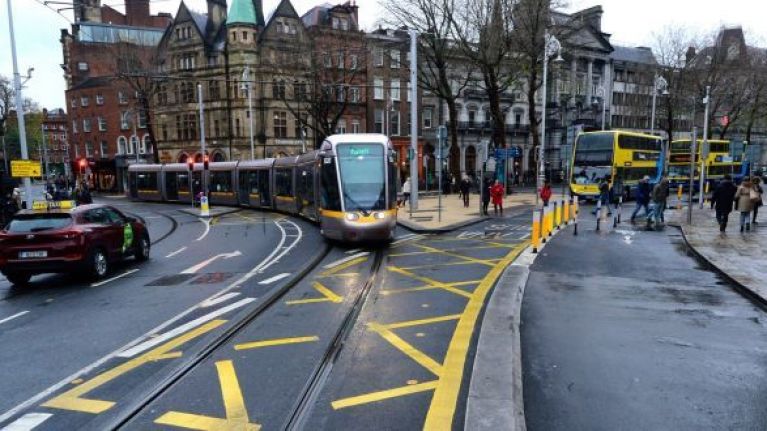
Dublin’s infrastructure and development was initially centred around car travel being the primary mode of transport. This position has drastically changed. In 2022, Dublin City Council committed to pivot away from car-centricity and make a move toward sustainable modes of transport, public transport and pedestrianisation through the Dublin City Centre Plan (DCCP). It contains various stages of implementation, with completion set for 2028. The key changes to be brought include the re-routing of private vehicles either side of O’Connell Bridge as well as no left turning onto Westland Row or Pearse Street. In 2023 the restriction of private vehicle access through the central College Green from 7am to 7pm was converted into a complete ban. Aside from focusing on restricting private vehicles, Dublin has also invested in improving the public transport systems to encourage their use, most recently through the approval of MetroLink.

The public is responding to and shifting their modes of transport accordingly. 2008 holds the peak of 59,000 private cars crossing the cordon, that number is down to 38,930 crossing in 2024 — which is the lowest ever number of cars reported entering (excluding COVID-19 years). In 2023 surveys found that six out of ten people commuted into Dublin using public transport, an increase of 13.4 per cent in the total amount of people using it from the previous year. 2023 also recorded the highest ever amount of people using the Luas. These statistics show a definite move away from car transportation. But if a move away from car transportation is meant to reduce inner city congestion, and Dublin’s congestion has recently ranked third highest in Europe, then how can the city combat it?
The only long-term way to combat congestion is to continue developing public (and other) modes of transportation and actively reducing private vehicle use. The congestion occurring in Dublin is the result of the ongoing transformation between maintaining car-centricity and moving away from it: we need to pick one lane and stay in it! This means that a continuation of implementing the remaining phases would alleviate the congestion, as further anti-car measures would push more drivers to turn down the alternative transport routes. However, there are two issues which need to be considered in this development. Firstly, any adversely affected businesses who rely on footfall from customers who need to drive into town, and those which have constructed multi-million-dollar car parking areas — which would become redundant. Development of the transport system itself needs to occur beyond Dublin, as several housing developments are quite remote and residents have no option but to drive into the city. No matter how effective the transport becomes within Dublin city centre, if people cannot get to Dublin city centre but by car, then combatting congestion will prove less effective.
The next biggest proposed step to cope with congestion is the proposed Grow College Green Project — the pedestrianisation of College Green. It is currently in stage ii(a) of preliminary design, and the architects are aiming to submit the planning application by mid-year. In 2018 a pedestrianisation plan for College Green was submitted to An Bord Pleanála, but it was rejected due to concerns around rerouting buses. The Grow College Green Project is headed by Dublin City Council and the National Transport Authority, who are confident that the urgent need for the pedestrianised area will ensure its approval this time around. This move would be a complete stop of transportation by vehicle in the area, which would completely reduce congestion within College Green. This operation alone would not be enough to reduce congestion in Dublin as there are more pedestrians travelling through College Green than by vehicle anyway; with over half a million pedestrians walking through weekly, compared to two million passengers passing by on public transport weekly. Inevitably, it would lead to congestion as the nearest supporting routes absorb the redirected traffic. But it will work as a necessary nudge in incentivising use of transport other than by car, as it will become much more convenient to commute by public transport and then walk anywhere within the city, than to drive into the city, find parking and then walk around the city having to remain in close proximity to where you parked. If the city continues its proposed plan, congestion should begin to lower — but this relies on the measures being implemented, and not remaining as pure plans, as Professor Caulfield stated in an interview with RTÉ:
“What’s happening in Dublin is also happening in many cities around the world. We need to urgently and rapidly increase the provision of public transport services and finally start construction on projects we’ve been talking about for decades.”