
In June 2025, after months of student protests, Trinity’s Board voted to cut institutional ties with Israeli universities and companies. The decision followed encampments, sustained by the Students’ Union and Boycott, Divestment and Sanctions (BDS) activists, culminating in a formal review of Trinity’s global partnerships and a Board vote that made national headlines. The message conveyed was clear: institutional relationships were now to be assessed through the lens of human rights accountability.
Months later, on January 4th 2026, students again gathered, this time outside the US Embassy, to protest the American role in the capture of Venezuelan leader Nicolás Maduro. The demonstration, organised by the Student Neutrality Front, reflected a campus and youth culture that questions the United States’ use of power worldwide.
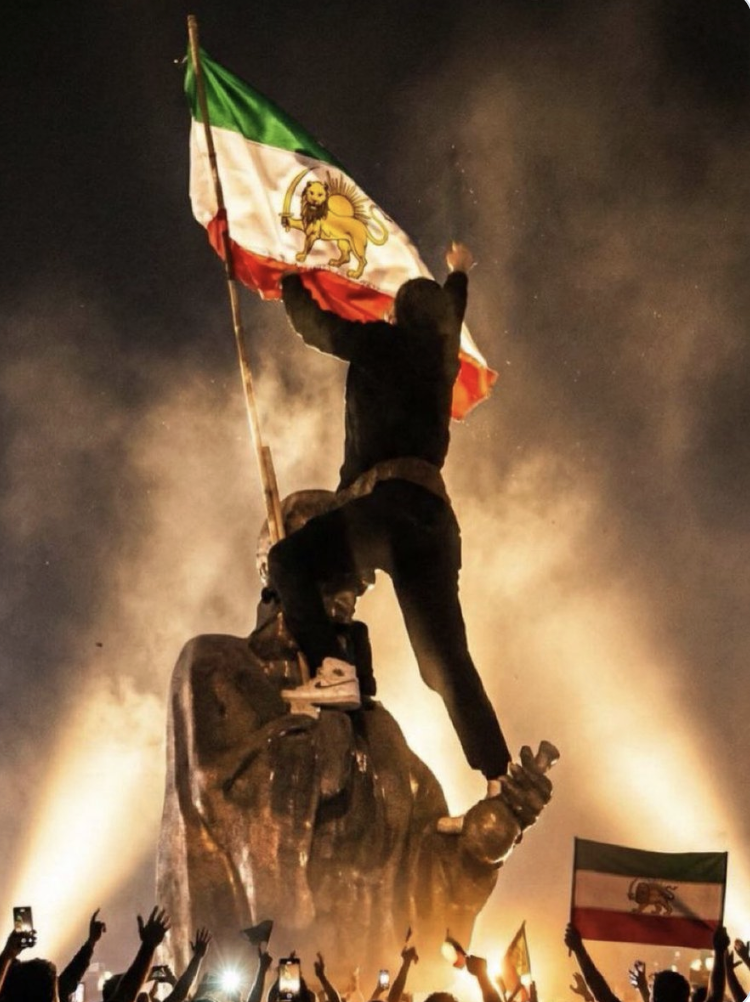
And yet, as of February 8th, there has been no comparable protest (rather, there hasn’t been any protest at all) or organised campus action over what human rights monitors and international reporters describe as one of the most lethal crackdowns on civilian protest in recent decades: the ongoing repression of demonstrators across Iran.

In late 2025, protests over inflation and currency collapse began, as conservative bazaar workers expressed their economic concerns. Iran’s rial has lost 60 per cent of its value since June, dropping to a record low of 1.445 million to the dollar roughly one week ago. During this already difficult financial period, the Iranian government also raised gasoline prices. This move alarmed lawmakers such as former prime minister Mir Hossein Mousavi, who now argue that the Islamic Republic is no longer reformable and fear a repeat of the deadly 2019 protests. The government had faced similarly violent demonstrations in late 2022 over Iran’s compulsory veil. According to a UN report, at least 551 people were killed when authorities suppressed what was known as the “Women, Life, Freedom” movement.
Yet in the past month, these economic protests evolved, particularly as youth participation swelled, into an anti-regime uprising that posed the greatest challenge to the country’s Shiite cleric rulers in their almost five decades in power. Notably, figures long associated with reform from within the system, including former prime minister Mousavi, have since argued that the Islamic Republic is no longer reformable, marking a shift from protest toward outright delegitimisation. According to reporting compiled in a detailed timeline by Associated Press, security forces used live ammunition and mass arrests, with thousands being detained, and many facing death sentences. Independent groups estimate death tolls in the tens of thousands.
For such a politically vocal campus, the silence at Trinity is surprising. Part of the answer lies in something few like to admit: some injustices are easier to narrate than others. When injustice fits neatly into familiar binaries — coloniser and colonised, West and non-West — activism comes with a ready-made vocabulary. But when repression is carried out by a non-Western regime against its own citizens, the moral script becomes more complex to deploy. We’ve seen this with Sudan, Congo, and now Iran.
The Iranian regime’s extensive internet blackouts might explain part of the dearth of protests at Trinity and around the West. Iranian authorities have repeatedly imposed nationwide internet shutdowns, cutting off access to global platforms while keeping a state-controlled intranet running. Virtual Private Networks (VPNs) are aggressively blocked, rendering standard circumvention tools unreliable. Even satellite internet has not proven a guaranteed escape; during earlier crackdowns, SpaceX’s Starlink was briefly made available to Iranians, but Iranian security forces have since used signal-jamming to disrupt its use, leaving an information vacuum.
This leads to another profound discomfort at play, what one might call the “enemy of my enemy” instinct. Iran is adversarial to Western powers. Some may feel an unease about appearing to align, even symbolically, with Western condemnation of Tehran. This framing is unfair and mistakes the issue entirely. Supporting Iranian protesters is not an endorsement of any one foreign policy agenda, but instead, it is support for civilians demanding a government they feel represents them fairly and humanely. One can oppose imperialism, oppose sanctions that harm civilians, and still unequivocally condemn a regime that shoots students in the streets.
Ultimately, this is not an argument against previous student activism. Recent campaigns concerning Palestine and Venezuela demonstrated that Trinity students are willing and able to mobilise around international political issues and to pressure the institution to reassess its external relationships. Nor is this an argument for a BDS-style campaign in the Iranian case. Unlike with Israel, there is no evidence that Trinity maintains formal academic or research partnerships with Iranian state institutions. A divestment campaign would not make sense because there are no ties to divest from.
While the recent Iranian strikes have shifted attention towards broader regional conflict, there has been little sign of corresponding concern on campus for those within Iran who continue to bear the cost of everything.
If Trinity’s past year has proven anything, it is that students here care deeply about global justice. If any movement fits the language of solidarity common on this campus, it is this one. Recognition that Iranian students—many of whom study abroad precisely because of repression at home—deserve to see their struggle acknowledged in the places they now learn.