
“We’re here with every Junior Cert student in the country”, my friend texted me while I was rushing from my seminar to the Bord Gáis. When, last November, I saw the play To Kill A Mockingbird (adapted from the homonymous novel by Aaron Sorkin) advertised all over Dublin, I immediately ran to Ticketmaster and booked a ticket for it.
In terms of plot and adherence to Harper Lee’s original novel, there are almost no notes to be made. Of course, in the transposition from literature to drama, a few changes are inevitable. The stage scene begins directly with the unraveling of the trial, which only appears in the second part of the book. As a consequence, many plot lines are summarised through monologues or dialogues between Scout (Anna Munden) and Jem (Gabriel Scott) and Dill (Dylan Malin), rather than being played out.
What immediately stands out from this stage adaptation is that it is the spitting image of Rober Mulligan’s 1962 movie, with Gregory Peck playing Atticus Finch. With this play, Sorkin brought the 1962 movie onto the stage, at times making questionable choices for the sake of realism.

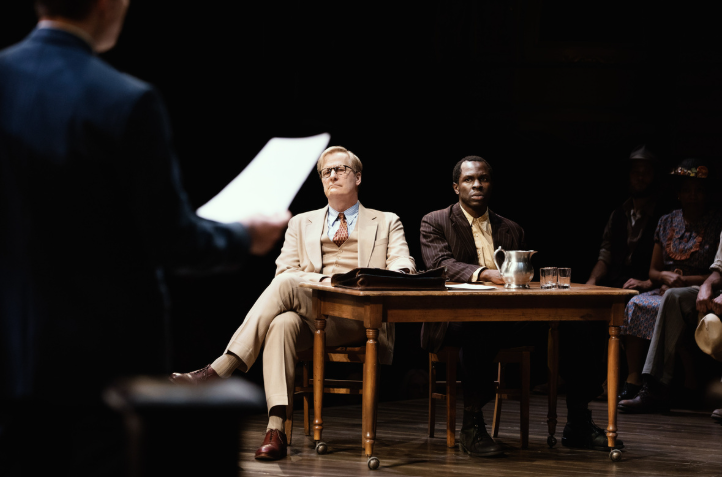
The characters’ costumes in the play imitate down to a tee the movie’s ones: the two obvious ones are Atticus Finch’s unmistakable beige suit and Scout’s blue jeans overalls.
The play also makes it a point to keep the characters’ language as close to the book (and the movie) as possible. The result is perhaps exaggeratedly open vowels and the use of words like yonder and, questionably, the reiterated (possibly more often than in the movie) use of the n-word.
The play is presented exactly how it has been described: the transposition on stage of To Kill A Mockingbird, perfectly satisfying for the lovers of both Lee’s novel and Mulligan’s movie. Therefore, if you are hoping to see the perfect theatrical readaptation of To Kill A Mockingbird, you’re surely in for a treat.
But I have to say, I was hoping for something more. The play is adapted and directed by the same person that was nominated as Best Original Screenplay for The Trial of the Chicago 7, a movie that is political, not only because of its plot, but because it offers food for reflection on American (and universal) politics. It was, therefore, pretty exciting that it would be him who would direct To Kill A Mockingbird, which celebrated its 65th birthday last year and is more current than ever.
There were two scenes, mainly, that I wish had been emphasised in some way.
At the beginning of the trial, the character of Atticus Finch says, next to an American flag, to “trust the court of law”. In an age when there is less and less faith in institutions, and at a time when the law does not look equal for all, we wonder why there are no trials being held for the people mentioned in the Epstein files, this line sounded grotesquely outdated.
Similarly, at the peak of the trial, Bob Ewell (Oscar Pearce) rules: “America was made by white people.” This line was accepted as the frenzied words of a 1950s illiterate man, but sadly, this is a sentence that in the past months has come back, under different forms, in the minds of Americans and of Europeans alike. Between United States Immigration and Customs Enforcement (ICE) raids and the rise of right-wing governments in European countries, anti-racism again needs active defence, rather than being taken for granted as a fight that’s already been concluded.
But none of this was underlined or emphasised in the play, not even by scenic silences or any form of stage props. In truth, it felt like an amazing occasion was missed out on: the beauty of theatre, in contrast to literature and film, is that it is not set in stone – the page is printed, the shot is shot. Theatrical performances can change even after opening night: a line can be added, voice intonation can be altered. So, I believe that the previously mentioned scenes could have been emphasised in some way, which did not happen.
If To Kill A Mockingbird teaches us anything, it is to always, kindly but firmly, take a stance. The fact that it not only gets replayed, but newly readapted, is the greatest giveaway of its fundamentality in the literary world. Ultimately, Sorkin’s play gives Lee’s book justice in the sense that it reverentially maintains its almost every aspect. But it is perhaps this overwhelming respect for the original novel that restrains the play from being actually great, remaining just a well-done tribute to Harper Lee like another could have been.