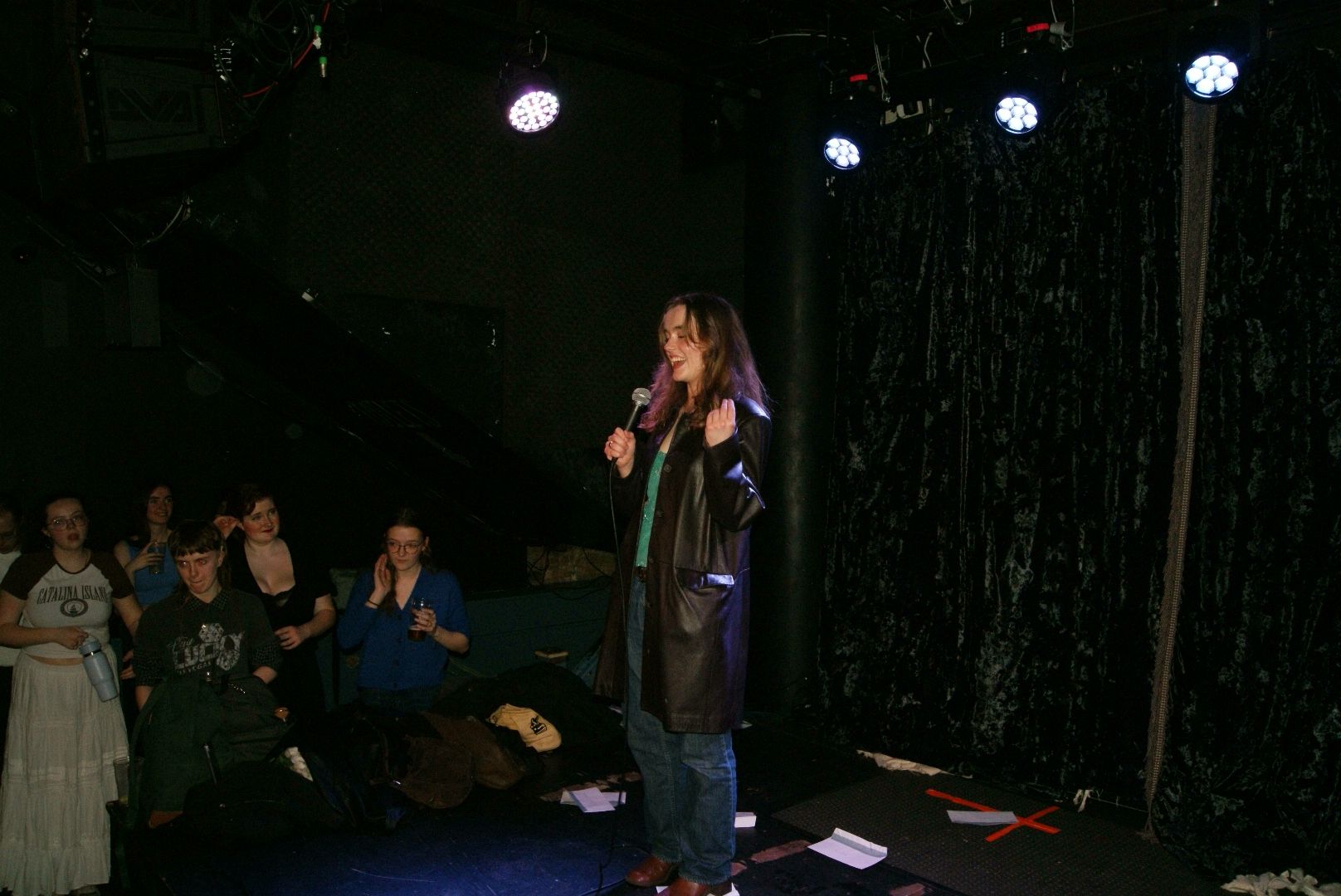

The Books Upstairs event space is full to the brim. All seats have been occupied, leaving those who arrived late stranded in the corridor and on the staircase. Windows, directly overlooking the busy street, are closed. The air is hot and stuffy. Despite that, the atmosphere is light. The gathered crowd laughs and mingles over the free wine. They only fall silent when, at quarter past six, someone approaches the speaker podium.
„The personal essay has had a resurgence within the literary world in the last 15 years.” Says Nathan Hugh O’Donnell in his introductory address. “It has become something there is an appetite for.”
O’Donnell is one of the editors of PVA Books, a Dublin- and Berlin-based publisher specialising in literary non-fiction. Tonight, February 25th, he is in Books Upstairs to promote PVA’s fourth book, As if nothing could fall: Essays on monuments. Along with O’Donnell, present are four contributors: Trinity’s own Associate Professor of English, Dr Julie Bates, the Irish author Gavin Corbett, former editor of the Stinging Fly journal, Roisin Kiberd and Derry-based non-fiction writer Neil Hegarty. They each give a reading from their contributed essay, exploring the significance, both public and personal, of different monuments.

Neil Hegarty opens, reading from his essay, Ghost Monument. It narrates the history of Derry’s Walker’s Plinth, a plinth that used to serve as a base for a column dedicated to Reverend George Walker, the 17th century Governor who defended the city during the 1689 Siege of Derry. The column itself was demolished by the Irish Republican Army on August 27th, 1973. Hegarty writes not just about the plinth’s history, but also about its importance to the city, describing how it is the camera’s point of focus whenever a Derry-based story is aired on the news. He says it has a tendency to be “paint-splattered or intruded upon” as part of political statements. He calls it one of the “points of rawness where history and the present rub against each other”.
Dr Julie Bates follows. Her piece is centred around the Holiday Inn in Sarajevo, a brutalist hotel initially built for the 1984 Olympics and which has since become famous as the place where international journalists have lived in the 90s during the Siege of Sarajevo. A „primal site in the life of the city,” Dr Bates describes it, „mad looking,… like a Lego block”. After that brief introduction, her essay then reveals Dr Bates’ own connection to the Inn. The Trinity academic has, earlier in her career, taught English Literature at the University of Sarajevo. During that time, as she describes, she was approached by a student and informed, with “passionate pessimism of the Bosnians,” that she was going to be part of an annual panto taking place in the Hotel, a tradition originating in the Siege. In the remainder of her excerpt reading, Dr Bates describes her surprise at the popularity of British sitcoms in Yugoslavia. In her time there, she has apparently encountered multiple bars themed after Only Fools and Horses, which, for a long period of time, has been the single most popular show on local television.
Gavin Corbett goes third, writing about his personal relationship with the Glasnevin Cemetery and the monuments present there. His reading is peppered with local Irish references, describing the graves of people ranging all the way from local celebrities to Michael Collins. Corbett’s essay is cheerful despite the melancholic atmosphere, as it describes how he often finds inspiration amongst “the lives cut short.” The author finishes the reading by revealing a personal connection with some of the deceased, a family of continental immigrants that has purchased Corbett’s own childhood home after he has moved out.
“There is a rumour that the sewers are full of noblemen,” Roisin Kiberd reads at the start of the final reading. Her approach is the most historical out of the gathered four. She has written about Maximilien Robespierre, imagining the revolutionary leader’s thoughts on June 8th, 1794, the day on which he staged the Festival of the Supreme Being and announced the existence of his new religion, the Cult of the Supreme Being. Kiberd finishes her excerpt reading with an imagined scene of Robespierre having a vision of Moscow in 1918, watching Lenin erect the statue honouring him as one of the early revolutionaries.
Other contributors to As If Nothing Could Fall include Beulah Ezeugo, Dan Hicks, Slinko and John Tuomey. O’Donnell has mentioned that PVA’s goal is to include writers of different backgrounds, gathering perspectives from not just writers and critics but also visual artists.
Following the reading, I reached out to Dr Bates. She was kind enough to speak to me further about her text and some of the other projects she is currently working on.
JP: You chose Sarajevo’s Holiday Inn as the focus of your essay. How does it place, for you, under the general theme of a ‘monument’?
JB: I’m very interested in the monuments of post-socialist countries, particularly the traces of the Soviet Union in Georgia and Armenia, and the amazing Spomeniks in the former Yugoslavia. When Nathan described the premise of the book to me, I immediately thought of those monuments – but they often have complex associations for the people who live with them, because they are official structures that tend to commemorate historical events or contribute to an official narrative about that place – and people may reject the stories that these imposing structures tell. I’m conscious that when I visit those monuments, it is as a tourist admiring their aesthetic qualities and with a decent but by no means deep understanding of what they actually mean to local people. The Holiday Inn is different. It’s an accidental monument, built originally for the Winter Olympics in 1984 which was a highpoint for Sarajevo, and only a few years later it was full of journalists reporting on the siege – so it is symbolic of two extreme highs and lows in the life of the city. It is a mad-looking structure too – a bright yellow cube that really stands out, so you can’t avoid staring at it. Crucially, I also have a personal link to the place – I got roped into a panto when I lived in Sarajevo, and rehearsals were in the hotel.
JP: You are currently writing a book about Erica van Horn. Between this and the essay just published would it be fair to say that you are shifting your focus towards visual art? Are there any other projects you are currently working on?
JB: It’s funny, I don’t think we spot these kinds of patterns ourselves (I certainly don’t!) – but you’re right, I have been writing increasingly about visual art over the years. I wrote a few things about Louise Bourgeois, and there’s a Japanese photographer I’m thinking about for a future project. I still love writing about literature, and Erica Van Horn is a writer as well as an artist – she uses books and cards as her medium. I write about Beckett all the time, and continue to find his work fascinating. I’m currently working on a project about Suzanne Déchevaux-Dumesnil, who was married to Beckett and it turns out was a fabulous writer. Some stories and poems of hers surfaced randomly at auction a few years ago and my friend and I are writing and speaking about her texts, and hoping to get them published. That’s a fun project.
JP: In his introduction, Nathan O’Donnell discussed the role of the recent resurgence of the personal essay form. He mentioned that it is particularly well-suited to discussions of visual art. What are your thoughts on the subject?
JB: That’s an interesting observation. I tend to think that the personal essay is such a wonderfully flexible thing that it can accommodate almost anything! It’s certainly a great way to give the reader a sense of what it is like to encounter a work of visual art or music or live performance or whatever – actually in the moment rather than the drier academic response which involves distance and analysis. Reading a personal essay can feel like you are with the person when they are in the middle of seeing, hearing, sensing whatever it is they are experiencing. It can be quite an intimate form of address too, so it can feel like they are speaking directly to you, maybe letting you in on a secret.
Dr Julie Bates is an Associate Professor in the School of English. Her research centres primarily on the works of Samuel Beckett as well as other modernists. As if Nothing Could Fall is available for purchase online as well as in stores, including in Books Upstairs.