
After directing Saltburn in 2023, Emerald Fennell unveiled her Wuthering Heights this year under the peculiar cloud of anticipation that accompanies any major reinterpretation of a canonical text: familiar excitement combined with uneasy suspicion that what we are about to witness is not so much a much-loved novel as its aesthetic residue. Adaptations inevitably rearrange their sources; fidelity, in the strictest sense, has never been the measure of cinematic success. Yet Fennell’s version raises a more complicated question than the usual complaints of omitted characters or compressed plotlines (that said, I will take issue with those too). The problem is not merely that the film alters Brontë’s brilliant novel, but that it appears to misunderstand the function of its excess, the violence and eroticism, that it repackages as something more akin to spectacle than critique. In doing so, the film participates in what might be called the eroticisation of Victorian literature.
By eroticisation, I do not mean nudity alone, though the film teases the viewer with the expectation of it. Rather, the term describes stimulation devoid of thought, the deliberate orchestration of arousal as an aesthetic endpoint. Lauded author of seminal Victorian classic Middlemarch George Eliot herself wrote, “I sicken again with despondency under the sense that the most carefully written books lie, both outside and inside people’s minds, deep undermost in a heap of trash”. Her frustrations mirror that of mine, as the new Wuthering Heights film has descended into the same heap of trivial entertainment Eliot decried. Wuthering Heights as a novel pulses with physical longing and cruel infatuation. Desire is not at all pleasurable; it is corrosive, entangled with themes of the time. Fennell’s approach flattens this complexity. The film renders salient the (quasi-incestuous) erotic tension between Heathcliff and Catherine while alleviating the social antagonisms that produce it. What remains resembles sensation fiction, stripped of its critical bite: a narrative engineered to evoke feeling rather than provoke thought.
The visual language of the film is poised to reinforce this shift. Fennell’s work in Saltburn (2023) demonstrated a fascination with surfaces that gleam with decadent excess, images so meticulously composed they verge on self-parody. A similar sensibility is animated in Wuthering Heights. Mr Linton’s home, with its obnoxiously red floors and lavish decor, is stylised to the point of unreality to emphasise the gulf between Cathy’s previous identity as Ms Earnshaw and her becoming Mrs Linton. Fennell communicates binaries of class, poor versus rich, through the mise en scène. Unfortunately, this attempt fails at moments where the film evokes the mood of a Taylor Swift music video more readily than the bleak metaphysics of the moors, which Brontë utilised as an elemental landscape to reflect the characters’ psychological extremity. Such disjunction of the avant-garde flair Fennell chooses to embody rather than Brontë’s conventional Edwardian epoch might be intentional and satiric, but to me it is unclear what exactly is being satirised.

The most controversial alterations occur at the level of narrative structure and casting. Fennell removes Hindley, Cathy’s brother, and replaces him with Mr Earnshaw as Heathcliff’s abuser. Hindley’s bigoted cruelty as he rivals Heathcliff for the affections of his father is what drives Heathcliff’s eventual desire for revenge and establishes the cycle of generational tension. Without Hindley, Heathcliff’s suffering becomes less a sibling rivalry and more a generalised sense of victimisation. Fennell rids us of this critical close reading: to what extent can we sympathise with Heathcliff in the novel? Not only does he suffer at the hands of Earnshaw’s legitimate son, but also through parental neglect. Naturally, without these compounding elements of the original narrative, how do our sympathies shift when the film portrays him solely as a victim?
Heathcliff and Cathy’s final moments in the novel are ferocious and tender, a moment that Fennell does not grant them in the film. The scene is undeniably beautiful: Jacob Elordi racing to Margot Robbie on horseback. Whilst denying the lovers of their final moments together does heighten the pathos of Cathy’s death, and — I agree — makes a good narrative choice, it simultaneously diminishes their emotional complexity. In the novel, Heathcliff, described almost as animalistic, utters the infamous lines hours before Cathy’s death: “I have not broken your heart – you have broken it: and in breaking it, you have broken mine”. Cathy’s death here does not function as a sentimental climax but as a turning point that releases Heathcliff into the next phase of his cruelty, his abuse of Isabella Linton, whom he marries not out of affection, but as an instrument of revenge.
Casting decisions have provoked even greater debate. Brontë repeatedly describes Heathcliff as racially ambiguous: “dark-skinned”, “your father an emperor of China, and your mother an Indian queen…” . His marginalisation and abuse is inseparable from this distinction. The prejudice he encounters explains why Cathy ultimately chooses Egdar Linton, the wealthy and socially-acceptable neighbor, who is described as fair-skinned. To cast Heathcliff as white therefore does more than revise a physical detail: it gets rid of the novel’s engagement with colonial displacement during a time of British imperialism.
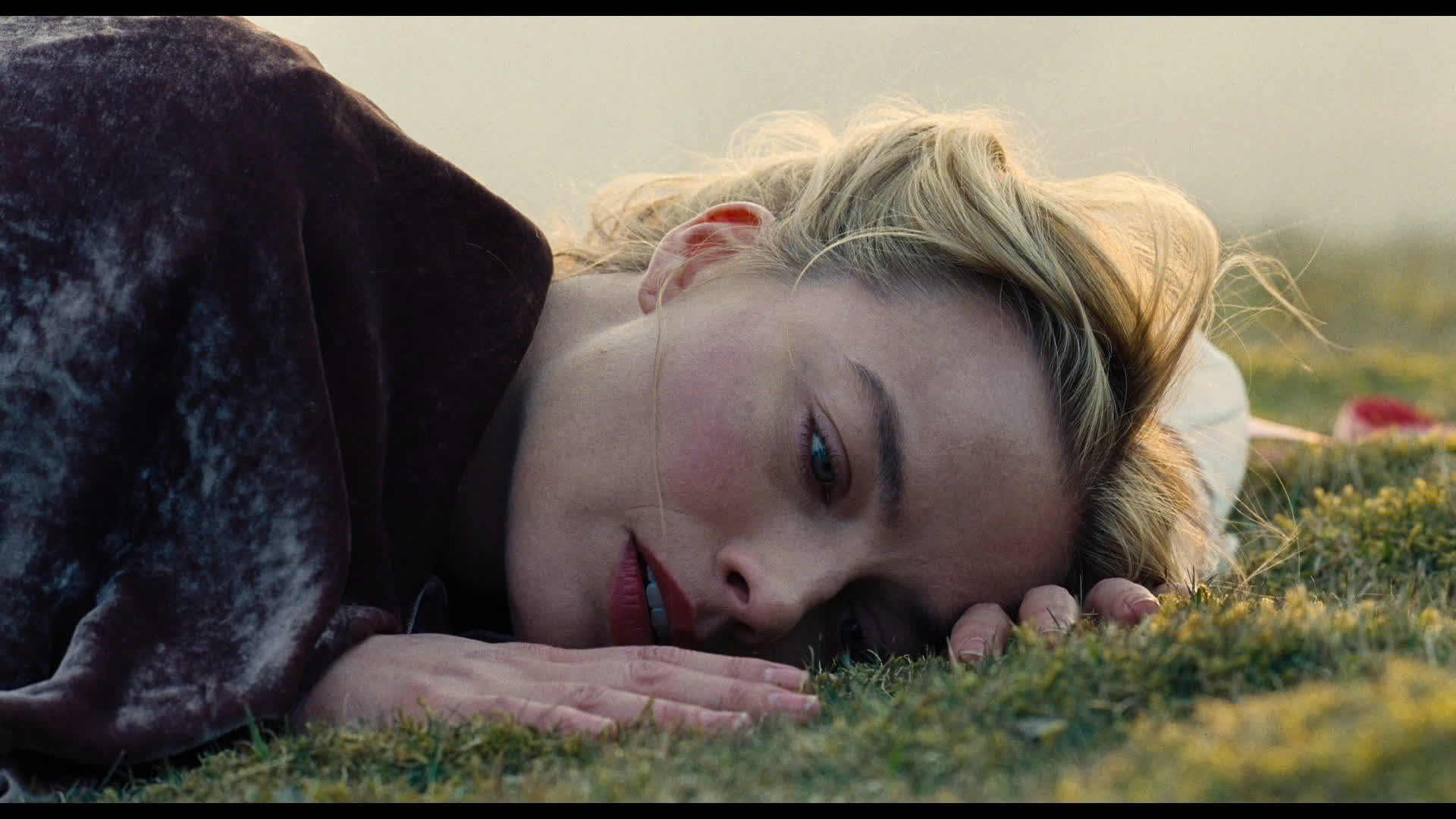
It must be said that there are elements that appear promising. The childhood sequences capture something of the novel’s wild intimacy, the sense that Cathy and Heathcliff exist as twin forces. Jacob Elordi, whatever one thinks of the casting choice, possesses a physical magnetism that suits Heathcliff’s brooding presence. Margot Robbie’s Cathy, with her pale skin and rose-flushed cheeks, aligns well with the Victorian aesthetic, even if her maturity risks undermining the character’s youth (and therefore bad decisions).
Adaptations have never been obligated to reproduce their sources with documentary precision and to some, it is entirely possible to enjoy a film that misreads its literary predecessor. As I’ve stated before, in a review on Guillermo Del Toro’s adaptation of Frankenstein (2025), the question is not simply whether the film works, but what it works as. When a reinterpretation has stripped away major elements that give the classic novel its disturbing force, what remains may still function as an engaging piece of cinema, but only that. In my opinion, Fennell’s film succeeds in theatres, but not on the terms that matter most, and certainly not as Wuthering Heights.