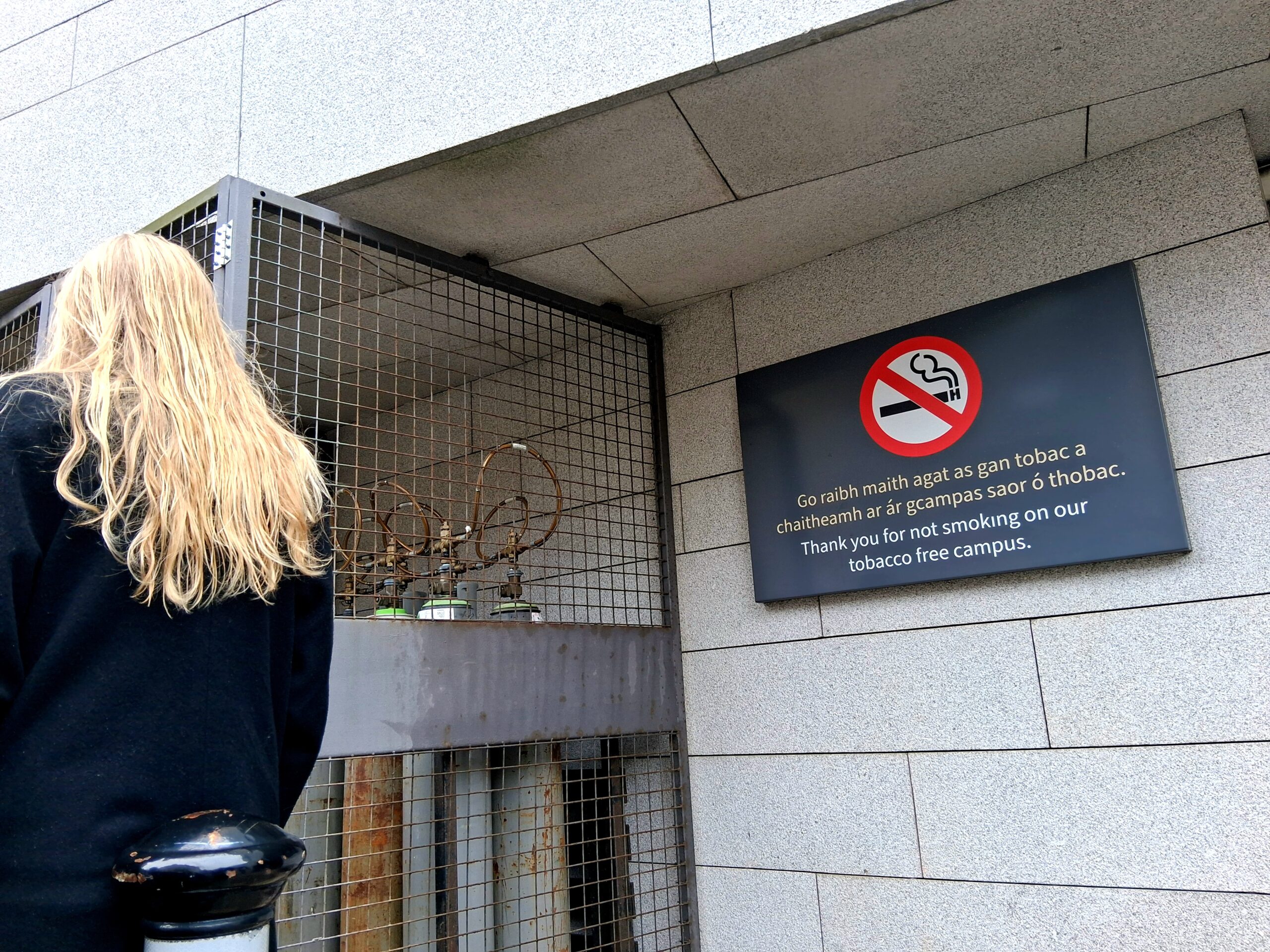

On March 18th, Trinity College Dublin officially extended its tobacco-free campus policy to include vapes and e-cigarettes. Under the updated policy, both smoking and vaping have been pushed out of campus, with the exception of three designated smoking areas; outside Kinsella Hall, behind the Catering Complex and along the perimeter of College Park.
The transition has been framed as part of Trinity’s “Healthy Planet, Healthy People” initiative and justified through public health data, sustainability concerns and a commitment to community welfare. The move has been presented as very straightforward and a strong step towards a cleaner, safer campus.
Yet, vital questions remain. Do the benefits of this intervention truly outweigh the costs, or does it represent another step towards an increasingly paternalistic university environment? The policy forces us to face a trade-off between student autonomy and intervention in university life. Is there any possibility or room for balance?

Trinity’s case for extending the ban is, undeniably, very compelling. In 2023, a survey centred on vaping was conducted on over 2600 students and staff. It revealed that 57 per cent had tried vaping at least once, while 31 per cent were current users. Among these, 42 per cent reported using both cigarettes and e-cigarettes. Further data from Trinity’s “Living Lab” initiative showed that visible vaping on campus had more than doubled between 2022 and 2025. These statistics strongly align with nationwide patterns. In Ireland, nearly a quarter of 15 to 17 year-olds are now classified as vape users and research increasingly indicates that young people who vape are more likely to transition to traditional forms of smoking.
From a public health perspective, the line of logic is clear: intervene early and reduce exposure on campus. The approach is proactive and the University has already successfully demonstrated that these policies can carry success. Between 2016 and 2020, Trinity’s original tobacco-free policy led to a 79 per cent reduction in visible smoking on campus. With a majority backing, 57 per cent of respondents supported restrictions on vaping. A 2018 vote reported even stronger support for smoke-free policies. In this sense, the policy reflects collective preference in Trinity.
Its strongest justification lies in the protection of non-tobacco users. Nearly half of Trinity students have reported being affected by second-hand smoke, challenging the notion that outdoor consumption is harmless.
Public health policies have long aligned with this line of thought; beginning with restricting indoor smoking, and then naturally progressing to extending those restrictions to outdoor spaces. Extending similar provisions to vaping is arguably a natural next step for Trinity. The environmental dimension is also vital. Disposable vapes, which contribute to 59 per cent of vaping on campus, are a large factor in causing plastic waste and battery pollution. Trinity’s policy therefore ties nicotine use directly to sustainability goals.
Yet, vaping adds complications to the wider discussion. It directly brings Trinity’s role to the centre of this debate. Unlike smoking, the risks of vaping, while considered very real, are widely contested. Vaping occupies a more ambiguous position. It is often perceived as less damaging than traditional forms of tobacco and has been widely promoted as a means of preventing smoking. In some lights, particularly among students, vaping is the solution to quitting smoking. When viewing the policy solely through this lens, it may feel counterproductive and risk pushing students back to smoking.
This is where the paternalism critique gains popularity. Universities are spaces of education, but are also spaces of freedom and autonomy. While regulating indoor smoking is widely accepted worldwide, extending that regulation across all outdoor spaces is more contentious. At what point does safeguarding health risk treating students as individuals being managed rather than individuals making their own choices? Is it Trinity’s role to control use beyond what is necessary for protection or this is an example of Trinity’s paternalistic policies?
Trinity’s response to these questions is its means of practical enforcement. The policy relies on a soft mode of enforcement, which centres on the encouragement of compliance. According to this mode, violators will be reminded of the policy rather than proactively punished. This approach worked well for smoking with 90 per cent of smokers complying when reminded. However, vaping is on a very different level. It is more discreet, integrated into everyday life and often perceived as something less stressful, raising the potential for more frequent interventions and tensions regarding enforcement.
Pushing vaping off campus may reduce its outward visibility, but not necessarily its prevalence.
Designated zones risk becoming concentrated areas of use and the discreet nature of vaping may lead to it being pushed into hidden zones, which is something far less possible with smoking. In this regard, the policy may merely relocate the behaviour rather than reduce it, raising more questions about whether it is usage that is reduced, or merely visibility.
It is vital to consider that Trinity is not alone in adopting these measures. In fact, they are arguably behind other Irish Universities, many of which have long implemented strict smoke- and vape-free policies. University College Dublin has a comprehensive tobacco-free campus policy. Smoking and vaping are prohibited across the entire campus. The policy was gradually introduced between 2015 and 2017, starting with designated smoke free zones and gradually expanding. University of Limerick has also prohibited smoking and vaping across its campus since June 2018. University College Cork has identical policies for both smoking and vaping, banning them indoors, in workplaces and in vehicles. At UCC, violations may result in disciplinary action, indicating the seriousness with which institutions are treating this issue. Internationally, thousands of campuses have embraced these restrictions, suggesting that Trinity is contributing to a wider trend among educational institutions that prioritises public health and the creation of tobacco-free environments.
The success of Trinity’s policy depends on how well it manages competing priorities of health protection, environmental harm reduction and preserving autonomy. Evidence suggests that tobacco-free policies can significantly reduce smoking rates and improve campus environments, but only with careful and collaborative implementation. Continued engagement with students, particularly those directly affected by the policy, will be crucial. Without this, there is a risk that the policy will be seen as a paternalistic restriction rather than a strong effort to improve campus wellbeing.
Institutions are increasingly expected to promote education but also sustainability and responsibility. The question is how far should they go? The new policy will certainly make Trinity a cleaner and, in many respects, healthier environment. But, it also raises fundamental questions regarding personal freedom and the role of Trinity in regulating everyday behaviour. Does the policy create a healthier campus? Yes. Does it extend control over student behaviour? Also, yes.
Ultimately, the trade-off between student wellbeing and student autonomy will always sit at the heart of Trinity’s new vape-free policy. This is a tension that is not new. It has long defined debates around smoking regulations on campus. However, what matters now is how effectively the policy navigates this tension. Its success will not solely be determined by a reduction in vaping levels on campus, but by its ability to protect student wellbeing while also respecting independence and autonomy. We will soon see whether it emerges as something that is protective, paternalistic, or a genuine balance between the two.