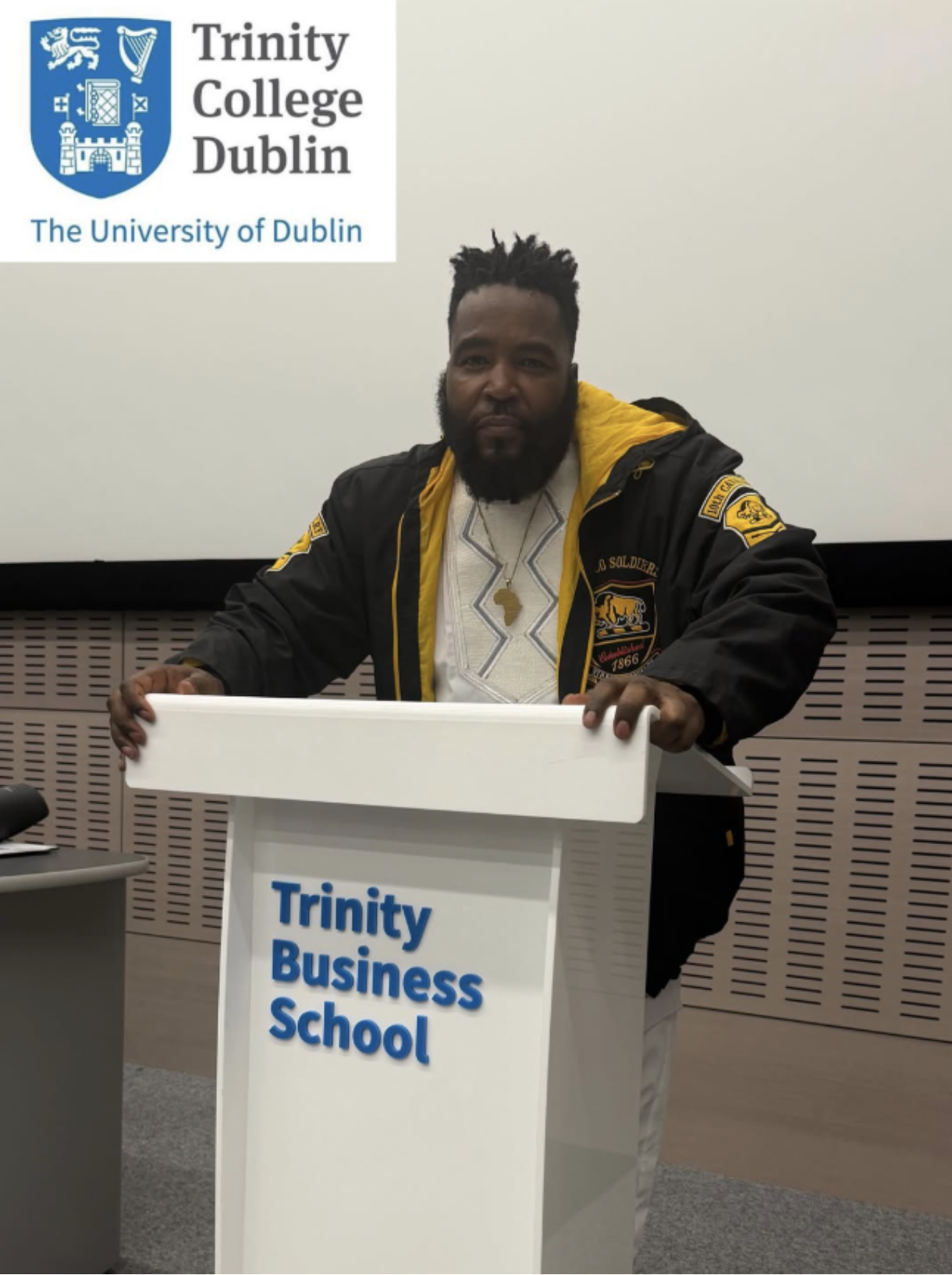

Few society events at Trinity can boast of an atmosphere so electric and an audience so engaged. Dr Umar Johnson, as he spoke, moved seamlessly from the comical and mundane to clarion calls for African liberation and recognising everyone’s unique purpose and mission. His answers were at times deeply moving and at other moments reinforced the popular perception of him that he purportedly wanted to leave behind.
This is because someone who knows Dr Umar (as he is professionally known) from online clips alone would be familiar with his aversion to interracial relationships, his catty comebacks to viewers in his live chat, and perhaps his motivational advice as a “child psychologist”; but not much else. He entered by shouting the first clause of a popular slogan of his, “Black queens forever!” to which the audience answered with an ovation, “Snow bunnies never!” (a “snow bunny” is a white woman who primarily dates Black men).
It is a compliment to Dr Umar that the event was such a success even after seemingly interminable scheduling difficulties: the event was originally meant to take place at the end of January of the previous academic year, as a Trinity Afro-Caribbean Society event. Tickets were refunded and moved around over months until 3 September, when, officially unaffiliated with the society, the event took place under the same name, “Back to the Motherland”. It was on short notice, but when Dr Umar arrived for his introductory remarks — an hour after the starting time for the event — a room with over 200 audience members rose to greet him. “He is running on African time”, someone behind me joked.

Dr Umar covered a range of topics, including mental health, relationships, education, religion, economics, and international politics, relating all of these to the worldwide African experience. Even when he provoked unease or drifted into extraneous points, he nevertheless related it always to his political programme and his moral convictions.
The Self, Upbringing, and Life
Dr Umar was at his most cosmopolitan when he frankly discussed the personal trials of life and the question of its purpose. He adamantly asserted that every person in the room had a purpose they were meant to fulfil in this world. Regardless of where or how you were born, he says, “If God brought you through your mother, you have a purpose for being here”.
What is each person’s purpose in life? Dr Umar insists that no one can determine that for anyone else. Speaking for himself, he traces his family history from Nigeria to their kidnapping and enslavement by white American settlers. Through a long lineage of struggle under the cruelties of American slavery, Dr Umar recognised that he wanted to become a psychologist at eight and that his ultimate end in life was to fight for African liberation.
Now, regardless of whether one becomes a psychologist or a lawyer, a teacher or a doctor, there is one decision which Dr Umar urges the audience to confront: “You will weaponise [your credentials] for African liberation, or you will use them to incarcerate African liberation. Everyone of you got to decide”.
He emphasised throughout the paramount importance of racial identity above all others: one can choose their political affiliation, religion, or even, Dr Umar implies, sexual orientation; but God has determined your racial identity. “Being African is the most spiritual thing you can ever be”. He expressed openness to all religious affiliations insofar as they could be employed in the struggle for racial self-determination: “If you’re Christian and you worship Jesus, he better be black. […] Why? Because God made us first”.
This came up in a discussion about the Frederick Douglass Marcus Garvey (FDMG) Academy, a school for the education of Black youth that Dr Umar has been building in Wilmington, Delaware. The school has not opened after raising millions of dollars and long delays because, according to Dr Umar, “the building inspector for our district is a Dr Umar hater”, as well as a “Negropean”, given that he’s Jamaican but doesn’t support Dr Umar’s project. When asked what the students would be taught, he stressed the importance of learning to love one’s identity in a racist society which tries to divide African people against each other. “Our enemy now is not as much the European you see outside. It’s the one that lives inside of you”, illustrated the necessity of early education to prevent self-hatred and mental health problems in adulthood. The pathos of his answers became a bit less sombre when he said, “If you don’t teach an African child to be loyal to Africa before they become a nuclear physicist, they will create nuclear weapons to bomb Africa”. When one man in the audience asked a question about the pressures to conform within a majority-white school, and how other Black students suggested allowing the casual use of the n-word by white students, Dr Umar quickly interrupted: “They coons. They are grade-A, certified coons!” But he tied it all together by stating that, before anything, love has to come first. “That’s foundation”.
Whatever profession one chooses, that must be the bedrock. After that, he says, the two most important questions in life are whether you enjoy what you do and whether you enjoy who you spend time with. Life is short, and Dr Umar urged the audience to take their education seriously before the years fly by, as well as reaching out for help if they were struggling with depression or other mental health conditions. “Because if you don’t treat depression, it’s gonna be whispering ideas in your mind that can lead to you hurting yourself”. Not only do these conditions sap one’s motivation, but it undermines achieving the purpose everyone has had assigned to them in this life. “You got a birth date that you know. You got a death date that you don’t know. […] And between your birth date and your death date, there’s a dash. And that dash represents everything you did or didn’t do when you were alive. When you get put in that box, […] did you leave a legacy that people will respect, or will people be applauding and celebrating because your ass is finally gone?”
Love and Relationships
When it came to choosing someone to love, marry, or have children with, Dr Umar delved into a subject at the centre of his most notorious remarks. He gave specific dating advice and firmly expressed his view that people should only date people of the same race.
His rationale is the same as his other political positions and social views: “Black-on-black love is a necessity for African liberation”, citing pan-Africanist philosopher and psychiatrist Frantz Fanon, who claimed in “Black Skin, White Masks” that beneath African men who enter interracial relationships is a deep-seated desire to escape their racial identity — though Fanon, Dr Umar notes, was “snow bunny-hopper himself”, as he married a white French woman.
Part of what makes it so inexcusable, in his eyes, is that (1) it was a quarter of a million years before humans even left Africa, and that it is disrespectful to the ancestors; and that (2) “African women are the largest human population on Earth” (although they are, in fact, outnumbered by Asians of either gender). He even made an extensive inventory to discourage those who would enter interracial romantic or sexual relationships out of physical preferences: “And for my brothers who like light colour and pale colour, guess what? We got piña colada African women! We got butterscotch African women! We got French vanilla African women! We got buttercream African women! We got butter almond, we got caramel, we got fudge, we got chocolate, we got pistachios, cinnamon, nutmeg, sweet brown sugar — we got every flavour you can savour”. The list launched a cavalcade of laughter terminating in exasperated applause. Similarly, he urged men who were dissatisfied with finding African women in Dublin to look for a partner in Paris, or New York, or Lagos, or Nairobi, and to keep travelling until they found a way to date within their race.
For anyone who thinks this is only in jest, there were audible gasps when he asked the first man to ask a question, “What colour is your girlfriend?” In one memorable anecdote, he recounts, “When I walk through the airports, and I see a Negro with a bunny, and they see Dr Umar coming, they’re about to act like they’re not really with each other”.
For Black men who do not date Black women, Dr Umar asked, “Why do you hate your mother so much?” to uproarious laughter. Clarifying that he had nothing against white women, he nevertheless asked them, if they care so much about the African freedom struggle, “Why not leave the Black man alone for once in a while?”
The answer that yielded perhaps the most uneasy response was when he answered a question about his views on homosexuality. Concerning “LGBTQRSTUVWXYZ”, he said — provoking laughter and one person behind me to mutter “You know this is gonna be bad” — he opposed the “lifestyle”, explaining that the inability of two men or two women to reproduce meant that homosexuality was a threat to African birth rates. It is for this reason that he believes Western powers like the United States have been adamant against homophobic policies in Africa (such as Ugandan law, which criminalises homosexual intercourse with life in prison or the death penalty under certain conditions), as they want to use homosexuality as a form of population control. It is “not about freedom or gay equality; it’s about African genocide”. There was considerably less applause for these remarks.
He also directed his rhetorical prowess in more everyday relationship advice, listing four types of women to stay away from and warning about certain kinds of men.
If a man has hit his partner in a relationship before, he will do so again. And if he is struggling with substance abuse or mental illness, he has to help himself; “It’s no woman’s job”, Dr Umar affirmed, to chimes of agreement. Meanwhile, one type of woman he warned men in the dating market about is the “homicidal honey”: she’ll destroy your car and chew you out and “she don’t care about going to jail ‘cause she been there already!” He lost track of the fourth type of woman to be wary of, and one woman in the audience reminded him, “high maintenance”, to which he said, “Brothers! This is a testify!”
Since relationships are so fundamental to overall well-being in life, it is important that you can live with someone for the rest of your life, despite their flaws, if they are truly the person you want to marry. He himself ruminated on when he was in love with two women, and couldn’t bear to choose between them: “I lost both of my queens!” he shouted, lest anyone make the same mistake. He cautioned the women in the room, “So don’t be out here in Ireland, giving your cookies out! Keep them in a case! There’s something known as the” — and here intervened a dramatic pause — “Ireland cookie monster!” He made a panting motion in imitation, and around the lecture hall I saw a few men sheepishly shrink in their seats as their friends pointed them out as the proverbial “cookie monsters”. “He want snow bunny cookies! He want Nigerian cookies! Ghanaian cookies! Brazilian cookies! Jamaican cookie – he’s a cookie monster!”
Pan-Africanism
One of the most famous proponents of pan-Africanism in history is Marcus Garvey. Founder of the Universal Negro Improvement Association and African Communities League, he promoted solidarity between all of African descent in pursuit of a unified African empire, governed by a single party with himself as the head. Although controversial for his vision of “racial purity” and his collaboration with the Ku Klux Klan for racial separatism, he worked tirelessly to cultivate a sense of pride and self-reliance among the African diaspora and exercised an unparalleled influence in shaping the future Black liberation movements.
Dr Umar Johnson sees himself as a disciple of Garvey and calls himself the “prince of pan-Africanism”. The “Back to the Motherland” event’s title hails from the “back-to-Africa” movement Garvey supported, which advocated for the Black American descendants of enslaved African people to return to the continent.
Combating racism and white supremacy in the West, Dr Umar argues, does not merely need community efforts in Western nations, but the backing of a free and powerful Africa which can throw its weight on the geopolitical stage. “How is Africa the richest continent, but the people are in the poorest condition?” He blames centuries of brutal colonialism, neo-colonial structural adjustment programmes (such as those imposed by the World Bank and the IMF), and internal divisions sowed among Africans for why Africa has not risen as the greatest power despite its vast population and abundant mineral resources.
Africa’s rise as a political power will offset the racism members of the African diaspora experience daily, he suggests. “Wherever you go in the world, Jews are respected”, he says, because of Israel; similarly for Chinese people because of China, and South Asians because of India. Although his casual dismissal of the struggles of other racial/ethnic groups at times made the atmosphere tense, his magnetic presence and elocution effectively conveyed his central points. He wove together historical trauma and experience from the Haitian Revolution, to police brutality in the United States, to Western political interference in Africa, to humankind’s evolutionary history and religious development in a sustained and vocal call for African pride and African liberation. “In order to put the glory back in Africa, you have to put the self-respect back in yourself”, he said, before finishing with the motto he appended to every answer, “Black power”.