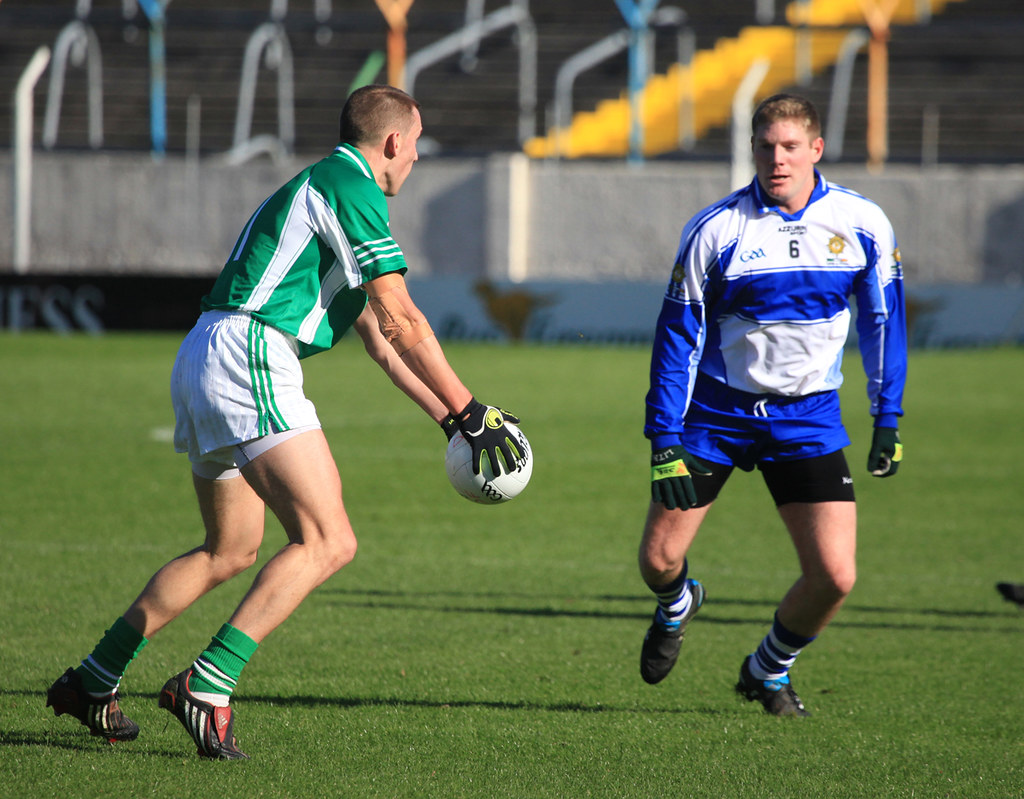

Consider this an address to incoming international students on the best way to assimilate into Irish culture: try out Irish sports. There’s no better cultural experience than being in a crowd full of drunk, sweaty Irishmen yelling at a player to “fekkin shooht ta ball!”
Whether it be camogie, hurling, or Gaelic football, all are offered by Trinity Sport for you to try your hand at. And if you have no idea what I’m talking about, you’re in luck, because I’m about to break it down for you.

Gaelic football
Gaelic football combines elements of both soccer and rugby in its layout, with a field containing both a soccer goalpost and two goalposts that extend over the crossbar in an ‘H’ shape. Consisting of two teams of 15 players each, the objective of the game is to score as many points as possible, either by kicking the ball into the soccer net, earning three points, or by shooting between the goal posts to score one point.
Sounds pretty simple so far, right? Well, bear with me because things are about to get slightly more confusing. The element that makes the sport so unique is the handling of the ball itself, which players maintain possession of by carrying in their hands. In order to avoid a foul, they must either bounce the ball on the ground or ‘solo’ it (drop and kick it back into their hands) at least every four steps. Passing to a teammate is not as simple as throwing the ball, but rather must be ‘handpassed’ (slapped with an open palm) or punched with a clenched fist.
Although the formal recognition of Gaelic football as a sport is slightly more recent, the first official documentation of football in Ireland dates all the way back to 1308, in which a legal letter detailed the accidental stabbing of player William Bernard during a match. It’s likely that the game was cut short after that, although this is not explicitly mentioned in the letter.
Hurling & Camogie
Hurling shares many of the same features as Gaelic Football, including the number of players on each team, the duration of the match, and the presence of H-shaped goal posts. One obvious difference between these Gaelic sports, however, is the addition of a ‘hurley,’ closely resembling a hockey stick, although slightly flatter and wider in shape. The ball, called a ‘sliotar,’ can be passed in one of the following ways: by hitting it with the hurley; by handpassing the ball; or by kicking it. The sliotar can be caught and carried for no more than four steps before being bounced on the hurley – sound familiar?
Forms of hurling have been played in Ireland since the Early Middle Ages, with similar configurations of the sport being featured in early Irish annals and poetry. In the 18th century – also referred to as ‘The Golden Age of Hurling’ – it was common for Anglo-Irish landed gentry to pit teams of their own making against each other for entertainment.
Hurling was so influential that, in the Statute of Kilkenny of 1366, the sport was banned by the English, as a way of stifling Irish cultural practices and identity. Its political significance does not end there, however, as a female equivalent to hurling was founded in 1904, called camogie. The establishment of this organisation marks an instance in which women were able to extend their influence into a largely male-dominated sphere. This acted as a kind of precursor to the more substantial legislation that was passed just 14 years later, which granted women the right to vote in Ireland.
The establishment of the Gaelic Athletic Association (GAA) in 1844 grew to become a symbol for Irish nationalism, representing a broader societal push for greater Irish autonomy. Although this is not the GAA’s greatest feat – which undoubtedly remains putting Paul Mescal in tiny shorts on our TV screens – this illustrates just how influential sports can be beyond the realm of social amusement, as the GAA played a significant role in uniting a political movement towards Home Rule.