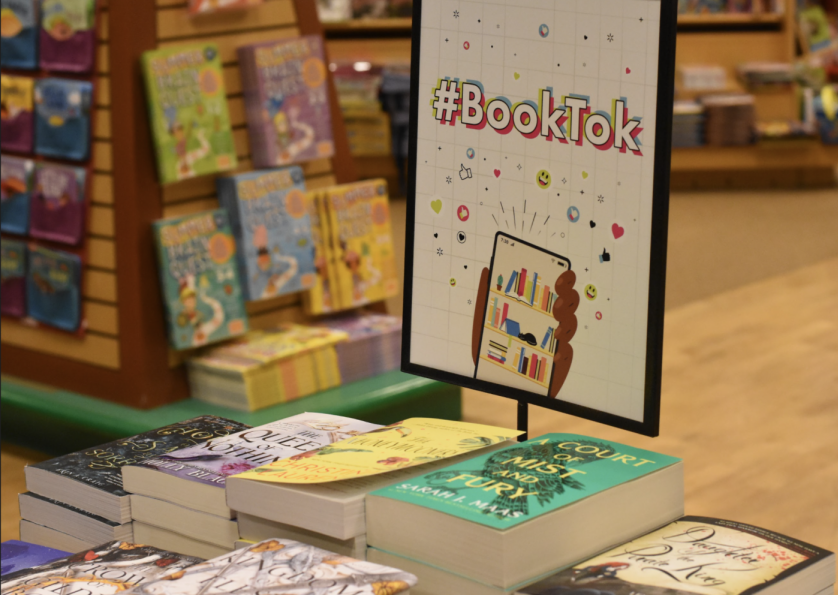

In the last few years, the internet has been inundated with articles on how BookTok has changed reading, but the focus has largely been on the readers and publishers, leaving authors out of the equation. If we can agree that TikTok has really brought about such fundamental changes in the publishing market, then surely it is time to consider how it has changed authorship as well.
Discussion along these lines has already happened regarding other creative industries. In 2022, Florence Welch, lead singer of Florence + the Machine, caused a stir by complaining that her record label was pressuring her to create TikTok content in order to promote the release of the band’s album “Dance Fever”. The thought of such an established musician, signed to a record label, having to take to TikTok to promote her own music seemed slightly strange. Should this not be the role of the label’s marketing team, instead of the artist’s?

Similar pressures seem to now plague modern authors, especially those publishing or looking to publish their first novels. It is no longer enough for them to write good books: today’s writers must also be skilled self-promoters. BookTok boasts many such success stories. After having her book repeatedly rejected by publishers, Alex Aster took to TikTok to raise interest, posting a short video that reduced her novel, “Lightlark”, to its basic concepts over a series of aesthetic Pinterest images. Just a week later, Aster secured a six-figure publishing deal in a book auction, followed shortly by the sale of film rights to Universal. Although she told the Guardian that this was not the expected outcome and that she had “no plan”, Aster’s story seemed to function as a wake-up call for publishers: maybe they didn’t have to take chances on what would sell or not, when BookTok could secure an author readers before a book was even published.
Many self-published authors have since capitalised on the trend in order to move into traditional publishing, using BookTok to get the attention of executives by selling their books to viewers as sets of tropes, or pairing clips with viral audio. Even authors who have already secured publishing deals are increasingly encouraged to cultivate TikTok and social media presences, and rely less on traditional marketing teams to do the work for them.
However, as Aster ironically makes clear in the aforementioned interview, BookTok stardom is seldom stumbled upon accidentally. It is about strategy and an understanding not only of what will appeal to readers but in what format. A quick search returns dozens of articles and videos guiding authors on how to use BookTok to promote their books effectively. They all return to the same main points: understanding online trends and the market — learning from other creators and authors working in similar genres — and choosing an identifiable niche (an author curating their BookTok to centre around “romantasy” exclusively is more likely to achieve success than one switching between crime, romance and coming-of-age).
But can the author as self-promoter really be said to have been invented or even popularised by BookTok? To address this question, it is useful to return to the original boom of publishing, the Victorian Period, and its best-selling authors. Today, “commercial” has become a dirty word in the literary scene, associated with BookTok marketing and low-quality, derivative plots and writing, but many of the now most canonical Victorian texts were bestsellers in their time: “Oliver Twist”, “Tess of the D’Urbevilles”, “Jane Eyre”, to name only a few. Authors like Charles Dickens were celebrities.
Dickens is an excellent case study because of the nature of his commercial success: he was broadly speaking a “self-made” phenomenon and very attuned to what his readership desired. Writing on Dickens, John Bowen argues that his “success as an author was built on an intimate understanding of the possibilities of literary markets.” Dickens popularised the serial — as we now understand it — driving sales to new heights. He was not just an author, he revolutionised the publishing market. The serial, Dickens-style, combined an understanding of what format worked — monthly installments, much cheaper and more readable than full-length novels — and how to generate sensation — chapters would often end in suspense, and in order to find out what happened to characters, readers would have to purchase and wait for the next installment. This turned out to be extremely effective: while Dickens was publishing “Oliver Twist”, for example, he would receive masses of fan letters begging him not to kill Oliver, who almost dies several times throughout the book. While waiting for the next installment, readers could do nothing except discuss the story generating excitement and a fanbase. Sound familiar?
Dickens also carved out a space for himself as a great “social-problem” novelist and was very intentional about the way he curated his persona. As Tony Williams explains: “he devoted considerable effort to the creation of the image he wished to project.”
Too often the conversation surrounding how BookTok has changed reading returns to ideas of its driving authors and readers increasingly towards commercial fiction, but, as Dickens demonstrates, knowing one’s audience and having commercial as well as intellectual aims, was not always an issue when it came to producing great, complex fiction. There is nothing inherently wrong with an author who is also a self-promoter: the issue seems to lie at least partially with us. Algorithms are undoubtedly designed to reward content which immediately grabs one’s attention, leading to an increasingly simplistic reduction of books to tropes and aesthetics, that in turn tells publishers and authors that this is what readers want more of. However, as the consumers driving these trends, we have more power than we like to grant ourselves. Why not engage with content which is thought-provoking as well as entertaining? Why not show authors and publishers that we want complex characters, layered plots, and good writing in our popular fiction? The issue has never been authors being aware of literary markets or trends, but audiences becoming increasingly content with the bare minimum.