
I spent a particularly dreary Thursday driving four hours to the Wexford coast, all in the name of looking at some sand and rock. At first glance, it might seem like an unreasonable way to spend my Thursday, especially since I had to miss class (and make up for it later). But standing on Ballyvaldon beach, looking up at sheer crumbling cliffs, and conversing with locals in Ballymoney alongside Dr Mary Bourke was an eye opener. Suddenly my fascination with said sand and rock made a little more sense.
The Wexford coast is one of the most erosion prone counties in the country. Composed primarily of soft unconsolidated sediment of glacial origin, the county’s cliffs and beaches are regularly subjected to intense erosion following storm periods and heavy rainfall. On average, Wexford has been losing 0.5 to 5m of coastline every year. Not a safe range to find yourself in if your family home stands crumbling at the cusp of a cliff face. With climate models guaranteeing the increasing frequency and intensity of storms, the two million of us living within 5km of the coast will have more to worry about than just fallen trees and departed trampolines. For now, this is the unsettling reality for many Wexford locals.
On my expedition to Ireland’s south-eastern coast I was joined by geomorphologist and Trinity professor Dr Mary Bourke. As part of my dissertation on coastal erosion, she kindly invited me to her home county to gain first hand social and environmental evidence of the rapidly retreating coastline. While our primary objective was to travel down to the Ballyvaldon beach and cliffs, we were warmly invited over for lunch at the home of one of Ballymoney’s long-term residents John Doran. Joined by his next door neighbour and close friend Paul Dubsky, together they shared their accounts of the changing coastline, ebbing and flowing in their backgardens.

Sitting down with our stomachs full of quiche and rhubarb pie, we poured over old historic maps and aerial images of the Wexford coast with a magnifying glass. I admit that my untrained, undergraduate eyes were slow to immediately pick up on shifting patterns of erosion. But it was when we left the toasty hearth of the dining room, tugged on our wellies and boots, and went outside that I came face to face with reality. A walk lasting less than a minute brought us to the intersection between the man’s home and the rolling sea. John Doran had two failing slopes as his next-door neighbours. Talk about daylight robbery of land.
Burke gets to work scanning the scene of the crime. Highly skilled in her fields of geomorphology, erosion and flooding, Burke concluded that the man’s home was luckily not in any immediate danger, but praised the man for his initiative in asking for help before it was too late. One of the slopes was evidently more intact than the other — judging by the presence of vegetation. This slope, unlike the other, had a row of rock armour atop a low sea wall, sheltering the hill from more powerful wave action. The other, earth-covered slope, in contrast, was left bare and vulnerable. But Burke did not suggest concrete walls or boulders of rock – otherwise termed as hard engineering. She suggested the fencing off of the area, the planting of willow trees and the use of smaller gravel to dissipate wave energy.
Like Burke, many natural scientists are becoming keenly aware that hard engineering for coastal protection is the worst route you could go down (although this can be site-dependent). Constructing hard engineering defenses has harmful effects on coastal environments — from reducing and eliminating sediment supply, to preventing energy attenuation, reflecting or directing excess energy, and eliminating coastal habitats. Cost-wise, they also require more upfront costs and maintenance throughout their use. Ultimately, these structures do not provide a sustainable long-term solution to coastal erosion. And yet, hard engineering is the accepted norm for engineers and policymakers, as these provide quick emergency solutions that are known to work (at least at the desired site). Nature-based solutions, on the other hand, are the preferred courses of action. These are actions taken to sustainably manage, protect, and restore ecosystems, while addressing biodiversity and human wellbeing. In other words, working with nature.
I asked Bourke about the use of rock armour at the bottom of the better protected slope. Why – if larger boulders are worse at dissipating wave power — were they installed? “Exactly,” Burke replied simply.
Right beside Ballymoney, Courtown had once been a flourishing tourist hot spot for its long extensive beach in the 1970s and 1980s. But in the 1990s, due to increased residential development in the area and the increasing frequency of storm events, coastal protection works were implemented in the form of rock armour and the dredging of the Courtown Harbour. While hard engineering efforts such as these are installed to protect the coastline, they more often than not encourage erosion down the coast. After these initiatives, the famous Courtown beach scarcely exists. All that remains are the feelings of place-loss for the residents of Courtown. The two men noted, with a hint of solastalgia, that the erosion has now reached Courtown’s beloved forests. Fallen trees litter what is left of the little beach.
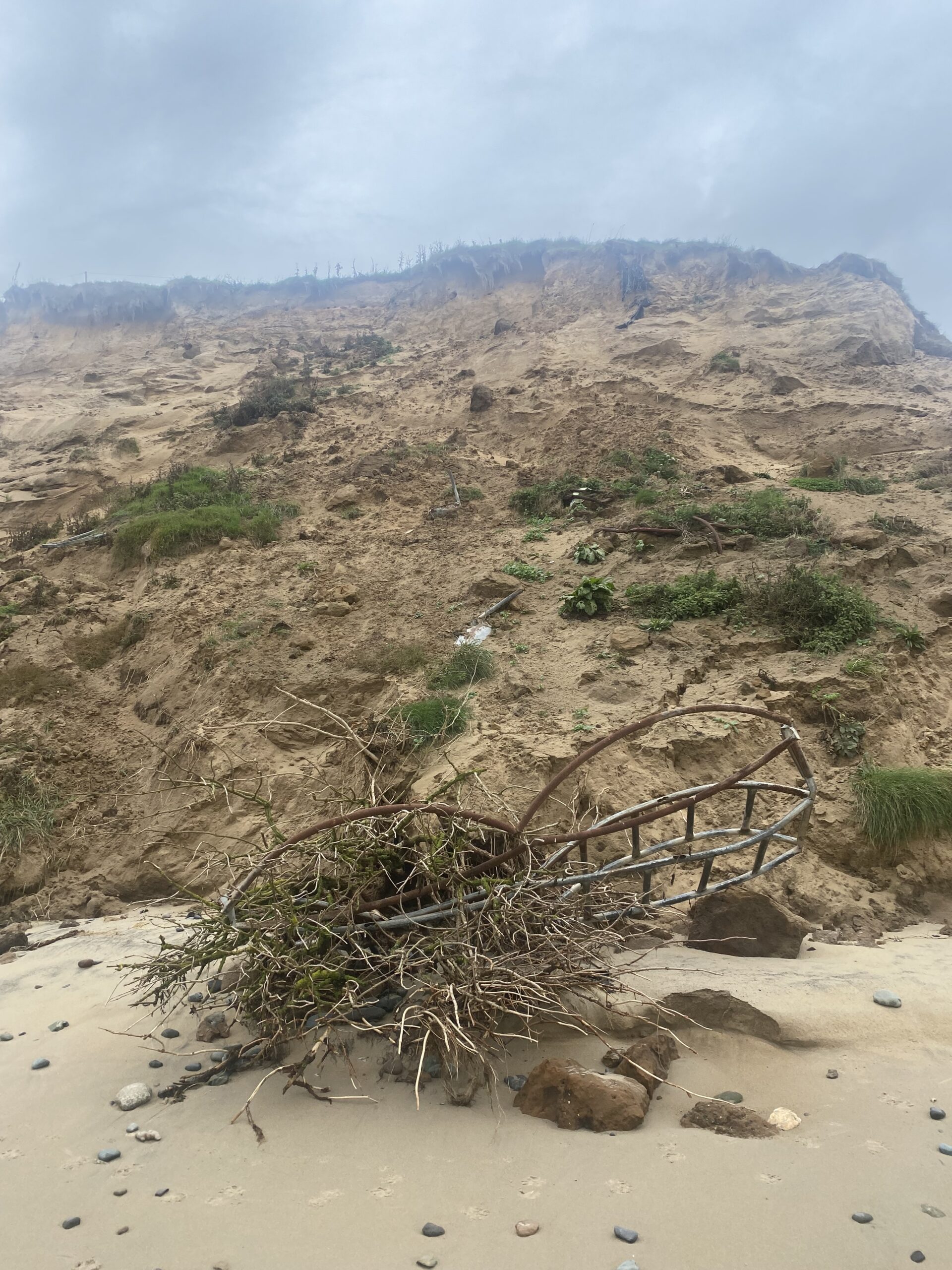
But Ballyvaldon told a more terrifying truth. Upon arriving at the two-car-sized parking lot, my jaw dropped open. Without being colossal in size, the cliffs had a precarious, vulnerable edge to them. They were wholly barren, with the cliff top being near perpendicular, while the bottom half was composed of hills of landslides. For good reason, it was forbidden to approach the cliff within 10m.
As Bourke and I traversed the coastline, she educated me on landslide failure types, going as far as pointing out landslides that had occurred within less than 24hrs of our arrival. Landslides probably seem relatively abstract to most — myself included. Somehow we tend to imagine landslides as these dramatic natural disasters that occur on rare occasions in far away places that don’t impact us here in Ireland. But these landslides — although small in scale — occur on a daily basis and are slowly eroding away not just sand and rock, but also communities. At the top of the sheer cliff edge were farmland fences dangling in midair …
The Ballyvaldon beach felt eerie. It felt wholly removed from earth. Not a single person was walking along the coast during our two hours of exploring, even as the sun eventually came out. There was no sign of human life at all. Only the fences reminded us that while the beach was seemingly removed from anthropogenic activity, there were people battling the slowly impending sea from up above.
Coastal erosion, with its multifaceted forms and impacts, presents ongoing and increasingly precarious challenges to coastal communities. And yet, coastal erosion is an entirely natural process. Throughout geological time, cliffs have ebbed and flowed between retreat and accretion. But now people are a part of the equation. A contradiction emerges. How do we mitigate coastal erosion to protect communities if we need coastal erosion for the normal function of the environment? Only one solution emerges: working with nature. Working with nature to overturn the hard engineering conventions and to restore our beaches, cliffs and communities. Or, unless you want the sea as your neighbour, leave it be. You will have no more excuses for not going for cold plunge sea swims.
P.S. I know Paul Dubsky, you were very curious about my University Times articles, so here is one featuring you!