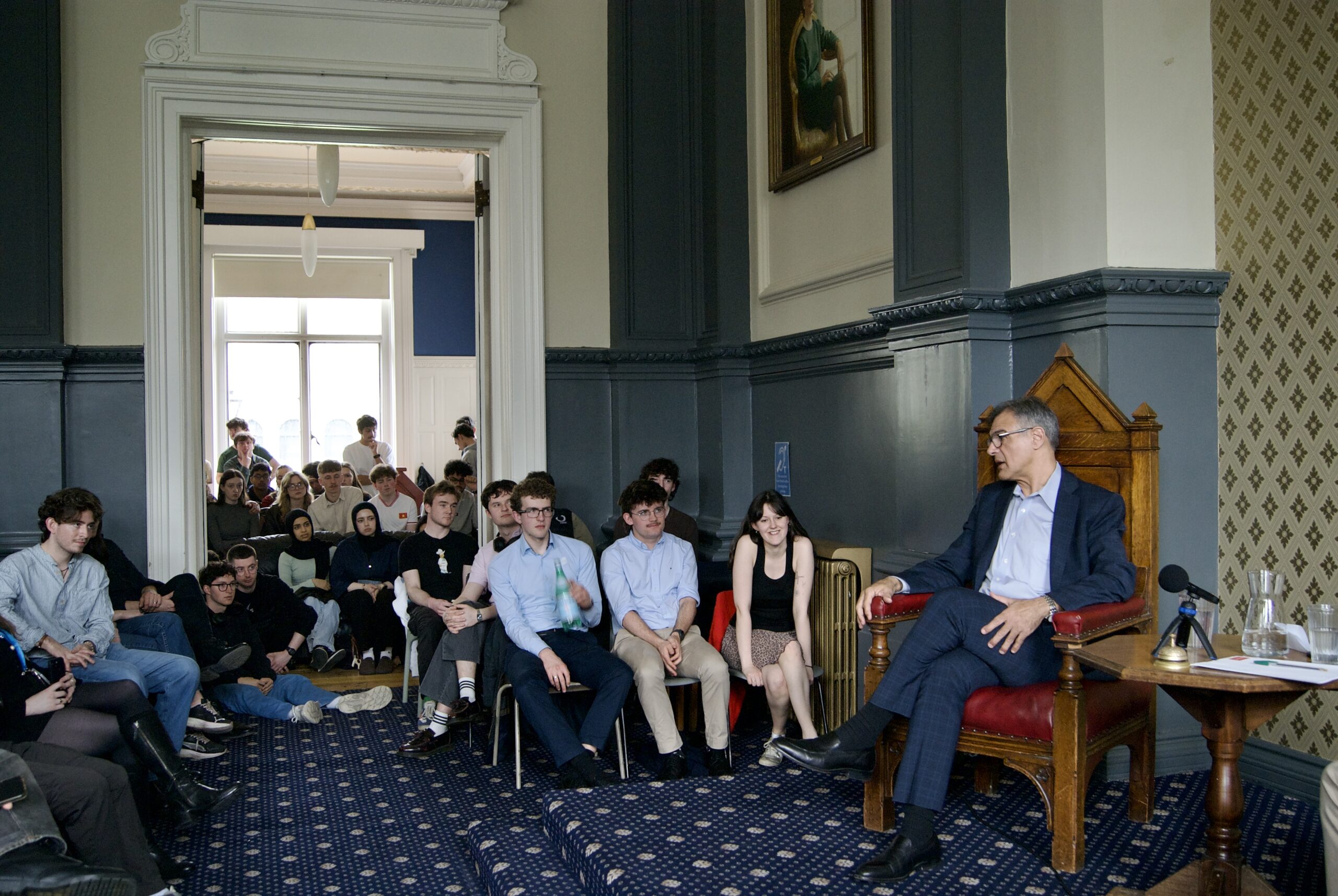
John Moran, Secretary General at the department of Finance, briefing students on the future of Ireland’s young people. Photo: Aidan Crawley/Irish Times
Owen Bennett | Editor
The second annual Trinity Economic Forum, Europe’s largest student economics forum took place last Friday and Saturday, February 8th and 9th. The event brought together over 400 students from across the country to discuss, debate and participate in the shaping of future Irish economic policy.
The event hosted a number of high-profile speakers from the worlds of politics, economics and business. Opening the event, An Tánaiste Eamon Gilmore said the forum “creates a much needed space for frank discussion of the challenges we face here in Ireland”. He went on to say that the goals posed by TEF constitute “a great challenge, (but) it’s an exciting challenge, and it is one I know you are up for.
Chairman of the Financial Services Authority Lord Adair Turner spoke to delegates on the lessons learned from the Great Recession, what we know after five years of economic malaise and the measures we need to take to return our economies to prosperity.
On Saturday morning, Secretary General at the department of Finance John Moran briefed student delegates on the future of Ireland’s young people. Moran spoke of his desire to create a “start-up city” culture in Dublin and make the city a global hub for innovation and technological advancement.
International Airlines Group CEO Willie Walsh gave the closing lecture, choosing to focus on global Irish leadership, and spoke of his experiences at the helm of some of the world’s largest airlines.
Other notable speakers at the forum included Any Haldane, Executive Director at the Bank of England and Peter Breuer, IMF Permanent Representative in Ireland.
The event also featured a series of student-led workshops. In these workshops, students attempted to produce real solutions to the questions which have defined public discourse of late: What would an optimal property tax look like?; How can we improve our social welfare system and other such questions.
A policy document resulting from the workshops is currently under production and will be circulated to the department of Finance and think-tanks in the coming weeks.
Speaking to The University Times, TEF co-ordinator Seán Gill said he was “absolutely delighted” with the feedback from the event. “Students from across Ireland engaged with the speakers and the policy problems at hand while also challenging the conventional wisdom. With TEF ’13 I feel we achieved our goal; we began the process of ‘rethinking economics’.”