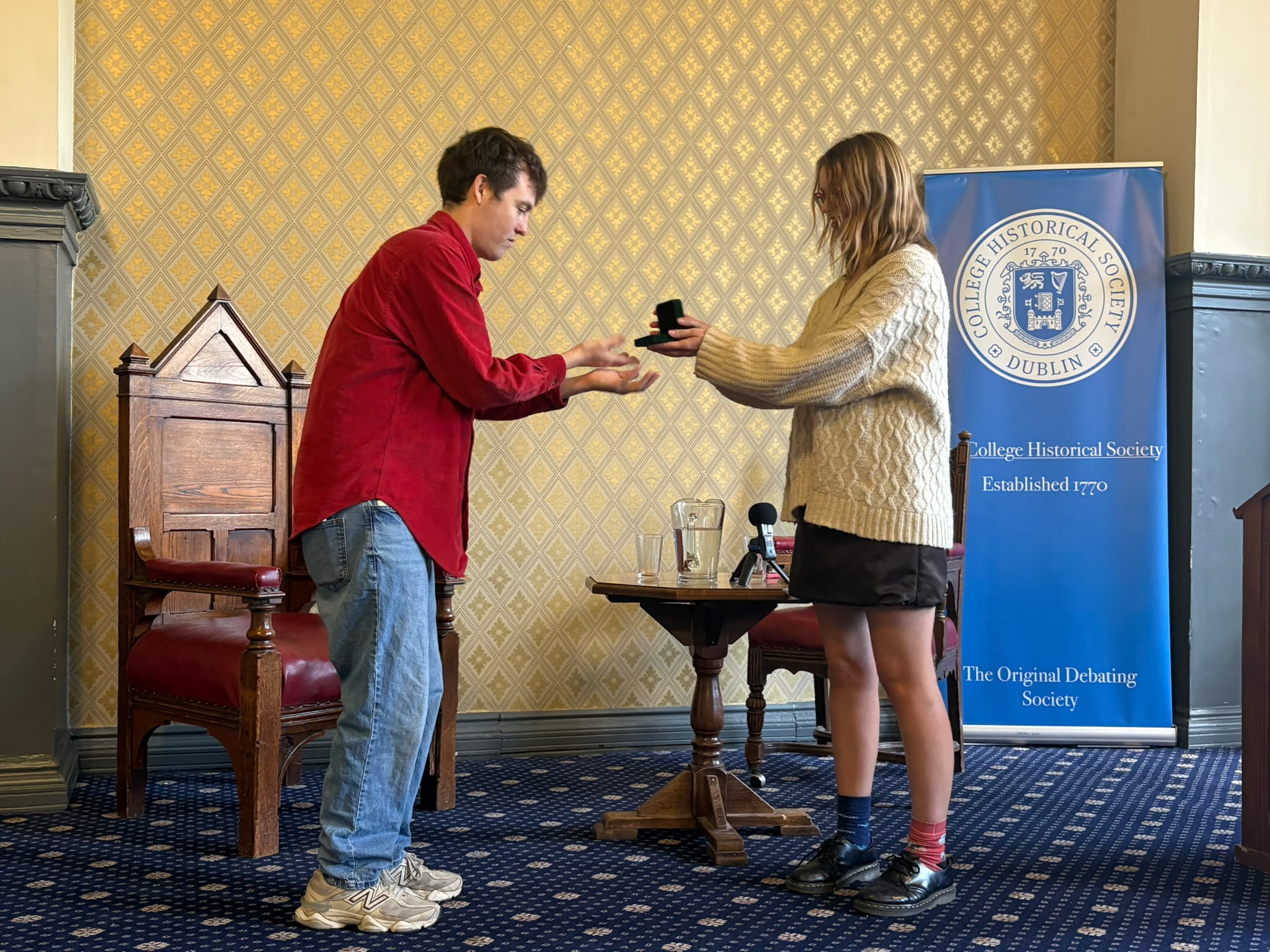
Grace McNally has just been elected as the President of Trinity College Dublin Students’ Union (TCDSU). She enters her new role in the wake of a president who has just resigned, another who was censured earlier this year, and yet another before that who was recommended for censure and saw a petition for their impeachment.
Something is clearly very wrong with the way TCDSU is run. Things need to change, and the first step towards a Union that is truly representative and democratic is addressing the root of the problem — a historically dysfunctional Presidential role.
TCDSU claims to represent the entire student body — an important claim, since all Trinity students are automatically enrolled in the Union. Whether the SU should act as a political body has therefore been an ongoing subject of debate. On the one hand, Trinity students represent a range of personal and political views, and there is certainly merit to the argument that the SU should acknowledge this and act accordingly. At the same time, drawing the dividing line between student concerns and political interests can be a slippery task. While the recent referendum of no confidence in the government, for example, is political practically by definition, saying the same for BDS policy, on-campus abortion services, event disruptions, housing protests and so on can be an increasingly tricky question, one that is in itself political.

Whether and how political the SU should be is therefore not a question that we are setting out to answer in this editorial. What we can say, however, is that the Union’s most controversial and unrepresentative actions can consistently be traced to its unwieldy and undemocratic balance of power — namely, the loosely-defined and overextended role of the SU President, who, according to the Union’s constitution, is its primary representative, Chief Campaigns Officer, college committee representative, Chief Administrator, Chief Executive Officer, co-treasurer and external liaison, amongst other duties.
The last few years have already shown us the power the President wields and how this can go catastrophically wrong. We saw a blatant example of this just earlier this year, when SU President Jenny Maguire and Welfare & Equality Officer Hamza Bana orchestrated an appalling campaign for sexual assault awareness that involved mock lynchings of effigies and the display of anonymous confessions without students’ consent. As other SU officers pointed out at the time, relevant officers were not consulted or even informed in advance; even worse, Sabbatical officers who knew about the plans and opposed the campaign were ignored. Zero due process was required or followed: as one officer said, “We weren’t even consulted on this matter as the president asserted that she had no duty to keep us informed of campaign committee matters”. The result, predictably, was disastrous: students not only felt unrepresented but were collectively shocked and disturbed. In the days following the backlash, Maguire and Bana called the problems of the campaign an “oversight”. While one can justifiably direct accusations of insensitivity at the organisers of the campaign, it is perhaps even more crucial to question how, under the current system, such personal oversights could have progressed unchecked into a fully-fledged SU-sponsored campaign in the first place.
This was hardly an isolated incident. The year prior saw then-President László Molnárfi deliberately and repeatedly breach the SU Constitution, according to the SU Oversight Commission. Among other incidents, Molnárfi refused to second a motion voted through via Union Forum to withdraw SU backing from an organisation he supported — something he was constitutionally mandated to do. Molnárfi would go on to say he ran no risk of impeachment because his “faction” of support was popular enough to prevent any such motion from being passed. This proved to be true: a vote to censure Molnárfi was prevented by him and a group of his supporters staging a walkout during Council. Molnárfi’s radical activism and direct action campaigns have faced criticism for being unrepresentative of the collective student body. Once again, however, the deeper-rooted issue lies not in Molnárfi’s particular political views but the fact that a president could act on these in a flagrantly unconstitutional and undemocratic manner repeatedly and with no repercussion.
That this is a systemic issue is easy to see. The SU Oversight Commission itself admitted it had “failed to fulfil its mandates” and “duties” in Molnárfi’s case, having brought their report to Council half a year after Molnárfi’s first constitutional breaches. Even if the SU’s oversight bodies were themselves more effective, the Union’s bureaucratic processes seem almost deliberately designed to prevent real action. As we have pointed out previously, impeachment procedures can be prohibitively difficult to initiate and absurdly slow to push forward; no president has ever been impeached, perhaps a surprising fact considering all of the above. Motions of censure have been doled out occasionally but are little more than a rap on the knuckles.
As McNally steps into Teach 6, then, it is a critical time to rethink the president’s role and how they must be held accountable. The responsibility and jurisdiction of the president must be clearly defined. Their actions must undergo due process. Perhaps most importantly, they must face efficient and effective oversight mechanisms for real repercussions in the inevitable cases that this goes wrong. For a Union that claims its first duty is to “represent every student in Trinity”, moving towards a real democracy must be the first order of business.